Marie Curie — "Nothing in life is to be feared, it is only to be understood. Now is the time to…"
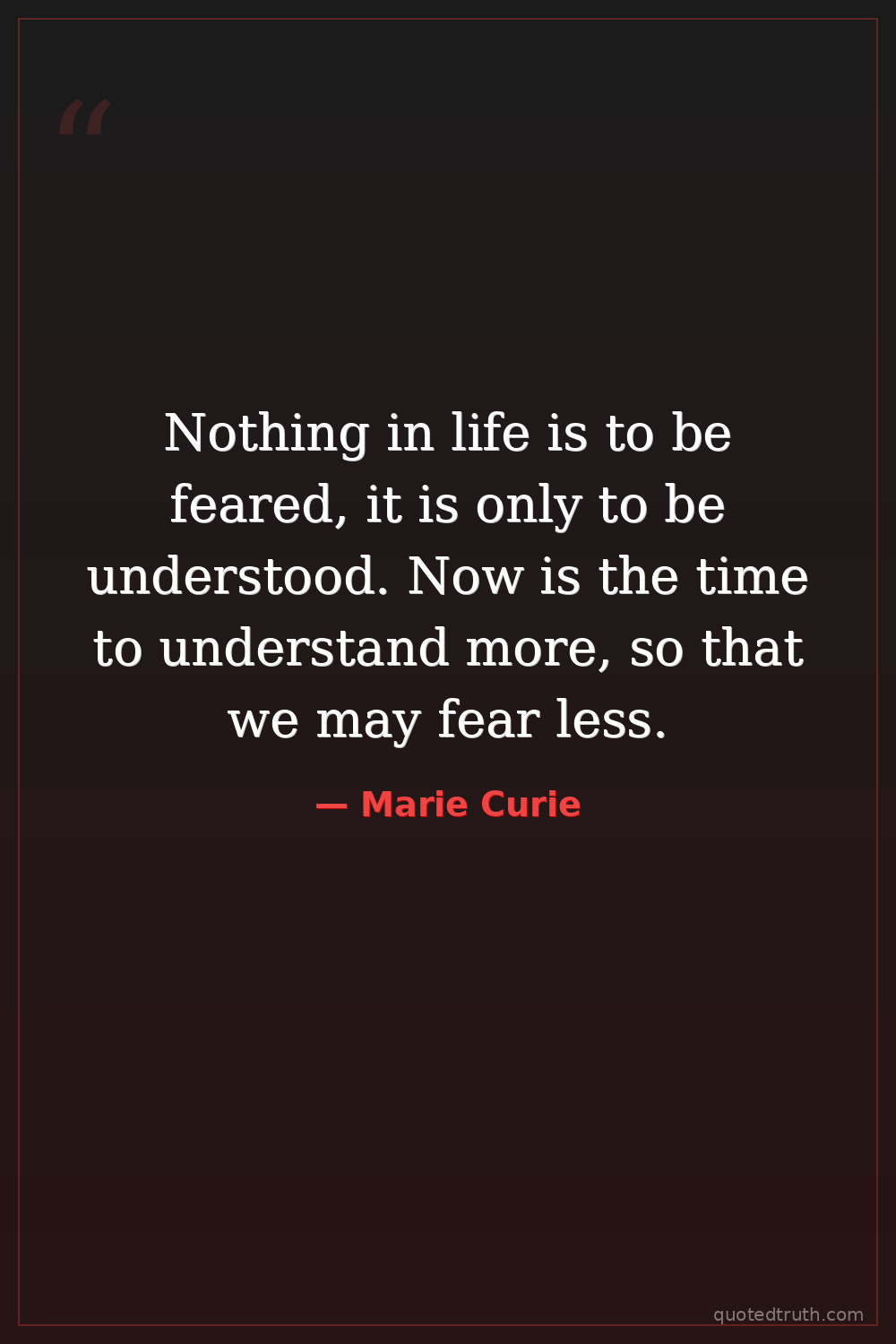
Nothing in life is to be feared, it is only to be understood. Now is the time to understand more, so that we may fear less.
Nothing in life is to be feared, it is only to be understood. Now is the time to understand more, so that we may fear less.
Click any product to generate a realistic preview. Up to 3 at a time.
* Initial load can take up to 90 seconds — revising the preview in another color is nearly instant.
"You cannot hope to build a better world without improving the individuals."
"I did not come to France to make money. I came to France to study science."
"Radium is not to enrich any one. It is an element; it is for all people."
"I am a Polish woman, and I am proud of it."
"One never notices what has been done; one can only see what remains to be done."
Found in 2 providers: grok,deepseek
2 sources checked
Fear comes from ignorance. When something seems threatening, the solution is not to avoid it but to study it, learn how it works, and grasp its actual nature. Once you understand something clearly, it loses its power to frighten you. The quote urges ongoing learning as the antidote to anxiety, framing knowledge as a practical tool for living with less dread and more confidence in the face of the unknown.
Curie lived this philosophy literally. She handled radioactive materials daily, isolating polonium and radium by hand in a leaky shed, while the broader public feared these invisible forces. Her two Nobel Prizes (Physics 1903, Chemistry 1911) came from refusing to treat radiation as mystical and instead measuring, naming, and quantifying it. She eventually died of aplastic anemia from that exposure, a cost she accepted because understanding mattered more than self-protection through avoidance.
Curie worked from the 1890s through the 1930s, an era of rapid scientific upheaval: X-rays (1895), radioactivity (1896), relativity (1905), and quantum theory reshaped reality. Meanwhile World War I spread mass dread across Europe, and women were barred from most universities and academies. Superstition about new rays and invisible energies was widespread. Her call to understand rather than fear spoke directly to a public overwhelmed by discoveries it could not yet interpret.
AI-generated insights based on extensive research and information for context. Factual errors? Email [email protected].
Your cart is empty