Linus Pauling — "On many questions I have a better understanding of the issues than any politicia…"
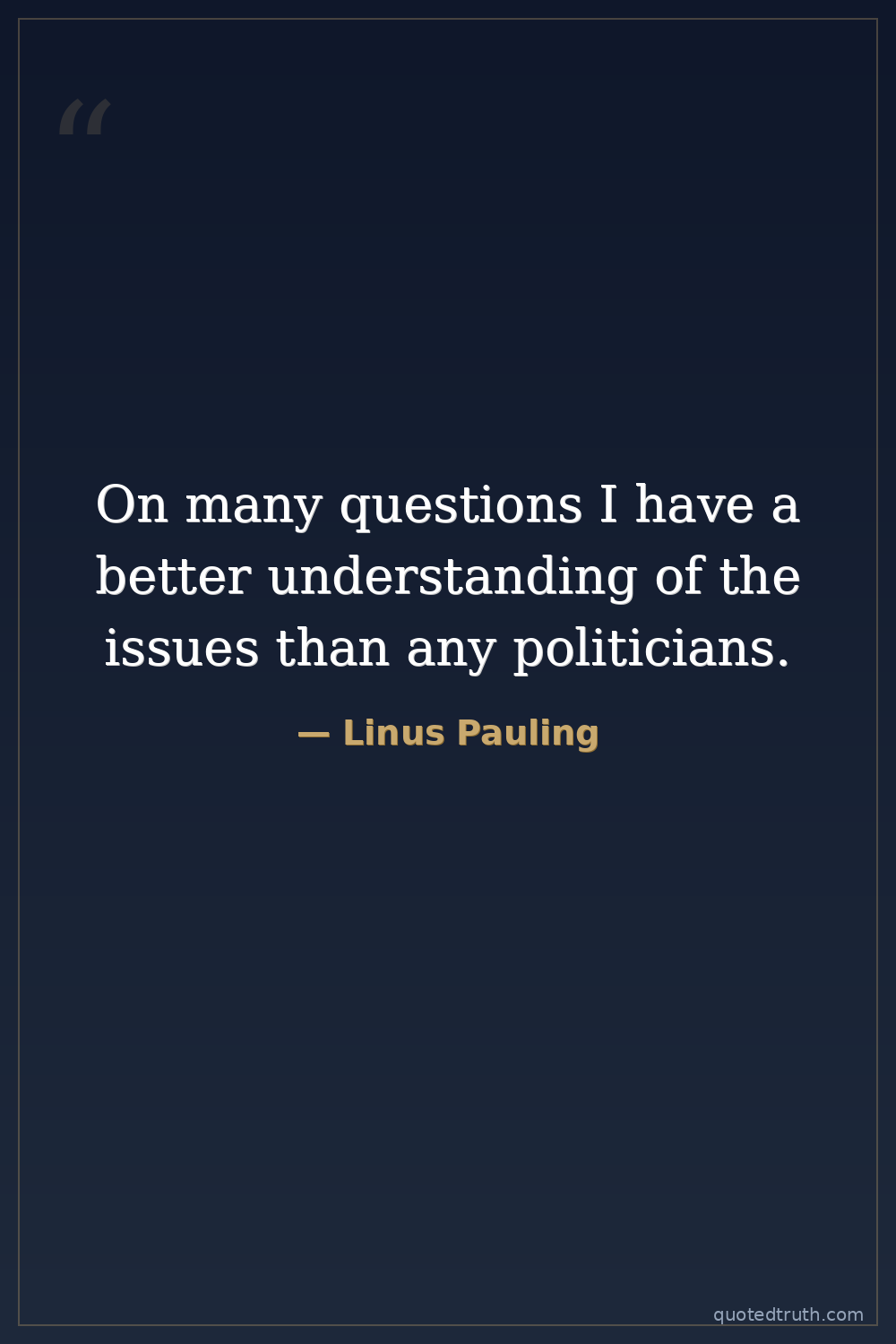
On many questions I have a better understanding of the issues than any politicians.
On many questions I have a better understanding of the issues than any politicians.
Click any product to generate a realistic preview. Up to 3 at a time.
* Initial load can take up to 90 seconds — revising the preview in another color is nearly instant.
"I don't think there's anything wrong with taking a lot of vitamin C."
"War is the greatest evil."
"I am convinced that we can abolish war, and that we must do so if we are to survive."
"I have always been an optimist, and I believe that the future is bright."
"I am convinced that there is no disease that cannot be cured by a proper intake of vitamin C."
Found in 1 providers: gemini
1 source checked
A person with deep technical knowledge often grasps the real stakes of a complex issue—nuclear risk, public health, environmental harm—better than elected officials whose expertise is in winning votes, not analyzing evidence. The claim is that rigorous scientific thinking produces clearer understanding of fact-based problems than political instinct does, and that expertise earns the right to challenge official positions regardless of whether one holds office.
Pauling won two Nobel Prizes—Chemistry in 1954 and Peace in 1962—giving him rare dual authority over both the science and ethics of nuclear weapons. He circulated the 1958 Pauling Petition, signed by over 11,000 scientists, demanding a nuclear test ban, and testified before the Senate. The U.S. government revoked his passport and had him investigated by HUAC. His confidence in his own understanding was not vanity—it was a direct product of decades of validated scientific work.
Pauling spoke during the Cold War's most dangerous years, when U.S. nuclear policy was driven by military strategists and politicians who systematically minimized the health risks of atmospheric bomb testing. The McCarthy era criminalized dissent, and scientists who challenged government narratives faced passport revocations and Senate subpoenas. Public understanding of radiation biology was almost entirely controlled by official sources. Pauling's assertion of expert authority directly contested that monopoly at a moment when the consequences of being wrong were existential.
AI-generated insights based on extensive research and information for context. Factual errors? Email [email protected].
Your cart is empty