Werner Heisenberg — "One cannot be a physicist without feeling that a religious element is present in…"
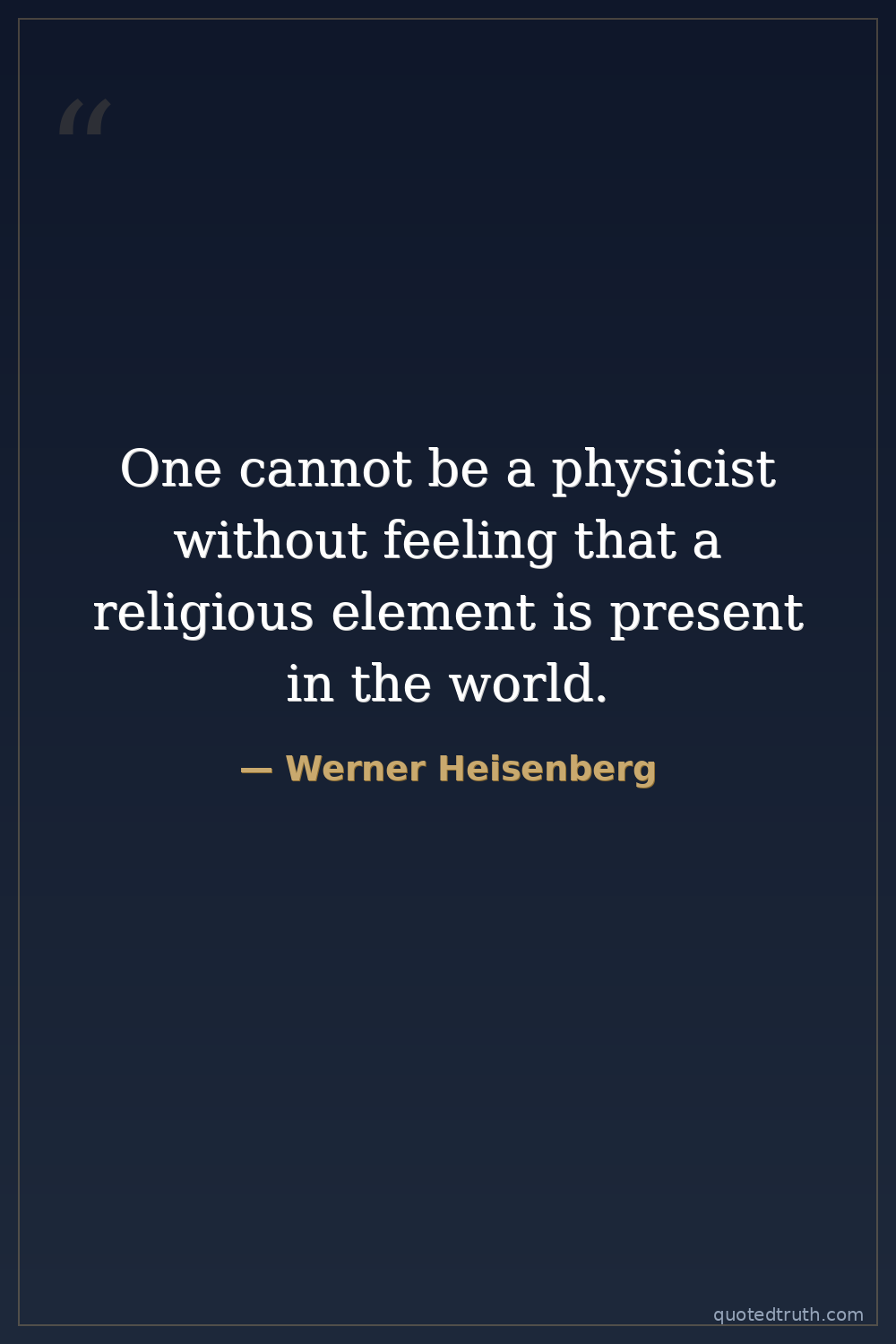
One cannot be a physicist without feeling that a religious element is present in the world.
One cannot be a physicist without feeling that a religious element is present in the world.
Click any product to generate a realistic preview. Up to 3 at a time.
* Initial load can take up to 90 seconds — revising the preview in another color is nearly instant.
"There are things that are so serious that you can only joke about them."
"The concept of the objective reality of the elementary particles has thus evaporated not into the fog of some new, unclear, or not yet understood reality concept, but into the transparent clarity of a…"
"You spoke in a manner that could only give me the firm impression that under your leadership everything was being done in Germany to develop atomic weapons."
"Can nature possibly be so absurd as it seemed to us in these atomic experiments?"
"Physics does not consist only of atomic research, science does not consist only of physics, and life does not consist only of science. The aim of atomic research is to fit our empirical knowledge conc…"
Found in 1 providers: grok
1 source checked
Studying the physical world deeply reveals an underlying order, beauty, and mystery that goes beyond what equations alone can explain. Heisenberg is saying that anyone who probes nature at its deepest level encounters something awe-inspiring, a sense that reality has a spiritual or transcendent dimension. It is not a statement about organized religion, but about the humility and wonder that serious scientific work produces when confronting the universe's hidden coherence.
Heisenberg formulated the uncertainty principle in 1927, revealing that reality resists complete observation. A devoted reader of Plato and a lifelong Lutheran, he wrote extensively about physics and philosophy, including his essay 'Scientific and Religious Truth.' His discoveries showed nature as probabilistic and observer-dependent, which pushed him toward a worldview where science and spiritual intuition coexisted rather than competed, making this remark a direct reflection of his personal conviction.
Heisenberg worked during the 20th-century quantum revolution, when classical determinism collapsed and Einstein, Bohr, and Schrödinger debated reality's foundations. Simultaneously, two world wars, the rise of secular materialism, and logical positivism pressured scientists to reject metaphysics. Yet many founders of quantum theory, including Planck, Pauli, and Eddington, openly connected physics with spiritual wonder, pushing back against reductionism. Heisenberg's remark fits this mid-century dialogue about whether science alone could exhaust the meaning of existence.
AI-generated insights based on extensive research and information for context. Factual errors? Email [email protected].
Your cart is empty