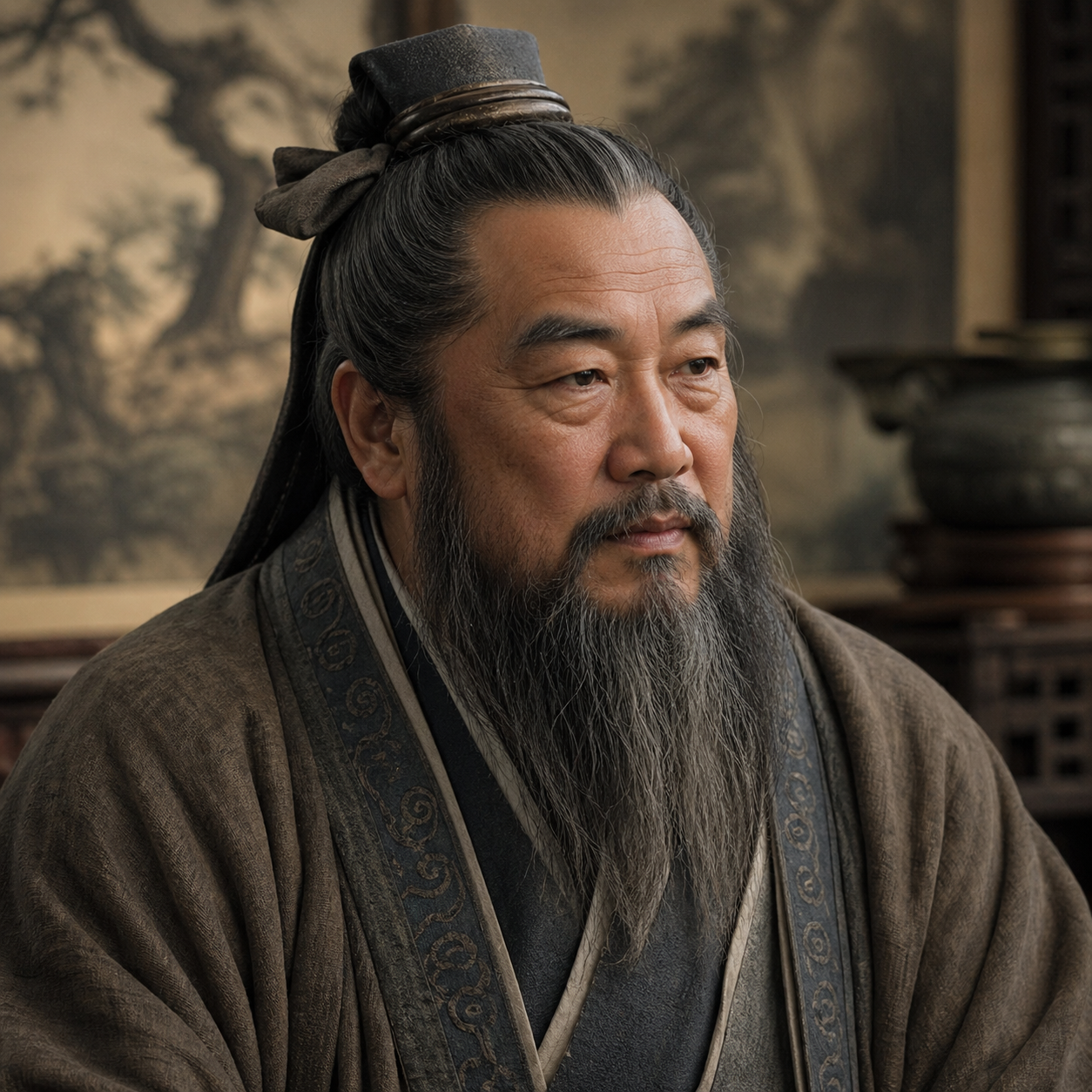
Confucius — "One who does not understand the Mandate of Heaven cannot be a gentleman."
One who does not understand the Mandate of Heaven cannot be a gentleman.
One who does not understand the Mandate of Heaven cannot be a gentleman.
Click any product to generate a realistic preview. Up to 3 at a time.
* Initial load can take up to 90 seconds — revising the preview in another color is nearly instant.
"Is it not a pleasure, having learned something, to try it out at due intervals?"
"The Master said, 'I walk in the company of two other men, and I can always learn from them. I select their good qualities and follow them, and I correct their bad qualities and avoid them.'"
"To be wealthy and honored in an unjust society is a disgrace."
"The superior man is easy to serve but difficult to please; the inferior man is difficult to serve but easy to please."
"The Master said, 'To see what is right, and not to do it, is want of courage.'"
Chinese philosopher and teacher whose teachings (compiled by his students in the Analects) became the foundational ethical framework of East Asian civilization for 2,500 years. Closely associated with Mencius (his most-influential follower a century later). For an intellectual contrast, see Laozi, near-contemporary Chinese sage and Tao Te Ching author — Confucius systematized social order through ritual and family hierarchy; Laozi's Taoist effortless-action philosophy argued such systems were the disease, not the cure. The two founding poles of Chinese moral philosophy — every East Asian moral tradition since has positioned itself between them.
The standard scholarly entry points to Confucius's work: Philip J. Ivanhoe (Georgetown, Chinese philosophy) — Confucian Moral Self Cultivation (2000); Edward Slingerland (UBC, Asian Studies) — Effortless Action: Wu-wei as Conceptual Metaphor (2003); Tu Weiming (Harvard, Confucian scholar) — Confucian Thought: Selfhood as Creative Transformation (1985). These are the works graduate seminars cite when teaching Confucius.
Found in 1 providers: grok
1 source checked
A truly noble person must grasp that life unfolds within a larger moral order beyond personal control. Recognizing what is fated, what duties are assigned by circumstance, and what limits constrain human action is essential to mature character. Without this awareness, someone may chase wealth, status, or pleasure heedlessly, mistaking ambition for virtue. Accepting one's role in a greater pattern allows steady ethical conduct rather than anxious striving against forces no person can overcome.
Confucius spent decades wandering between feudal courts seeking a ruler who would adopt his ethical reforms, repeatedly failing yet persisting. His concept of the junzi, or gentleman, was central to his teaching: a person cultivated through ritual, learning, and moral self-discipline. Tian ming, the Mandate of Heaven, framed his acceptance of obscurity and hardship. He famously said at fifty he understood Heaven's decree, treating that understanding as a milestone of mature wisdom and humble service.
Confucius lived during the late Spring and Autumn period around 551 to 479 BCE, when the Zhou dynasty's authority had collapsed and rival states waged constant war. The Mandate of Heaven was the political-religious doctrine justifying dynastic rule, originally invoked by the Zhou to overthrow the Shang. In an age of betrayal, regicide, and shifting allegiances, invoking Heaven's mandate reminded ambitious aristocrats that legitimate power required moral worthiness, not merely military success or hereditary claim.
AI-generated insights based on extensive research and information for context. Factual errors? Email [email protected].
Your cart is empty