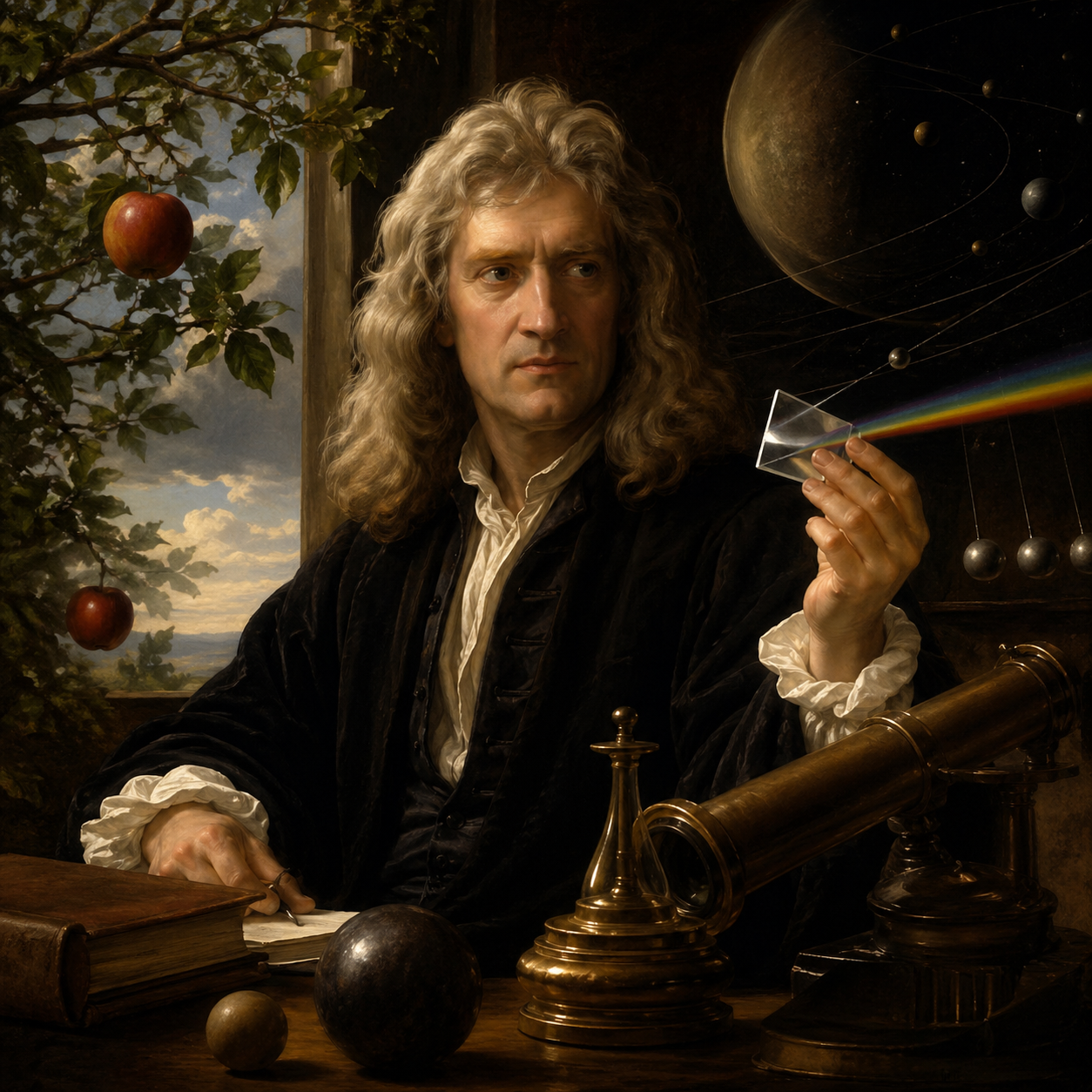
Isaac Newton — "Plato is my friend, Aristotle is my friend, but my greatest friend is truth."
Plato is my friend, Aristotle is my friend, but my greatest friend is truth.
Plato is my friend, Aristotle is my friend, but my greatest friend is truth.
Click any product to generate a realistic preview. Up to 3 at a time.
* Initial load can take up to 90 seconds — revising the preview in another color is nearly instant.
"Atheism is so senseless. When I look at the solar system, I see the earth at the right distance from the sun to receive the proper amounts of heat and light. This did not happen by chance."
"I have studied these things – you have not."
"The light which comes from the sun, and from all fire, consists of all the primary colours mixed together."
"I consider the world as a stage, and the actions of men as a play, in which every one acts a part."
"To explain all nature is too difficult a task for any one man or even for any one age. 'Tis much better to do a little with certainty, & leave the rest for others that come after you, than to explain …"
Found in 1 providers: deepseek
1 source checked
Even the most celebrated intellectual giants must yield to empirical truth. Loyalty to any philosopher or tradition, however prestigious, is secondary to what evidence actually demonstrates. It's a declaration of intellectual independence: don't accept claims because a revered authority made them — test them. Reputation cannot substitute for proof. Truth is the ultimate arbiter of knowledge, outranking every human thinker regardless of their stature or historical influence.
Newton inscribed this in his Cambridge student notebook around 1664, signaling his break from Aristotelian natural philosophy still ruling university curricula. His laws of motion and universal gravitation directly overturned 2,000 years of inherited doctrine. His method — rigorous mathematics plus observation — embodied truth over authority. He studied predecessors like Kepler and Galileo carefully but corrected them freely. No ancient reputation, however towering, could withstand a better-supported theory in Newton's framework.
Newton lived during the Scientific Revolution, when Aristotle's authority had dominated European learning for over 1,500 years, enforced by universities and the Church. Galileo had been forced to recant heliocentrism just decades before Newton's birth. The Royal Society, founded in 1660, championed empirical observation over inherited dogma. Challenging classical authorities carried genuine institutional risk. Newton's era was a decisive hinge point where ancient prestige was finally being subordinated to experimental and mathematical demonstration.
AI-generated insights based on extensive research and information for context. Factual errors? Email [email protected].
Your cart is empty