Erwin Schrodinger — "Quantum mechanics is a wonderful theory. But it is not the last word."
Quantum mechanics is a wonderful theory. But it is not the last word.
Quantum mechanics is a wonderful theory. But it is not the last word.
Click any product to generate a realistic preview. Up to 3 at a time.
* Initial load can take up to 90 seconds — revising the preview in another color is nearly instant.
"The important thing is not to stop questioning."
"If we were to pursue the idea to its logical conclusion, we would have to assume that every thought, every feeling, every sensation is somehow connected with an elementary process in the brain, with a…"
"The quantum mechanical description of reality is certainly incomplete."
"The fact that life exists and that it is maintained by a continuous stream of 'negentropy' from the outside, is the most profound mystery of all."
"If you ask a theoretical physicist today, ‘What is an electron?’ he will probably say, ‘It is a symbol in the wave equation.’ We have got so far from the concrete picture of nature."
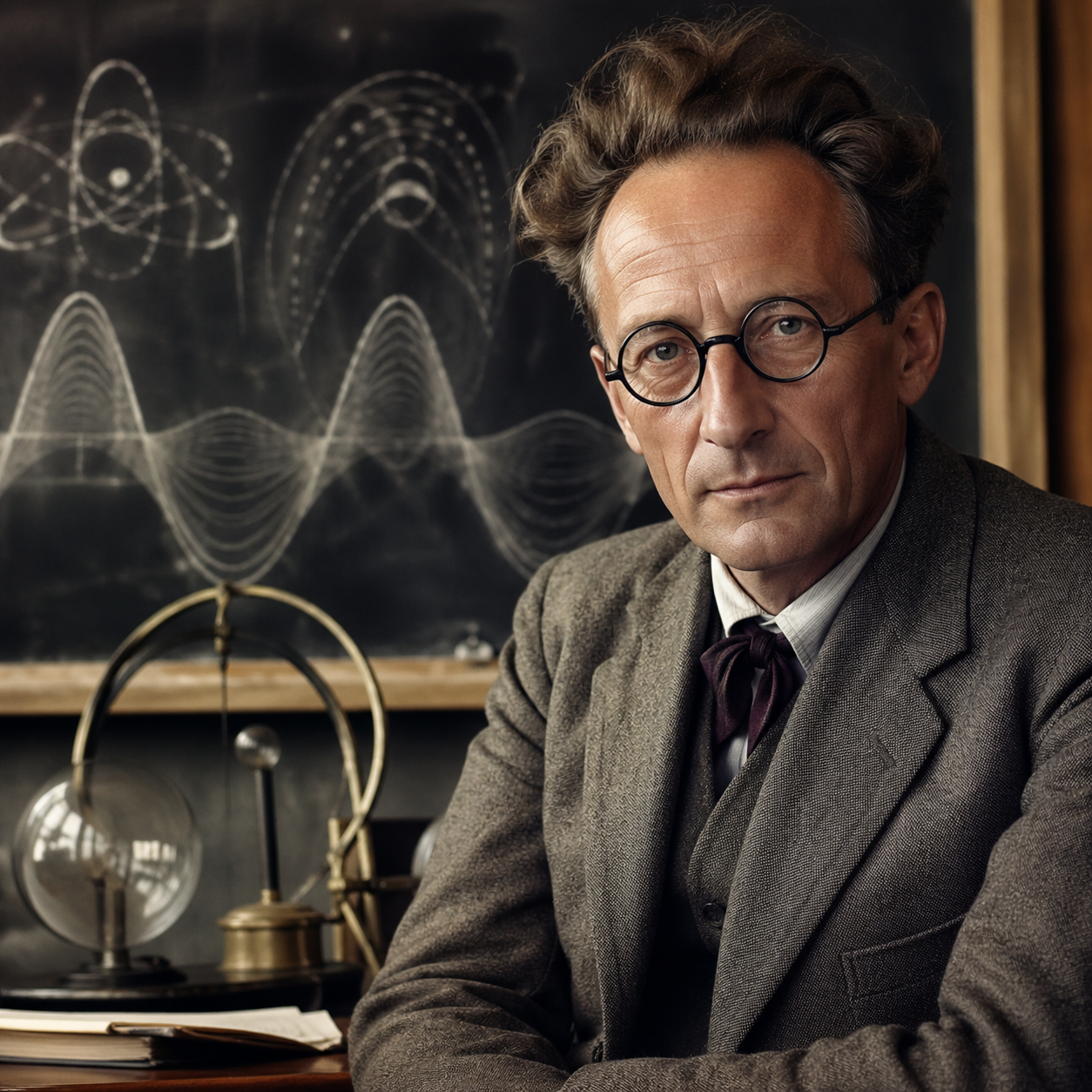
Austrian physicist who shared the 1933 Nobel for the wave equation that bears his name and the famous cat thought-experiment. Closely associated with Werner Heisenberg (matrix-mechanics rival who reached the same physics by different math) and Albert Einstein (his pen-pal on quantum interpretation). For an intellectual contrast, see Niels Bohr, Danish physicist and architect of the Copenhagen interpretation — Schrödinger's cat thought-experiment was specifically designed to ridicule Bohr's 'observer-dependent reality' reading of quantum mechanics — Schrödinger thought the Copenhagen interpretation was absurd; the cat was meant as reductio ad absurdum.
Attributed, reflecting his lifelong engagement and occasional discomfort with quantum mechanics' implications.
Date: Unknown
GeneralFound in 1 providers: grok
1 source checked
Quantum mechanics is praised as a genuine triumph of human understanding, but science never reaches a final destination. Even the most successful theories are stepping stones, not endpoints. Deeper truths likely remain undiscovered. Accepting any framework as definitive closes the mind prematurely. The universe is complex enough that today's best explanation will eventually be refined, extended, or superseded by something more complete and more accurate.
Schrödinger built the wave equation foundational to quantum mechanics in 1926, yet spent decades skeptical of its philosophical completeness. His famous cat thought experiment was designed to expose the absurdity of the Copenhagen interpretation, not celebrate it. He pursued unified field theory in later life, convinced physics hadn't reached bedrock. This quote reflects his lifelong tension: proud architect of QM, yet its most persistent internal critic.
Schrödinger worked through the quantum revolution of the 1920s into the postwar era, when physics felt simultaneously triumphant and philosophically fractured. Einstein fought probabilistic interpretations until his death in 1955. Hidden variable theories circulated widely. Bell's theorem arrived in 1964. Efforts toward quantum gravity and unified field theories stalled repeatedly. The field was demonstrably powerful yet visibly unfinished, making skepticism about finality a rigorous scientific position rather than mere modesty.
AI-generated insights based on extensive research and information for context. Factual errors? Email [email protected].
Your cart is empty