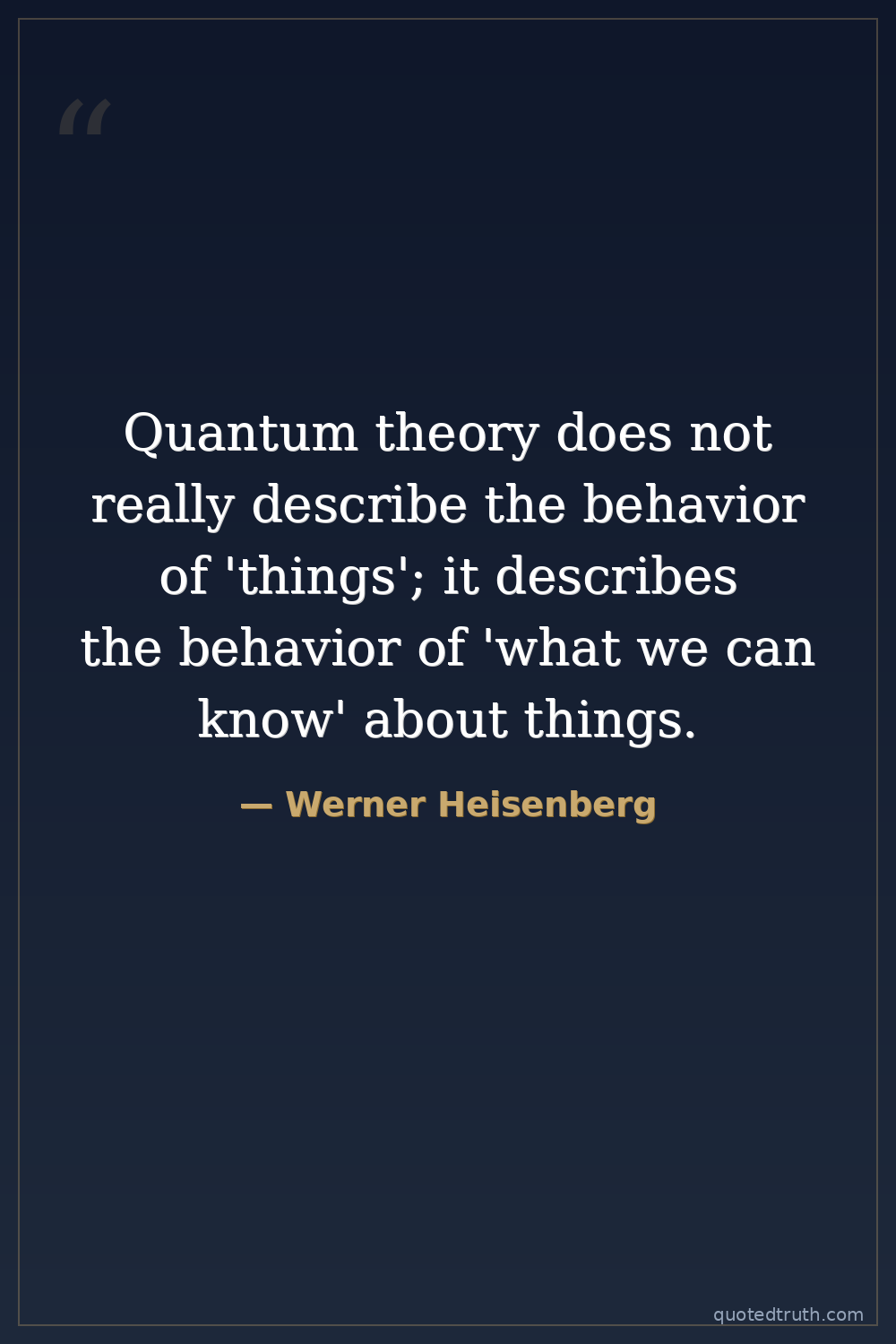
Werner Heisenberg — "Quantum theory does not really describe the behavior of 'things'; it describes t…"
Quantum theory does not really describe the behavior of 'things'; it describes the behavior of 'what we can know' about things.
Quantum theory does not really describe the behavior of 'things'; it describes the behavior of 'what we can know' about things.
Click any product to generate a realistic preview. Up to 3 at a time.
* Initial load can take up to 90 seconds — revising the preview in another color is nearly instant.
"One can't say that one could equally well say that's the quickest way of ending the war."
"The decision to break with the tradition of classical physics was a very difficult one."
"The smallest units of matter are not physical objects in the ordinary sense; they are forms, structures or—in Plato's sense—Ideas."
"The history of physics is not only a sequence of experimental discoveries and observations, but also a history of concepts."
"Modern physics has, in a certain sense, revived Plato's philosophy of forms in the atomic world."
Interpretive statement about quantum mechanics
Date: Undated, paraphrasing a common interpretation
EducationalFound in 1 providers: grok
1 source checked
Quantum physics isn't a picture of what particles actually are or do on their own. Instead, it's a framework for predicting what measurements and observations will reveal. The theory tracks probabilities, outcomes, and information available to an observer, not an independent reality humming along behind the scenes. Reality at the smallest scale is defined by what can be measured and known, not by hidden objective properties waiting to be uncovered.
Heisenberg built quantum mechanics around observables, famously formulating matrix mechanics in 1925 using only measurable quantities like spectral lines. His 1927 uncertainty principle proved that position and momentum cannot both be precisely known, cementing his view that physics describes knowledge, not hidden reality. This epistemic stance anchored the Copenhagen interpretation he developed with Niels Bohr, and it shaped his lifelong philosophical writings bridging physics with Platonic and Kantian thought.
In the 1920s and 1930s, classical determinism was collapsing. Einstein's relativity had reshaped space and time, and experiments on atoms defied Newtonian intuition. Physicists in Copenhagen, Gottingen, and Munich debated whether science could still claim to describe objective reality. Heisenberg worked amid this upheaval, later continuing under Nazi Germany's strained scientific climate. His insistence that theory tracks knowledge rather than things echoed a broader modernist crisis about observation, certainty, and the limits of human understanding.
AI-generated insights based on extensive research and information for context. Factual errors? Email [email protected].
Your cart is empty