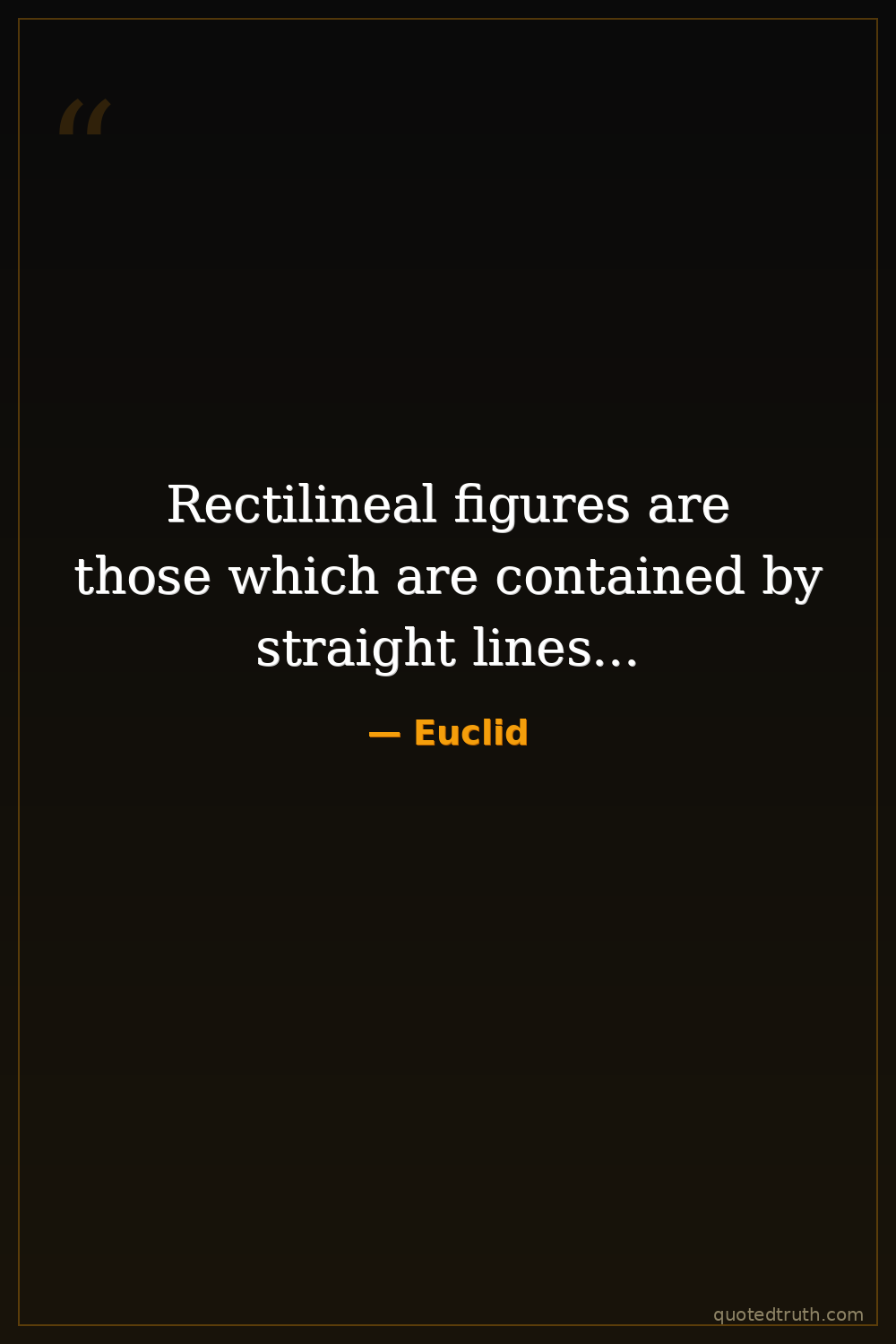
Euclid — "Rectilineal figures are those which are contained by straight lines..."
Rectilineal figures are those which are contained by straight lines...
Rectilineal figures are those which are contained by straight lines...
Click any product to generate a realistic preview. Up to 3 at a time.
* Initial load can take up to 90 seconds — revising the preview in another color is nearly instant.
"What do I gain by learning these things?"
"A diameter of the circle is any straight line drawn through the center and terminated in both directions by the circumference of the circle, and such a straight line also bisects the circle."
"To construct a regular pentagon in a given circle."
"Further, of trilateral figures, a right-angled triangle is that which has a right angle, an obtuse-angled triangle that which has an obtuse angle, and an acute-angled triangle that which has its three…"
"Rectilinear figures are those which are contained by straight lines, trilateral figures being those contained by three, quadrilateral those contained by four, and multilateral those contained by more …"
Found in 1 providers: grok
1 source checked
Shapes made entirely of straight edges — triangles, squares, polygons — belong to one category; curved shapes like circles belong to another. Before proving anything, every term must be exact. This is a geometric definition: rectilineal figures are simply what we now call polygons. The precision is the point. Nothing is left assumed or vague; the classification must be airtight before any logical reasoning can proceed on top of it.
Euclid built Elements around 23 definitions before stating a single axiom or proving any theorem — this quote is Definition 19. His defining trait was methodical rigor: nothing assumed, everything stated explicitly. Working in Alexandria, he synthesized centuries of Greek geometric knowledge into one unified deductive system. The definition reflects his core belief that mathematics must begin with airtight foundations; only from exact language can reliable, universal proofs follow.
Euclid worked in Alexandria around 300 BCE during the early Ptolemaic dynasty, when the Great Library was becoming the ancient world's intellectual center. Greek thinkers had long used geometric reasoning informally, but no one had organized it axiomatically. Plato's Academy had elevated geometry as the highest intellectual discipline. Euclid's era demanded rigor over intuition — this definition embodies that cultural drive to ground all knowledge in first principles before building further.
AI-generated insights based on extensive research and information for context. Factual errors? Email [email protected].
Your cart is empty