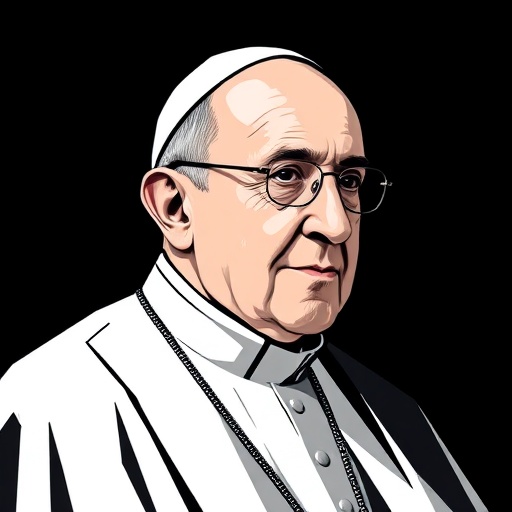
Pope Francis — "Sometimes when I see a clericalist, I suddenly become anticlerical."
Sometimes when I see a clericalist, I suddenly become anticlerical.
Sometimes when I see a clericalist, I suddenly become anticlerical.
Click any product to generate a realistic preview. Up to 3 at a time.
* Initial load can take up to 90 seconds — revising the preview in another color is nearly instant.
"A good Catholic is interested in politics."
"I like to talk to people, to go out into the street. I like to be a street priest."
"The Church must be a field hospital."
"The Church must be a field hospital, where people are healed and cared for."
"There are cases in which separation is inevitable. Sometimes, it can even be morally necessary, when it comes to shielding the weaker spouse or young children from more serious wounds caused by intimi…"
First Latin American and Jesuit pope (2013-), who has steered the Catholic Church toward pastoral inclusion on LGBTQ pastoral care, divorced Catholics, and climate. Closely associated with Pope John XXIII (the Vatican II reformer pope) and Cardinal Walter Kasper (his theological ally on pastoral reform). For an intellectual contrast, see Cardinal Raymond Burke, American traditionalist cardinal, former head of the Vatican Apostolic Signatura — Burke is the public face of Catholic traditionalism that views Francis's pastoral approach as doctrinally dangerous — he has formally challenged Amoris Laetitia and other Francis reforms.
Found in 1 providers: deepseek
1 source checked
Clericalism describes clergy who treat ordination as a source of privilege, status, and power over others rather than a call to humble service. Francis is expressing visceral frustration — when he encounters priests or officials who lord authority over laypeople, he feels an almost instinctive desire to dismantle that entire structure. It is a candid, self-aware admission that institutional abuse of clerical rank provokes in him its own radical opposite reaction.
Jorge Mario Bergoglio chose the name Francis to signal simplicity over grandeur. He lives in a guesthouse, not the Apostolic Palace, washes prisoners' feet, and carries his own bags. As the first Jesuit and first Latin American pope, he witnessed how clerical arrogance poisoned the Argentine church. His entire papacy — synodality, lay empowerment, repeated attacks on careerism in the curia — is a sustained campaign against the clericalist culture he openly despises.
Francis became pope in March 2013 as the Catholic Church reeled from global clergy sex abuse scandals in Ireland, the United States, Australia, Chile, and Germany. Investigations repeatedly identified clericalism — a culture of unchecked clerical authority shielding abusers — as the structural root cause. His comment carries sharp urgency in that context, describing the reform impulse of a pope trying to dismantle an institution where deference to priests had, for decades, silenced victims.
AI-generated insights based on extensive research and information for context. Factual errors? Email [email protected].
Your cart is empty