Richard Feynman — "Study hard what interests you the most in the most undisciplined, irreverent and…"
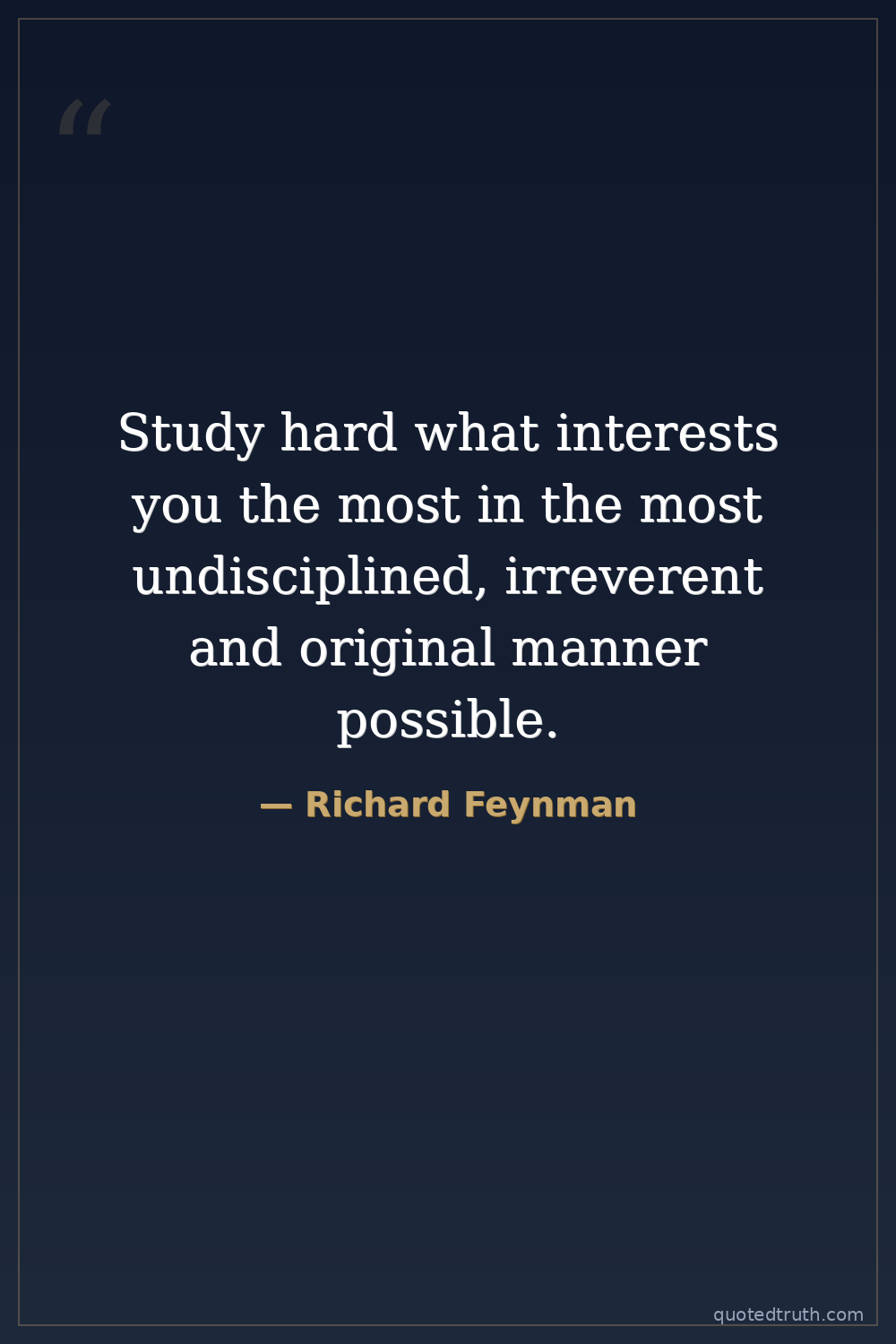
Study hard what interests you the most in the most undisciplined, irreverent and original manner possible.
Study hard what interests you the most in the most undisciplined, irreverent and original manner possible.
Click any product to generate a realistic preview. Up to 3 at a time.
* Initial load can take up to 90 seconds — revising the preview in another color is nearly instant.
"There are no miracles, only wonders."
"I would often go to these conferences where they would talk about the ultimate theory, and I would always say, 'What's the ultimate experiment?'"
"I think that when you're doing science, you're trying to find out something that nobody knows."
"I have a great deal of difficulty with the idea of 'truth' in the philosophical sense."
"I can live with doubt and uncertainty and not knowing. I think it's much more interesting to live not knowing than to have answers which might be wrong."
American theoretical physicist who shared the 1965 Nobel for QED, developed Feynman diagrams, and wrote the Feynman Lectures on Physics. Closely associated with Julian Schwinger (co-Nobelist for QED) and Murray Gell-Mann (Caltech rival and Eightfold-Way physicist). For an intellectual contrast, see Deepak Chopra, physician and quantum-mysticism author — Feynman's Caltech 'cargo cult science' commencement address is the precise template for what he saw as misuse of physics terminology — Chopra-style appropriation of quantum vocabulary for metaphysical claims is the canonical example of what Feynman called 'fooling yourself'.
Found in 1 providers: grok
1 source checked
Chase your genuine curiosity with full intensity, but refuse to let convention, authority, or rigid structure constrain how you learn. Real understanding comes from breaking rules, questioning assumptions, and approaching problems from unexpected angles rather than following prescribed paths dictated by others.
Feynman embodied this philosophy completely. He taught himself calculus from a borrowed library book, developed his own idiosyncratic notation system, and solved complex QED problems through unconventional pictorial diagrams now called Feynman diagrams. He played bongo drums, cracked safes at Los Alamos, and deliberately cultivated amateur curiosity in biology and art throughout his career.
Post-WWII American science became increasingly institutionalized and specialized, with rigid academic hierarchies and Cold War funding pressures pushing researchers toward narrow, approved problems. Feynman pushed back against this conformity during an era when the Manhattan Project demonstrated both science's immense power and the danger of scientists unquestioningly following authority.
AI-generated insights based on extensive research and information for context. Factual errors? Email [email protected].
Your cart is empty