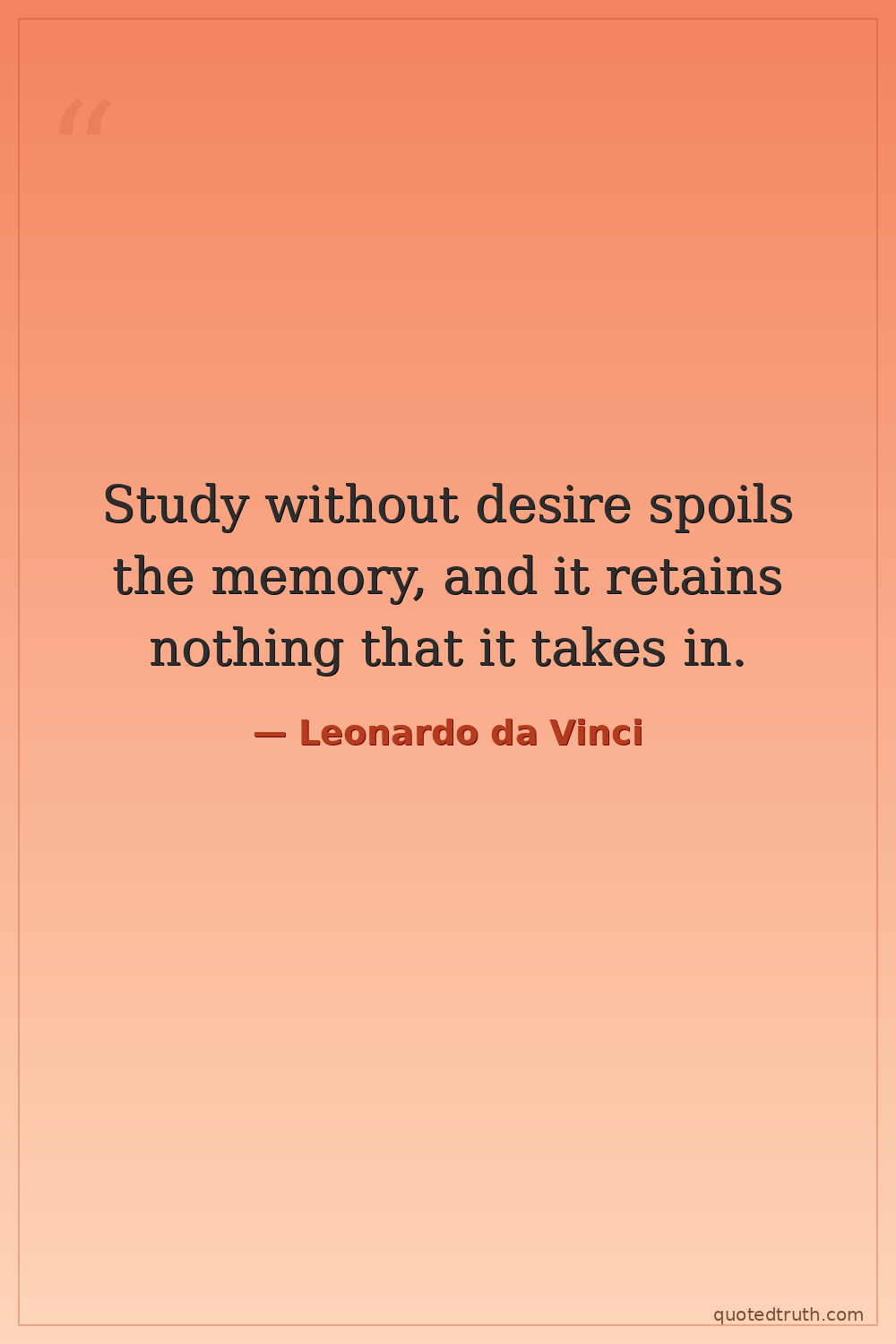
Leonardo da Vinci — "Study without desire spoils the memory, and it retains nothing that it takes in."
Study without desire spoils the memory, and it retains nothing that it takes in.
Study without desire spoils the memory, and it retains nothing that it takes in.
Click any product to generate a realistic preview. Up to 3 at a time.
* Initial load can take up to 90 seconds — revising the preview in another color is nearly instant.
"The greatest good is that which is chosen in preference to all others."
"Birds, being provided with wings, can always fly where they wish, and so can men, if they have wings."
"As every divided kingdom falls, so every mind divided between many studies confounds and saps itself."
"He who does not punish evil commands it to be done."
"Art is never finished, only abandoned."
Found in 1 providers: grok
1 source checked
Learning without genuine curiosity is a waste of time — facts won't stick if you don't care about them. Passion is the engine that makes knowledge permanent. When you're truly interested in something, your mind actively engages, connects ideas, and remembers them. Going through the motions of studying — reading without wanting to understand — leaves you with nothing. Desire isn't a bonus for learning; it's a requirement.
Leonardo embodied this belief completely. He never attended university yet filled over 7,000 notebook pages with observations on anatomy, hydraulics, optics, botany, and flight — driven entirely by obsessive curiosity. He dissected human corpses to understand muscle movement for his paintings, studied bird wings to design flying machines. His passion made him retain staggering breadth across disciplines. Subjects he found less compelling — many commissioned portraits among them — he frequently left unfinished.
The Renaissance saw Europe shift from medieval scholasticism — where students memorized authoritative texts without questioning them — toward humanist inquiry rooted in observation. Gutenberg's printing press flooded Europe with books after 1450, but critics noted that students who crammed without understanding retained little. Leonardo lived amid this tension: formal scholars debated ancient authorities while self-taught practitioners learned by doing. His era was actively arguing over what genuine learning meant and whether curiosity could replace rote drill.
AI-generated insights based on extensive research and information for context. Factual errors? Email [email protected].
Your cart is empty