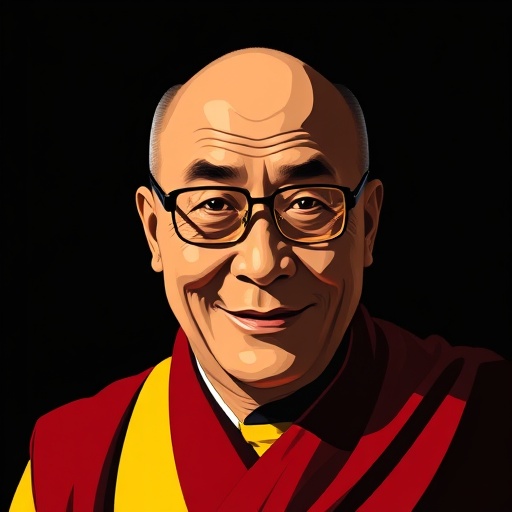
Dalai Lama (14th) — "The 21st century should be a century of dialogue, not violence."
The 21st century should be a century of dialogue, not violence.
The 21st century should be a century of dialogue, not violence.
Click any product to generate a realistic preview. Up to 3 at a time.
* Initial load can take up to 90 seconds — revising the preview in another color is nearly instant.
"A good friend who always tells you the truth is a blessing."
"I think the most important thing is to have a good heart. If you have a good heart, everything else will follow."
"My main interest is to promote human values, compassion, forgiveness, tolerance, self-discipline, contentment. That's my main interest."
"If you want others to be happy, practice compassion. If you want to be happy, practice compassion."
"Lack of transparency, lack of accountability, that is the main source of corruption."
Found in 1 providers: grok
1 source checked
Humanity has the tools — global communication, international institutions, diplomacy — to resolve disputes without war. This quote argues we should consciously choose conversation and negotiation over military force or terrorism. It is not naive idealism but a practical prescription: the same energy nations pour into weapons and warfare should instead fuel sustained, patient dialogue. Progress on climate, poverty, and security all depend on nations talking rather than fighting each other.
Tenzin Gyatso has lived this principle since 1959, when China's military crushed Tibet's uprising and forced him into Indian exile. For over 60 years he pursued his Middle Way — seeking genuine autonomy through negotiation, never armed resistance, despite Beijing's repeated refusals. His 1989 Nobel Peace Prize honored exactly this commitment. As a Buddhist monk, ahimsa (non-harm) is foundational to his theology, making dialogue not merely a political strategy but a deeply held spiritual imperative.
Said against the backdrop of the September 11 attacks, U.S.-led wars in Afghanistan and Iraq, and ongoing Israeli-Palestinian violence, this quote arrived when the world's dominant response to conflict was military. Nuclear proliferation in North Korea and Iran alarmed global powers. The post-Cold War peace dividend had evaporated. Meanwhile, the internet was creating unprecedented human connectivity — proving dialogue was technically feasible even as governments repeatedly defaulted to force.
AI-generated insights based on extensive research and information for context. Factual errors? Email [email protected].
Your cart is empty