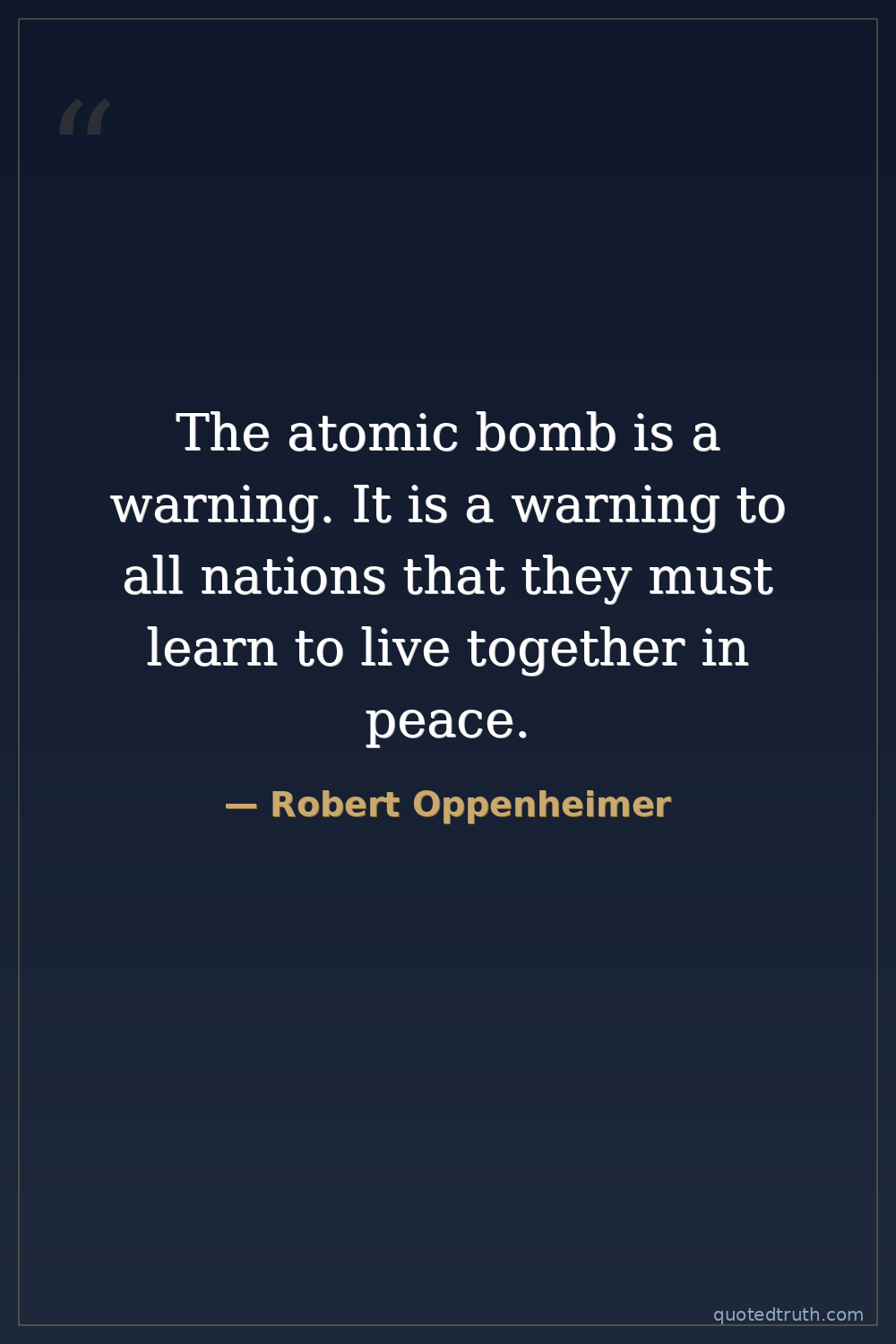
Robert Oppenheimer — "The atomic bomb is a warning. It is a warning to all nations that they must lear…"
The atomic bomb is a warning. It is a warning to all nations that they must learn to live together in peace.
The atomic bomb is a warning. It is a warning to all nations that they must learn to live together in peace.
Click any product to generate a realistic preview. Up to 3 at a time.
* Initial load can take up to 90 seconds — revising the preview in another color is nearly instant.
"The atomic bomb is not merely a new weapon, but a new thing in the world."
"The greatest discovery is to find oneself."
"The atomic bomb is a testament to the fact that human beings are capable of both great good and great evil."
"We are scientists. We are not politicians. We are not moralists. We are scientists. We have done our job. It is up to others to decide what to do with it."
"Knowledge cannot be pursued without morality."
American theoretical physicist who directed the Manhattan Project's Los Alamos Laboratory and oversaw the atomic bombs; lost his security clearance in 1954. Closely associated with Niels Bohr (Manhattan Project consultant and atomic-policy advisor) and Hans Bethe (Los Alamos theoretical-division chief). For an intellectual contrast, see Edward Teller, Hungarian-American physicist and 'father of the H-bomb' — Teller pushed the H-bomb against Oppenheimer's objections and testified against him at his 1954 security hearing — the precise moment that ended Oppenheimer's career. The canonical 'physicist-of-conscience vs physicist-of-state' pairing in nuclear-age ethics; Christopher Nolan's Oppenheimer (2023) dramatized this rivalry for a mass audience.
Found in 1 providers: grok
1 source checked
The atomic bomb is not merely a weapon but a civilizational ultimatum. Its destructive capacity is so absolute that war between major powers becomes irrational — mutual annihilation replaces victory as the only outcome. The quote argues that this reality strips nations of the option to resolve disputes through conventional conflict, making international cooperation and diplomacy no longer idealistic but existentially necessary for human survival.
Oppenheimer directed the Manhattan Project at Los Alamos, witnessing the Trinity test in July 1945 — the first atomic detonation in history. He famously recalled the Bhagavad Gita: 'Now I am become Death.' Haunted by what he built, he lobbied postwar for international atomic control through the Acheson-Lilienthal Report and opposed the hydrogen bomb, believing scientists bore direct moral responsibility for preventing the weapons they created from destroying civilization.
When Oppenheimer spoke, Hiroshima and Nagasaki had just been destroyed in August 1945, killing over 200,000 people. The Soviet Union tested its own atomic bomb in 1949, launching a full arms race. The newly formed United Nations struggled to assert authority over sovereign nations. Humanity had entered an era where a single political miscalculation could trigger civilizational collapse — a reality that made international governance urgent rather than utopian.
AI-generated insights based on extensive research and information for context. Factual errors? Email [email protected].
Your cart is empty