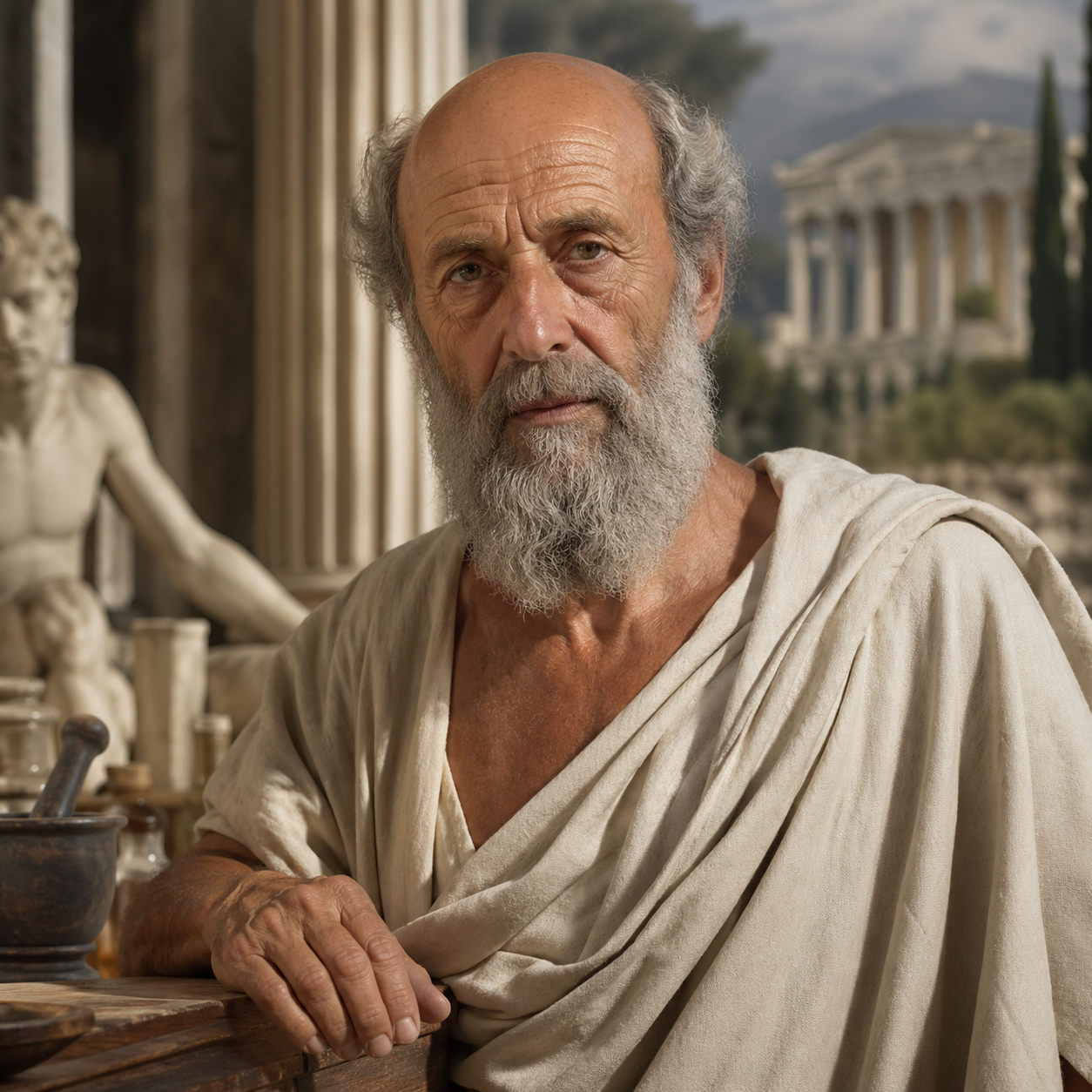
Hippocrates — "The best physician is also a philosopher."
The best physician is also a philosopher.
The best physician is also a philosopher.
Click any product to generate a realistic preview. Up to 3 at a time.
* Initial load can take up to 90 seconds — revising the preview in another color is nearly instant.
"The diet is the foundation of health."
"The art of medicine consists in amusing the patient while nature cures the disease."
"The sacred disease (epilepsy) is no more divine or sacred than any other disease, but has a natural cause."
"The greatest medicine of all is to teach people how not to need it."
"It is more important to know what sort of person has a disease than to know what sort of disease a person has."
A statement on the ideal qualities of a physician, combining medical skill with wisdom.
Date: c. 460-370 BCE
WisdomFound in 1 providers: gemini
1 source checked
A doctor who only knows procedures and remedies without deeper reasoning is incomplete. The finest physicians think like philosophers: they question assumptions, consider causes rather than just symptoms, reason through uncertainty, and treat patients as whole human beings. Philosophy brings critical thinking, ethics, and humility to medicine — qualities that separate rote practice from genuine healing. Technical skill alone is not enough; wisdom and inquiry are equally essential.
Hippocrates spent his life separating medicine from superstition and religious ritual, insisting disease had natural causes discoverable through observation and reason — the core tools of philosophy. He created the Hippocratic Oath, embedding ethics at medicine's heart. His treatises blend natural philosophy with clinical detail, showing he saw the two as inseparable. A physician-philosopher himself, he modeled inquiry-driven practice that shaped Western medicine for two millennia.
In 5th-century BC Greece, illness was widely attributed to divine punishment or demonic possession, with priests at Asclepian temples performing the actual healing. Meanwhile, natural philosophers like Socrates and Plato were revolutionizing thought by demanding rational explanations for all phenomena. Hippocrates entered this charged moment, arguing disease had physical causes, not supernatural ones. Yoking medicine to philosophy was therefore radical — claiming the sick body belonged to reason, not the gods.
AI-generated insights based on extensive research and information for context. Factual errors? Email [email protected].
Your cart is empty