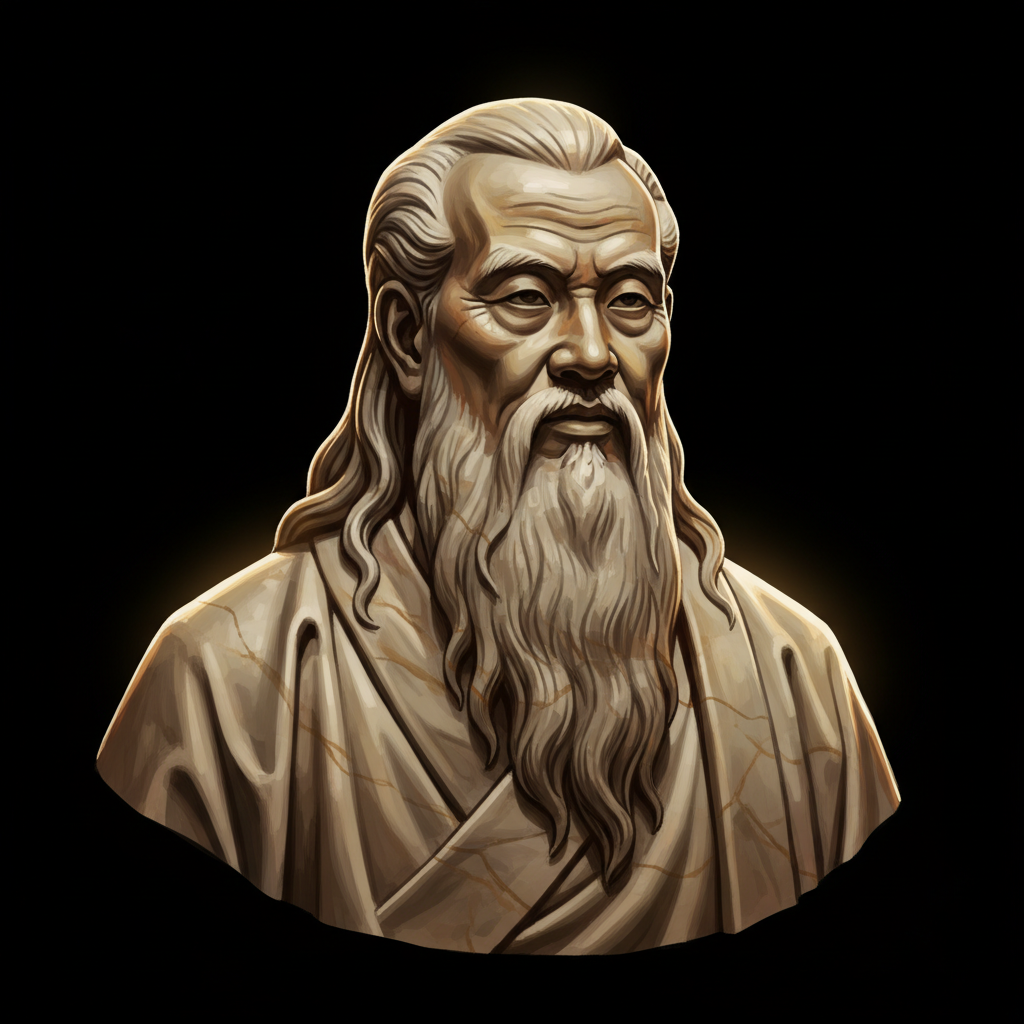
Laozi — "The best way to carve is not to split."
The best way to carve is not to split.
The best way to carve is not to split.
Click any product to generate a realistic preview. Up to 3 at a time.
* Initial load can take up to 90 seconds — revising the preview in another color is nearly instant.
"Yield and overcome; Bend and be straight; Empty and be full; Wear out and be new; Have little and gain; Have much and be confused."
"Silence is a source of great strength."
"The empire is a sacred vessel and cannot be acted on. He who acts on it harms it; he who grasps it loses it."
"Govern a great nation as you would cook a small fish. (Do not overdo it.)"
"When the people are ignorant, they are easy to control."
Reputed founder of Taoism and author of the Tao Te Ching, whose wu wei (effortless action) shaped East Asian philosophy. Closely associated with Zhuangzi (later Taoist who extended Laozi's framework). For an intellectual contrast, see Confucius, near-contemporary Chinese sage of social ritual and duty — Confucius systematized social order through ritual and hierarchy; Laozi argued that all such systems were the disease, not the cure — the two founding poles of Chinese moral philosophy.
Found in 1 providers: gemini
1 source checked
Real skill in shaping something doesn't come from forcing it apart with brute effort. The finest craftsman works with the natural grain, finding the seams that already exist rather than hacking through resistance. Applied broadly, it means the best way to handle problems, people, or situations is not through division, aggression, or imposed force, but through yielding guidance that lets things separate or resolve along their own hidden lines.
Laozi built Taoism around wu wei, effortless action that follows nature rather than fighting it. As a reputed archivist in the Zhou court, he watched rulers exhaust themselves through control and witnessed the elegance of unforced order. This saying distills his central conviction that mastery is alignment, not domination, the same insight behind his image of water wearing stone and the uncarved block as the ideal of untouched potential.
Laozi lived during the late Zhou period as China fractured into warring states, with rulers competing through harsh laws, heavy taxation, and military force. Confucian scholars pushed rigid ritual and hierarchy as the fix. Against this backdrop of aggressive intervention, Laozi's teaching that cutting without splitting, governing without meddling, and acting without striving produced better outcomes was a radical counterstatement to an age obsessed with forcing order onto chaos.
AI-generated insights based on extensive research and information for context. Factual errors? Email [email protected].
Your cart is empty