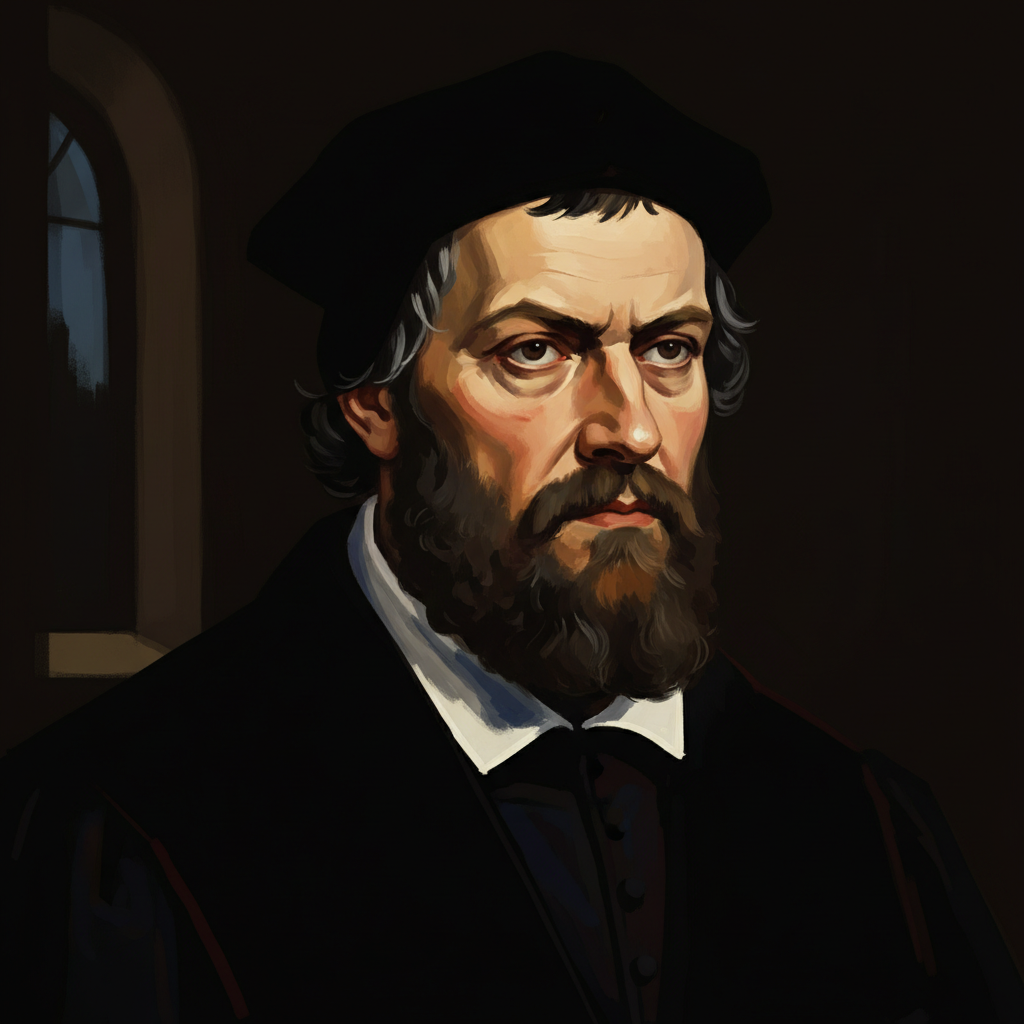
Martin Luther — "The best way to worship God is to do your ordinary work well."
The best way to worship God is to do your ordinary work well.
The best way to worship God is to do your ordinary work well.
Click any product to generate a realistic preview. Up to 3 at a time.
* Initial load can take up to 90 seconds — revising the preview in another color is nearly instant.
"The greatest gift of God is a pious, cheerful, God-fearing wife."
"Printing is the ultimate gift of God and the greatest one. Through it, God intends to spread the true knowledge of religion through the whole world."
"If the earth is fit for laughter, then surely heaven is filled with it. Heaven is the birthplace of laughter."
"To kill a peasant is not murder; it is helping to extinguish the conflagration. Let there be no half measures! Crush them! Cut their throats! Here, there, everywhere! Whoever can, strike, slay, stab, …"
"So when the devil throws your sins in your face and declares that you deserve death and hell, tell him this: 'I admit that I deserve death and hell, what of it? For I know One who suffered and made sa…"
German theologian whose 95 Theses (1517) launched the Protestant Reformation and broke the Catholic Church's monopoly on Western Christianity. Closely associated with Philipp Melanchthon (Lutheran systematizer) and John Calvin (later Reformer who built on Luther's break). For an intellectual contrast, see Pope Leo X, Renaissance pope (1513-1521) — Leo X's indulgence sales triggered Luther's break and Leo excommunicated him in 1521 — Luther's entire Reformation is structured as a direct answer to the indulgence-funded Vatican Leo represented.
Found in 1 providers: grok
1 source checked
Genuine devotion to God is not limited to prayer, rituals, or religious ceremonies. It is expressed through performing your everyday tasks, whatever your job or role, with care, diligence, and excellence. A farmer plowing a field, a parent raising children, or a cobbler making shoes honors God just as much as a priest at the altar when they do their work faithfully and well.
Luther rejected the medieval split between sacred clergy and secular laity. His doctrine of vocation taught that every honest occupation is a divine calling, not just monastic or priestly life. Having been an Augustinian monk who abandoned the cloister, he came to see milkmaids and magistrates as doing work equally pleasing to God, dismantling the spiritual hierarchy the Catholic Church had built around ordained religious life.
In the early 1500s, European society rigidly separated holy work (monks, priests, nuns) from common labor. People paid indulgences and funded monasteries hoping clergy-mediated grace would save them. Luther's 95 Theses in 1517 and subsequent writings shattered this framework, elevating ordinary trades to spiritual dignity. This teaching fueled the Protestant work ethic that later sociologist Max Weber linked to capitalism's rise across northern Europe.
AI-generated insights based on extensive research and information for context. Factual errors? Email [email protected].
Your cart is empty