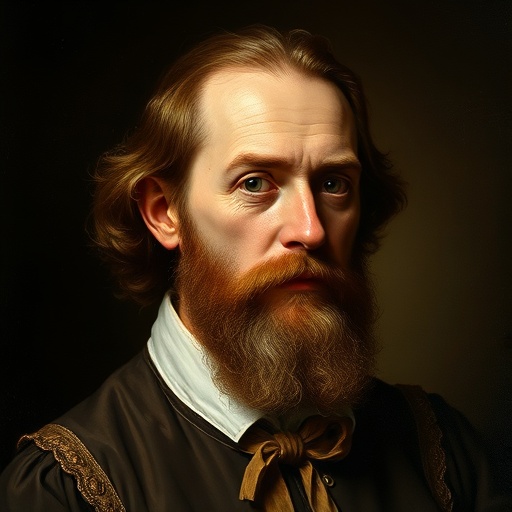
William Harvey — "The blood in the arteries is of a more florid colour than that in the veins."
The blood in the arteries is of a more florid colour than that in the veins.
The blood in the arteries is of a more florid colour than that in the veins.
Click any product to generate a realistic preview. Up to 3 at a time.
* Initial load can take up to 90 seconds — revising the preview in another color is nearly instant.
"The blood in the animal body is impelled in a circle, and is in a state of ceaseless motion."
"The physician must be a philosopher, for there is not so great a difference between them."
"The valves in the veins are so constructed as to permit the passage of blood towards the heart, but to prevent its return."
"The greatest discovery is to find the truth."
"The heart is the household divinity which, discharging its function, nourishes, cherishes, quickens the whole body."
English physician whose On the Motion of the Heart and Blood in Animals (1628) demonstrated blood circulation, overturning 1,400 years of Galenic medicine. Closely associated with Francis Bacon (his contemporary in the new English empiricism). For an intellectual contrast, see Galenic medicine, the 2nd-century Greek medical tradition (humors, blood-as-consumed-fuel) — Harvey calculated that the heart pumps more blood per hour than the body could possibly produce as fuel — a single quantitative observation that demolished the entire Galenic-Aristotelian medical worldview. The cleanest example in medical history of arithmetic disproving 14 centuries of authority.
Found in 1 providers: grok
1 source checked
Harvey is noting that blood in the arteries appears noticeably brighter red than blood in the veins. In modern terms, arterial blood is oxygen-rich and scarlet due to oxyhemoglobin, while venous blood, depleted of oxygen and returning carbon dioxide to the lungs, looks darker and more purplish. Harvey documented this as a real, visible distinction observed through direct dissection — empirical fact, not inherited theory.
Harvey's 1628 'De Motu Cordis' proved blood circulates continuously rather than being consumed. This observation exemplifies his defining method: meticulous empirical detail over Galenic doctrine. He recorded color differences during dissections and vivisections without yet knowing oxygen caused them — that discovery came a century later. His insistence on trusting direct observation over ancient authority is precisely what made him the founding figure of modern physiology.
Harvey worked during the Scientific Revolution while Galen's 1,400-year-old claim that the liver continuously produces new blood still dominated medicine. Vesalius had recently corrected anatomical errors, and Bacon was championing inductive observation over scholastic tradition. Human dissection was newly tolerated at anatomy theaters across Europe. Harvey's precise, unglamorous color notation embodied the era's break from received wisdom — European physicians were only just learning to trust their eyes over ancient texts.
AI-generated insights based on extensive research and information for context. Factual errors? Email [email protected].
Your cart is empty