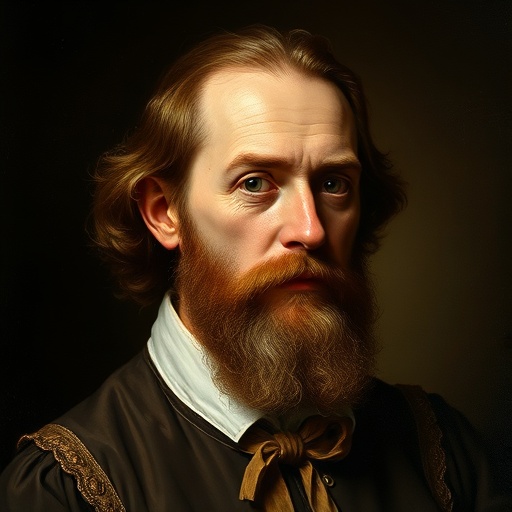
William Harvey — "The blood in the veins moves towards the heart, not away from it."
The blood in the veins moves towards the heart, not away from it.
The blood in the veins moves towards the heart, not away from it.
Click any product to generate a realistic preview. Up to 3 at a time.
* Initial load can take up to 90 seconds — revising the preview in another color is nearly instant.
"The heart is the beginning of life; the sun of the microcosm."
"The heart is the seat of the affections."
"It is not by words, but by facts and arguments, that we must seek for truth."
"I profess to learn and to teach anatomy not from books but from dissections."
"The causes of diseases are often hidden, and to find them requires much labor and diligence."
English physician whose On the Motion of the Heart and Blood in Animals (1628) demonstrated blood circulation, overturning 1,400 years of Galenic medicine. Closely associated with Francis Bacon (his contemporary in the new English empiricism). For an intellectual contrast, see Galenic medicine, the 2nd-century Greek medical tradition (humors, blood-as-consumed-fuel) — Harvey calculated that the heart pumps more blood per hour than the body could possibly produce as fuel — a single quantitative observation that demolished the entire Galenic-Aristotelian medical worldview. The cleanest example in medical history of arithmetic disproving 14 centuries of authority.
Found in 1 providers: grok
1 source checked
Blood flows through veins in one direction only — toward the heart — contradicting centuries of medical assumption. This is a factual claim about physiology: the circulatory system operates as a closed loop with the heart as its central pump, not a passive reservoir. Venous blood returns to the heart before being recirculated, a fundamental principle underlying all of modern cardiovascular medicine.
Harvey spent years dissecting animals and observing live hearts to prove this mechanically. His 1628 work Exercitatio Anatomica de Motu Cordis challenged Galen's 1,400-year-old doctrine that blood was continuously produced in the liver and consumed by tissues. This finding defined his career, cost him patients who distrusted him, yet became the cornerstone of his enduring legacy.
In early 17th-century Europe, Galenic medicine remained dogma in universities despite growing anatomical evidence against it. Vesalius had already corrected skeletal anatomy, but blood's movement remained untouched. Harvey's claim landed during the Scientific Revolution, when empirical observation was beginning to displace ancient authority — making his mechanistic, measurement-based proof a defining moment in medicine's shift toward modern science.
AI-generated insights based on extensive research and information for context. Factual errors? Email [email protected].
Your cart is empty