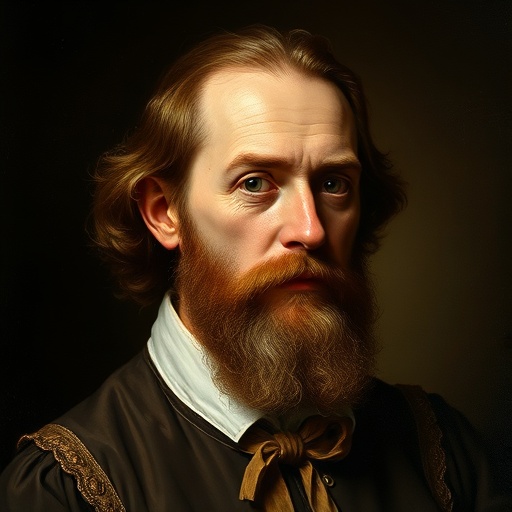
William Harvey — "The blood, therefore, moves in a circuit, and is impelled by the heart."
The blood, therefore, moves in a circuit, and is impelled by the heart.
The blood, therefore, moves in a circuit, and is impelled by the heart.
Click any product to generate a realistic preview. Up to 3 at a time.
* Initial load can take up to 90 seconds — revising the preview in another color is nearly instant.
"Nature is nowhere accustomed more openly to display her secret mysteries than in cases where she shows tracings of her workings apart from the beaten paths; nor is there any better way to advance the …"
"The heart is the beginning of life, and the source of all motion."
"It is by experiment alone that we can arrive at the knowledge of nature."
"There is no science which does not spring from pre-existing knowledge, and no certain and definite idea which has not derived its origin from the senses."
"The physician must be a man of experience."
English physician whose On the Motion of the Heart and Blood in Animals (1628) demonstrated blood circulation, overturning 1,400 years of Galenic medicine. Closely associated with Francis Bacon (his contemporary in the new English empiricism). For an intellectual contrast, see Galenic medicine, the 2nd-century Greek medical tradition (humors, blood-as-consumed-fuel) — Harvey calculated that the heart pumps more blood per hour than the body could possibly produce as fuel — a single quantitative observation that demolished the entire Galenic-Aristotelian medical worldview. The cleanest example in medical history of arithmetic disproving 14 centuries of authority.
Found in 1 providers: grok
1 source checked
Blood continuously travels in a closed loop throughout the body rather than being produced and consumed — it circulates. The heart acts as a mechanical pump, propelling blood through arteries and veins in an endless circuit. Harvey's statement replaces the ancient idea of blood as a one-way flow consumed by tissues with the modern understanding that the same blood recirculates, driven by rhythmic cardiac contractions.
Harvey spent years dissecting animals and observing beating hearts, publishing De Motu Cordis in 1628. He calculated that the heart expels far more blood per hour than the liver could possibly produce, making circulation the only logical conclusion. This quote is his central finding distilled — rooted in quantitative, empirical reasoning rather than inherited dogma, defining him as a founder of experimental medicine and modern physiology.
In the early 17th century, European medicine still operated on Galen's 1,400-year-old model — blood was made in the liver and consumed by the body. Harvey published during the Scientific Revolution, when Copernicus and Galileo were overturning cosmological authority. His empirical, measurement-based challenge to Galenic doctrine paralleled those upheavals, helping shift medicine from ancient textual authority toward observation and experiment as the standard for medical truth.
AI-generated insights based on extensive research and information for context. Factual errors? Email [email protected].
Your cart is empty