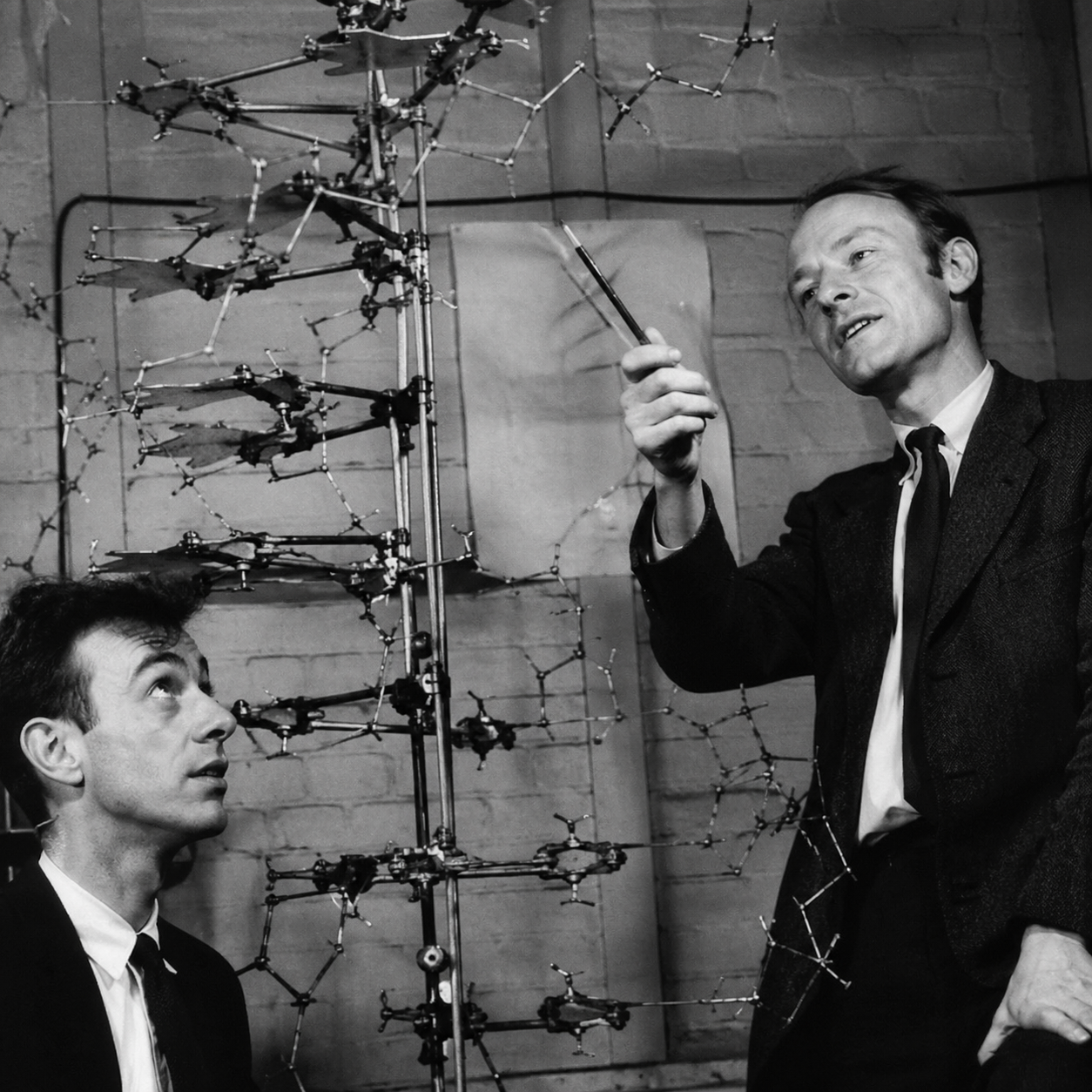
Francis Crick — "The central dogma of molecular biology."
The central dogma of molecular biology.
The central dogma of molecular biology.
Click any product to generate a realistic preview. Up to 3 at a time.
* Initial load can take up to 90 seconds — revising the preview in another color is nearly instant.
"The human brain is a wonderful thing. It starts working the moment you are born and never stops until you stand up to speak in public."
"Chance is the only source of true novelty."
"If, for example, a certain protein consistently appears in the urine of schizophrenics, one would be foolish not to take notice."
"The brain is a machine that makes theories."
"It is essential to be a bit arrogant to do good science."
Found in 1 providers: grok
1 source checked
The central dogma states that genetic information flows in one direction: DNA is transcribed into RNA, which is translated into proteins. Proteins cannot write information back into DNA. This explains how the inherited code inside every cell becomes functional biological machinery. It is the master rule governing how life stores, copies, and expresses instructions at the molecular level — essentially the operating system underlying all known living organisms.
Crick coined this phrase in 1958, five years after co-discovering DNA's double helix with Watson. A physicist-turned-biologist, he knew that revealing structure demanded explaining function. The dogma answered what DNA actually does. He was characteristically bold naming it a dogma — acknowledging the provocation while insisting the principle was foundational. His later career studying consciousness at the Salk Institute showed the same lifelong drive: identify the single governing principle behind a complex phenomenon.
The 1950s–60s saw a molecular biology explosion after DNA's structure was revealed. Scientists raced to crack the genetic code — how four bases specify twenty amino acids. Sputnik triggered massive science funding across Western nations. Crick's dogma gave this ferment a unifying framework. HIV's reverse transcriptase later complicated the picture, but the core held. The era ultimately produced genetic engineering, recombinant DNA technology, and the intellectual foundation for sequencing the human genome decades later.
AI-generated insights based on extensive research and information for context. Factual errors? Email [email protected].
Your cart is empty