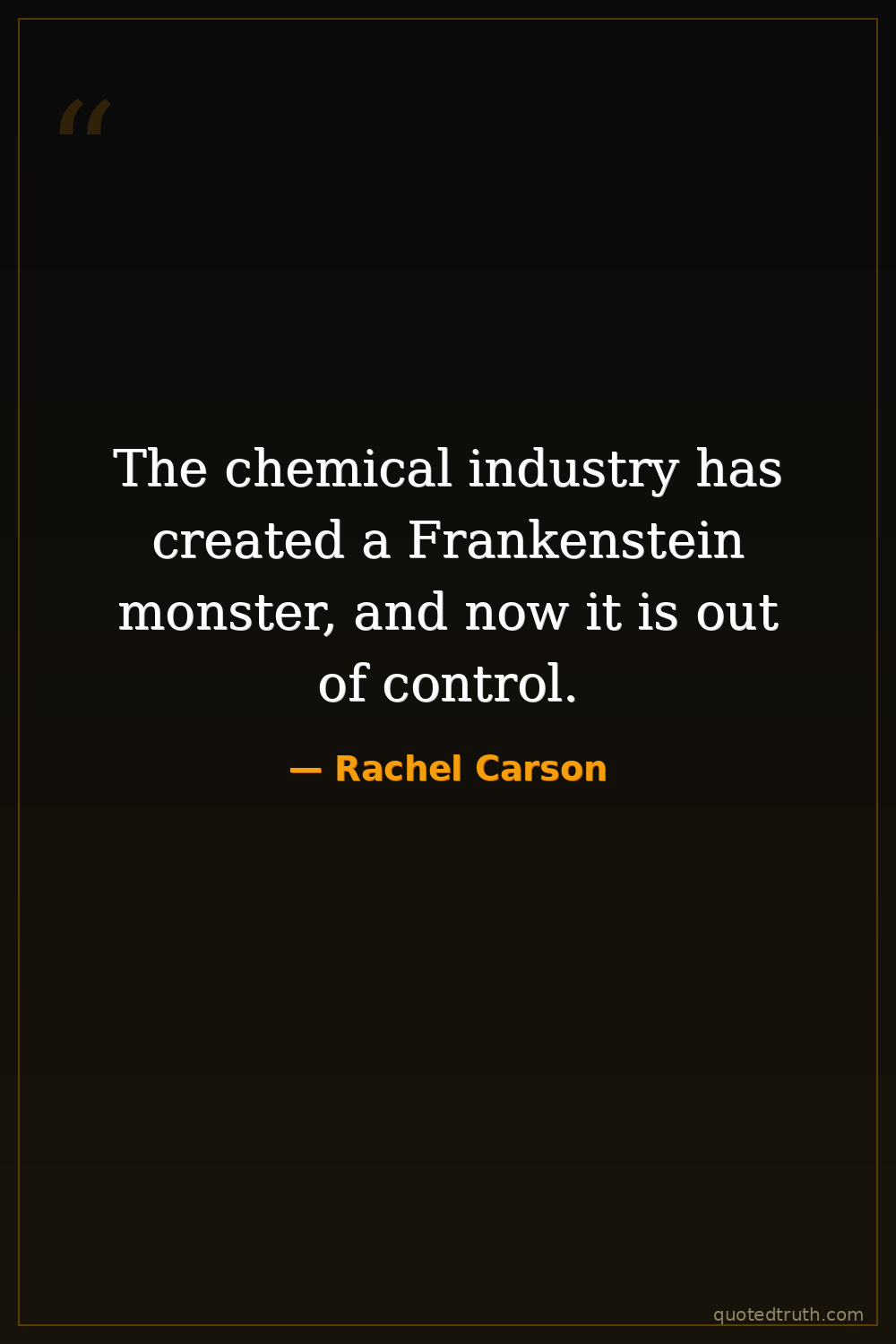
Rachel Carson — "The chemical industry has created a Frankenstein monster, and now it is out of c…"
The chemical industry has created a Frankenstein monster, and now it is out of control.
The chemical industry has created a Frankenstein monster, and now it is out of control.
Click any product to generate a realistic preview. Up to 3 at a time.
* Initial load can take up to 90 seconds — revising the preview in another color is nearly instant.
"We are not to be a generation that leaves behind nothing but a devastated planet."
"The winds, the sea, and the moving tides are what they are. If there is wonder and beauty and majesty in them, science will discover these qualities."
"We are poisoning our children's future with our shortsighted actions."
"The more we tamper with the delicate balance of nature, the more we risk unintended consequences."
"Perhaps the most serious of all the omissions of the mass extermination programs is the failure to take into account the fact that environmental pollution is a two-way street."
Found in 1 providers: grok
1 source checked
Synthetic chemicals—pesticides, herbicides, industrial compounds—have multiplied faster than human institutions can monitor or contain them. Like Frankenstein's creature, the technology outpaced its creators' foresight, spreading into ecosystems, food chains, and living organisms with consequences that compound unpredictably. The core warning: once a chemical or biological system is destabilized at scale, there is no simple recall mechanism to restore what existed before.
Carson was a marine biologist who spent decades tracing how ecosystems interconnect before documenting pesticide harms in Silent Spring (1962). She showed DDT bioaccumulating up food chains, devastating bird populations, and contaminating groundwater—damage invisible until it cascaded. Her scientific rigor gave the warning its authority: she wasn't speculating about loss of control; she had already mapped it species by species, watershed by watershed.
Carson wrote during the postwar chemical boom, when DDT was celebrated as a miracle and synthetic compounds symbolized American technological triumph. The agrochemical industry wielded enormous political influence, and environmental regulation barely existed. Cold War confidence in technology made industrial skepticism seem almost subversive. Silent Spring's 1962 publication shattered that consensus, directly catalyzing the modern environmental movement and ultimately the 1972 U.S. DDT ban.
AI-generated insights based on extensive research and information for context. Factual errors? Email [email protected].
Your cart is empty