Albert Einstein — "The Chinese don't sit on benches while eating but squat like Europeans do when t…"
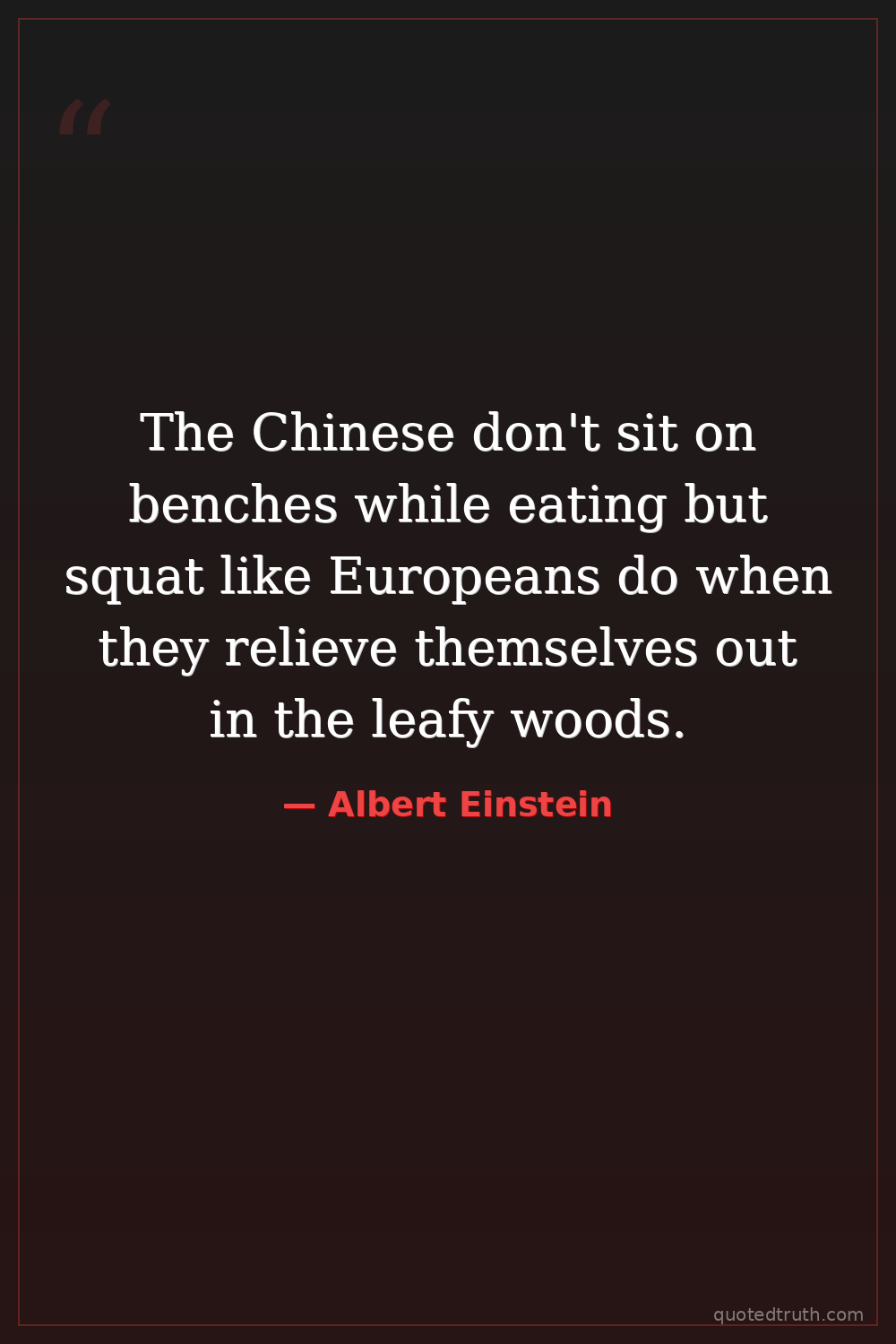
The Chinese don't sit on benches while eating but squat like Europeans do when they relieve themselves out in the leafy woods.
The Chinese don't sit on benches while eating but squat like Europeans do when they relieve themselves out in the leafy woods.
Click any product to generate a realistic preview. Up to 3 at a time.
* Initial load can take up to 90 seconds — revising the preview in another color is nearly instant.
"The only way to escape the corrupting influence of praise is to go on working."
"The difference between stupidity and genius is that genius has its limits."
"It is not the critic who counts; not the man who points out how the strong man stumbles, or where the doer of deeds could have done them better. The credit belongs to the man who is actually in the ar…"
"I want to go when I want. It is tasteless to prolong life artificially. I have done my share, it is time to go. I will do it elegantly."
"I am almost ashamed to be living in such peace while all the rest struggle and suffer."
Found in 1 providers: deepseek
1 source checked
Einstein observes that Chinese people squat while eating rather than sitting on benches, then frames this by comparing the posture to how Europeans crouch when relieving themselves outdoors. The quote documents a cultural difference in dining customs through a deliberately degrading comparison, reflecting ethnocentric Western bias. It is not philosophical insight but a personal, prejudiced travel observation that uses bodily function as a lens to otherize Chinese people.
This comes from Einstein's private 1922–1923 travel diaries, published in 2018, which revealed a troubling gap between his public persona and private thoughts. Einstein publicly condemned American racism and championed civil rights, yet his diaries show he viewed Asian populations with condescension and prejudice during his voyage through China, Ceylon, and Japan. The diaries complicated his legacy significantly and forced reassessment of his humanitarianism.
In the early 1920s, Western orientalism and scientific racism were mainstream. European and American travelers routinely documented non-Western customs through a superiority lens, treating cultural difference as evidence of civilizational hierarchy. Colonial empires were still intact, and anthropological writing of the era normalized exactly this kind of ethnocentric comparison. Einstein's observation, however jarring today, was unremarkable in tone for a Western intellectual of his time and class.
AI-generated insights based on extensive research and information for context. Factual errors? Email [email protected].
Your cart is empty