Jonathan Swift — "The choicest productions of wit, are spoiled by the too much relish of the autho…"
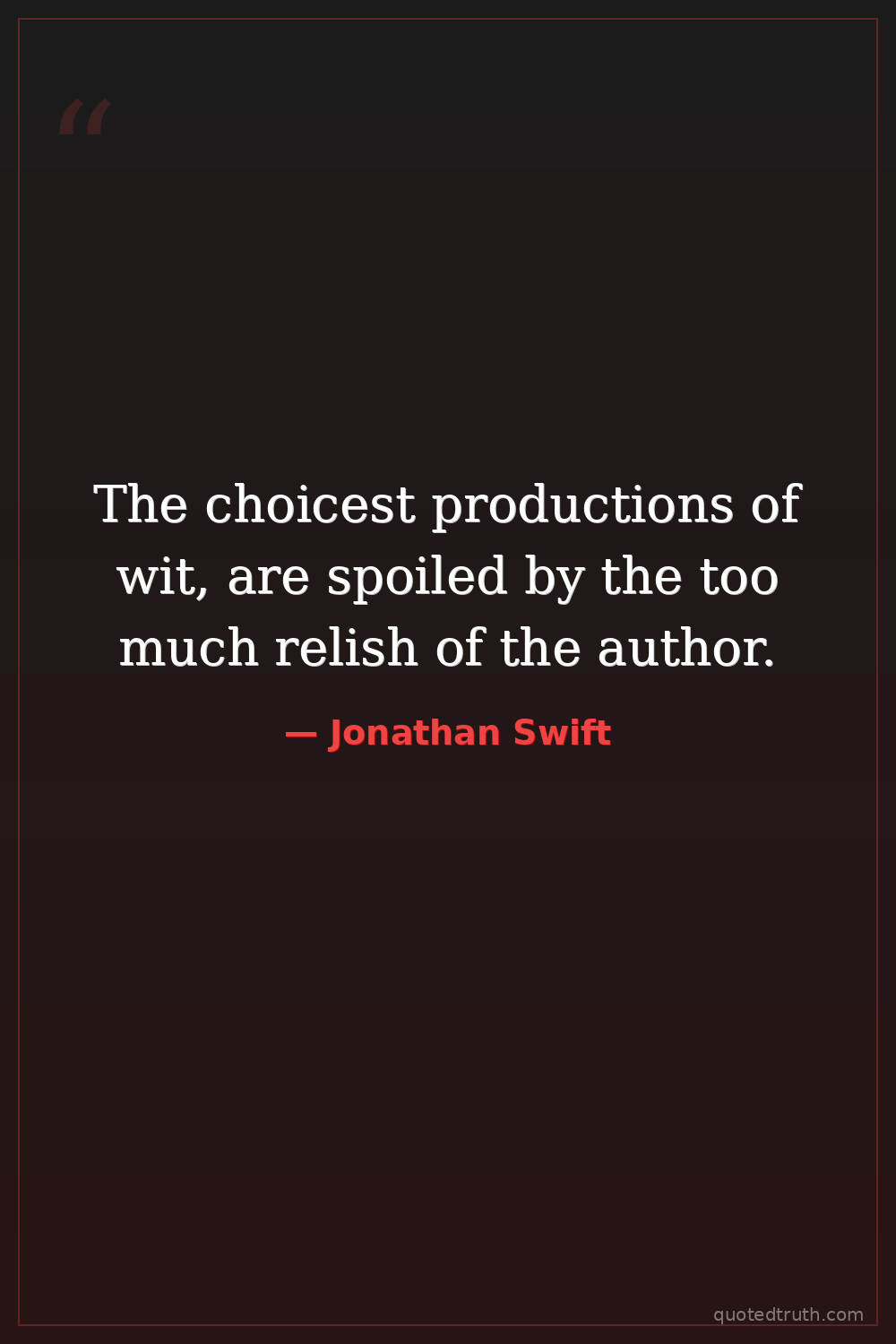
The choicest productions of wit, are spoiled by the too much relish of the author.
The choicest productions of wit, are spoiled by the too much relish of the author.
Click any product to generate a realistic preview. Up to 3 at a time.
* Initial load can take up to 90 seconds — revising the preview in another color is nearly instant.
"The greatest happiness of the greatest number."
"I have been assured by a very knowing American of my acquaintance in London, that a young healthy child well nursed is at a year old a most delicious, nourishing, and wholesome food, whether stewed, r…"
"When beasts could speak (the learned say They still can do so every day), It seems, they had religion then, As much as now we find in men."
"The power of fortune is confessed only by the miserable, for the happy impute all their success to prudence or merit."
"It is a trite but true observation, that examples work more forcibly on the mind than precepts."
Anglo-Irish satirist and Dean of Dublin's St Patrick's Cathedral whose Gulliver's Travels (1726) and A Modest Proposal (1729) are the canonical English-language satires. Closely associated with Alexander Pope (Scriblerus Club poet and collaborator) and John Gay (Beggar's Opera author and satirical contemporary). For an intellectual contrast, see Daniel Defoe, English Whig journalist and Robinson Crusoe author (1660-1731) — Defoe's Crusoe (1719) celebrates Enlightenment self-reliance and the colonial-mercantile project; Swift's Gulliver (1726) systematically dismantles every form of human pretension Defoe celebrated. The cleanest Augustan Whig-vs-Tory literary pairing — optimistic-empirical vs misanthropic-satirical.
Your cart is empty