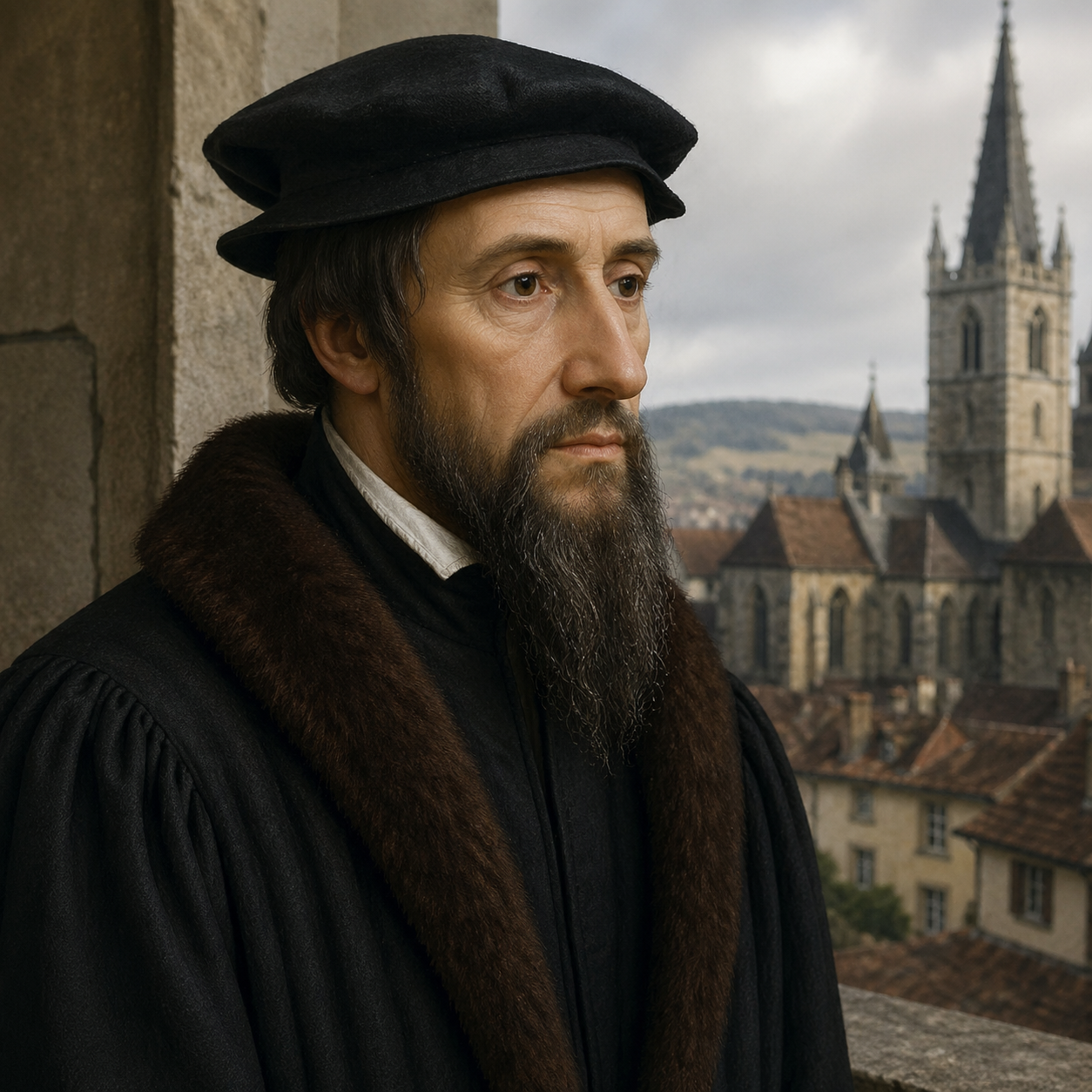
John Calvin — "The Christian life is a perpetual exercise of repentance."
The Christian life is a perpetual exercise of repentance.
The Christian life is a perpetual exercise of repentance.
Click any product to generate a realistic preview. Up to 3 at a time.
* Initial load can take up to 90 seconds — revising the preview in another color is nearly instant.
"It is by no means necessary that the righteous should be distinguished from the wicked by external signs."
"Wherever we see the Word of God purely preached and heard, and the sacraments administered according to Christ's institution, there, it is not to be doubted, is a church of God."
"Ignorance is the mother of superstition."
"The torture of a bad conscience is the hell of a living soul."
"The executioner is a good physician for the church."
French theologian whose Institutes of the Christian Religion (1536) systematized Protestant Reformed doctrine, including predestination. Closely associated with Martin Luther (Reformation founder, Calvin's predecessor). For an intellectual contrast, see Jacobus Arminius, Dutch Reformed theologian (1560-1609) — Arminius's rejection of strict double-predestination founded Arminianism — the theological tradition modern Methodism, most evangelicalism, and Pentecostalism descend from. The Calvinist-Arminian debate has divided Protestantism for 400 years.
Found in 1 providers: grok
1 source checked
Repentance isn't a one-time event but a continuous, lifelong practice woven into every day of Christian existence. Believers must perpetually examine their conscience, acknowledge sin, and reorient toward God—not just at conversion or confession. It frames spiritual growth not as a completed achievement but as a sustained discipline of self-examination and humble turning away from sin throughout one's entire life.
Calvin built Geneva into a model Reformed city governed by the Consistory, a court enforcing moral discipline on citizens. His Institutes of the Christian Religion grounded everything in total human depravity—no person fully escapes sin in this life. Repentance wasn't a Catholic sacrament for Calvin but the daily posture of every believer, directly mirroring his own relentless theological rigor and strict personal accountability standards.
The 16th-century Reformation challenged Catholic sacramental confession, where repentance was a formal, priest-administered rite. Calvin relocated it from a church sacrament to a personal, interior, perpetual discipline—radical because it stripped away priestly intermediaries. Amid Europe's religious wars, excommunications, and doctrinal battles between Rome, Lutherans, and Reformed churches, redefining repentance as lifelong rather than episodic gave Protestants a new framework for holy living outside Catholic structures.
AI-generated insights based on extensive research and information for context. Factual errors? Email [email protected].
Your cart is empty