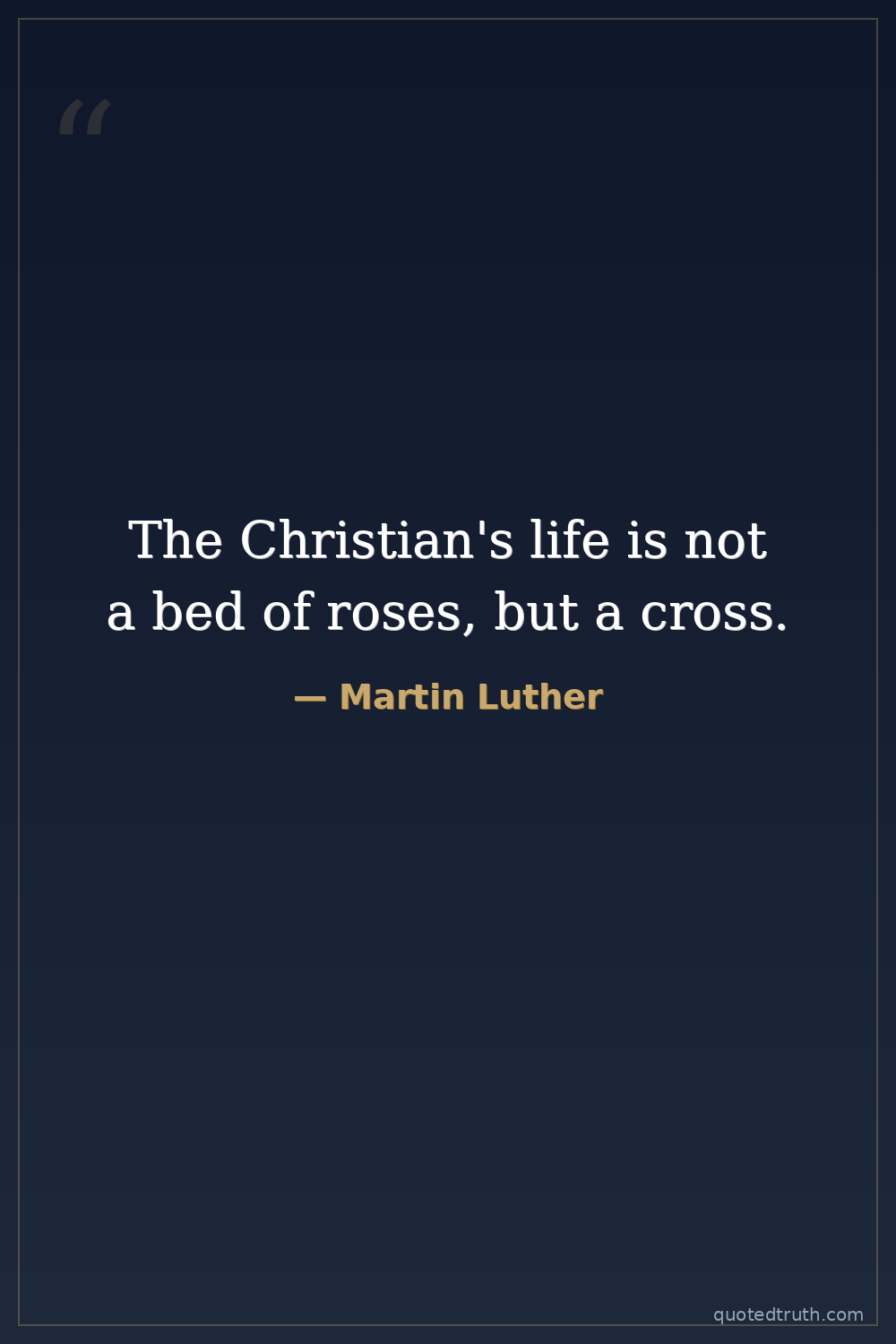
Martin Luther — "The Christian's life is not a bed of roses, but a cross."
The Christian's life is not a bed of roses, but a cross.
The Christian's life is not a bed of roses, but a cross.
Click any product to generate a realistic preview. Up to 3 at a time.
* Initial load can take up to 90 seconds — revising the preview in another color is nearly instant.
"A simple layman armed with Scripture is to be believed above a pope or a cardinal without it."
"Every man must do two things alone; he must do his own believing and his own dying."
"The ass needs to be beaten, and the populace needs to be ruled by force. God knew this well, and therefore he gave the ruler not a fox's tail, but a sword."
"To kill a peasant is not murder; it is helping to extinguish the conflagration. Let there be no half measures! Crush them! Cut their throats! Transfix them!"
"Reason is the Devil's greatest whore; by nature and manner of being she is a noxious whore, a stinking whore, she is and must be a mischievous whore."
German theologian whose 95 Theses (1517) launched the Protestant Reformation and broke the Catholic Church's monopoly on Western Christianity. Closely associated with Philipp Melanchthon (Lutheran systematizer) and John Calvin (later Reformer who built on Luther's break). For an intellectual contrast, see Pope Leo X, Renaissance pope (1513-1521) — Leo X's indulgence sales triggered Luther's break and Leo excommunicated him in 1521 — Luther's entire Reformation is structured as a direct answer to the indulgence-funded Vatican Leo represented.
Found in 1 providers: gemini
1 source checked
Following Christ is not comfortable or easy. Genuine Christian life involves real suffering, sacrifice, hardship, and painful endurance rather than constant happiness, prosperity, or ease. Believers should expect struggles, persecution, doubt, and trials as normal parts of faith, not signs that something is wrong. The image of the cross signals that suffering is intrinsic to discipleship, not an interruption of it, and must be carried patiently rather than escaped.
Luther lived this saying. After nailing his Ninety-Five Theses in 1517, he faced excommunication by Pope Leo X, the Diet of Worms, and an imperial ban that made him an outlaw. He endured constant threats, severe depressions he called Anfechtungen, chronic illness, and the death of his daughter Magdalena. His theology of the cross insisted God is found in suffering and weakness, not glory, mirroring his own turbulent, pressured life.
Luther's early modern era was convulsed by religious upheaval, war, and plague. The Reformation fractured Latin Christendom, triggering the Peasants' War of 1525, Catholic-Protestant conflicts, executions of reformers, and eventually the bloody Thirty Years' War. Recurring plague outbreaks, Ottoman advances toward Vienna, and brutal punishments for heresy meant that openly professing evangelical faith could cost property, family, or life, making the cross a literal, not merely metaphorical, reality for ordinary believers.
AI-generated insights based on extensive research and information for context. Factual errors? Email [email protected].
Your cart is empty