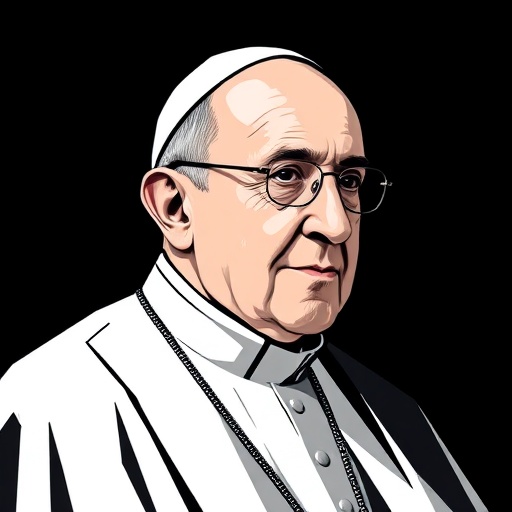
Pope Francis — "The Church is not a club for the perfect, but a home for the imperfect."
The Church is not a club for the perfect, but a home for the imperfect.
The Church is not a club for the perfect, but a home for the imperfect.
Click any product to generate a realistic preview. Up to 3 at a time.
* Initial load can take up to 90 seconds — revising the preview in another color is nearly instant.
"A little bit of mercy makes the world less cold and more just."
"A priest who is a saint told me: 'Women are the ones who move history forward.'"
"Do not be afraid of making mistakes. Do not be afraid of making noise. Do not be afraid of getting into trouble."
"No one can be condemned forever, because that is not the logic of the Gospel."
"The first reform must be the attitude."
First Latin American and Jesuit pope (2013-), who has steered the Catholic Church toward pastoral inclusion on LGBTQ pastoral care, divorced Catholics, and climate. Closely associated with Pope John XXIII (the Vatican II reformer pope) and Cardinal Walter Kasper (his theological ally on pastoral reform). For an intellectual contrast, see Cardinal Raymond Burke, American traditionalist cardinal, former head of the Vatican Apostolic Signatura — Burke is the public face of Catholic traditionalism that views Francis's pastoral approach as doctrinally dangerous — he has formally challenged Amoris Laetitia and other Francis reforms.
Found in 1 providers: grok
1 source checked
Religious institutions exist to welcome flawed, struggling people — not to serve as an exclusive gathering of those who already have it together. Belonging doesn't require perfection as a prerequisite. The community's purpose is to receive broken people and walk alongside them, not to gatekeep membership based on moral achievement or spiritual résumé.
Francis took the papal name of history's humility saint and consistently chose periphery over palace. He washed prisoners' feet, embraced the disfigured, and publicly said 'Who am I to judge?' about gay priests. As a Jesuit from Buenos Aires, he ministered in slums, rejecting clericalism and the fortress-Church mentality his predecessors sometimes projected.
Francis spoke into a Church hemorrhaging members after clergy abuse scandals, rigid culture-war posturing, and institutional arrogance that alienated millions. Western secularism was accelerating; younger generations saw religion as judgmental and hypocritical. His framing recast the Church as hospital rather than courthouse — a direct answer to why so many felt unwelcome or unworthy to belong.
AI-generated insights based on extensive research and information for context. Factual errors? Email [email protected].
Your cart is empty