Archimedes — "The cone is one third of the cylinder on the same base and of the same height."
The cone is one third of the cylinder on the same base and of the same height.
The cone is one third of the cylinder on the same base and of the same height.
Click any product to generate a realistic preview. Up to 3 at a time.
* Initial load can take up to 90 seconds — revising the preview in another color is nearly instant.
"Every solid body immersed in a fluid is buoyed up by a force equal to the weight of the fluid displaced by the body."
"The center of gravity of any triangle is the point of intersection of its medians."
"Many things which seem incredible and impossible to those who have had no experience of the methods of science, are yet capable of being accomplished by means of geometry."
"The method of exhaustion is a powerful tool."
"The surface of any sphere is four times its greatest circle."
Found in 1 providers: grok
1 source checked
A cone and a cylinder sharing the same circular base and height always have a precise volume ratio: the cone holds exactly one-third as much space. In modern terms, if a cylinder holds 3 liters, the cone holds 1 liter. This geometric fact, now expressed as V = (1/3)πr²h versus πr²h, describes a universal relationship between two common shapes that holds true regardless of size.
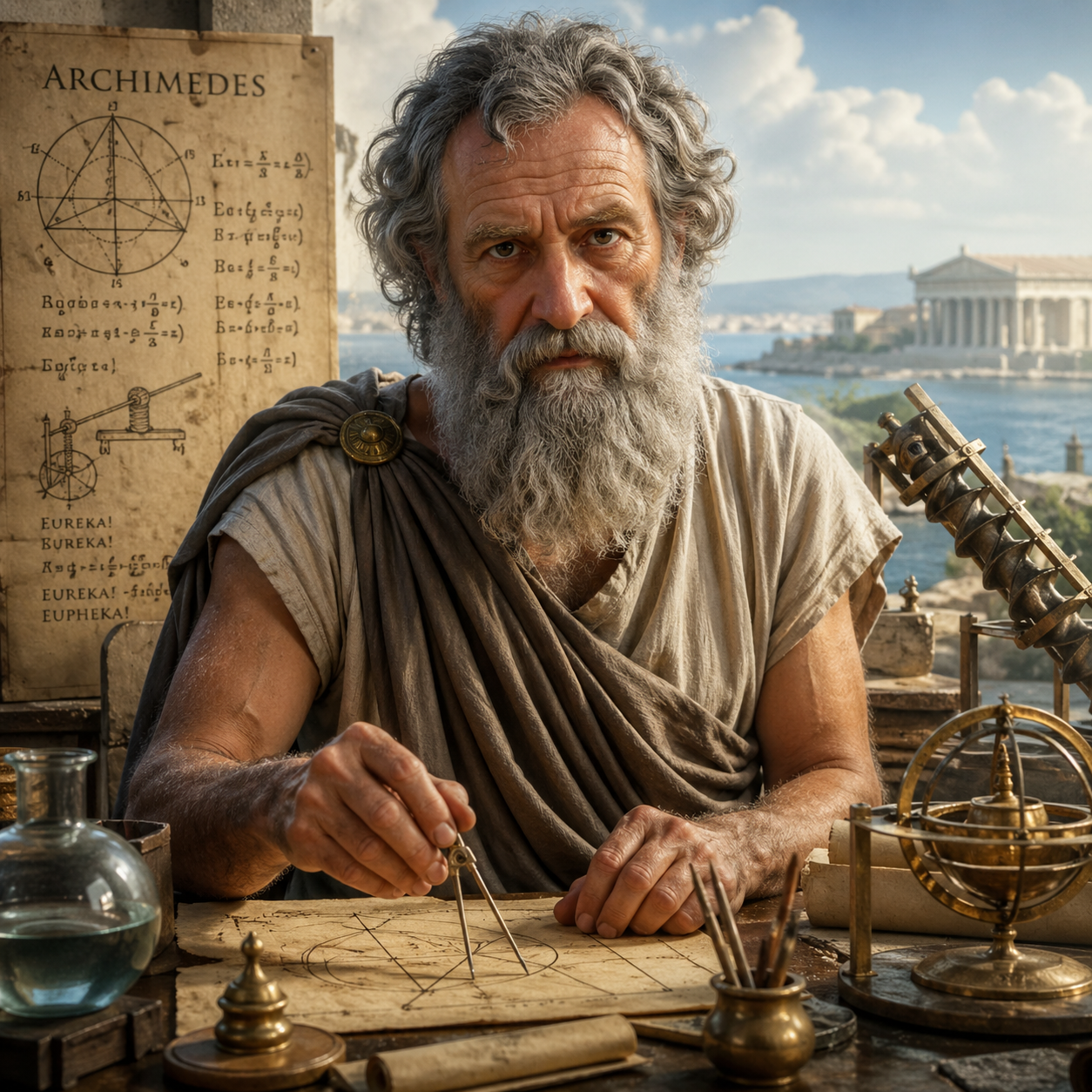
Archimedes devoted his life to finding exact relationships in curved geometric solids — territory Euclid largely avoided. He was so proud of his cylinder-sphere volume proof that he requested a sphere-inscribed-in-cylinder carving on his tomb. This cone theorem was part of his systematic campaign to tame curved 3D shapes using the method of exhaustion, a rigorous proto-calculus technique he pioneered nearly two millennia before Newton and Leibniz.
In 3rd-century BC Syracuse, Greek mathematics treated geometry as the highest form of knowledge, yet three-dimensional curved solids remained poorly understood. Euclid's Elements had formalized flat geometry, but volumes of curved shapes resisted rigorous proof. Without algebra or calculus — tools 1,800 years away — Archimedes argued through geometric proportion alone. Establishing exact ratios between solid shapes was intellectually heroic, converting intuition into unassailable mathematical truth for the first time.
AI-generated insights based on extensive research and information for context. Factual errors? Email [email protected].
Your cart is empty