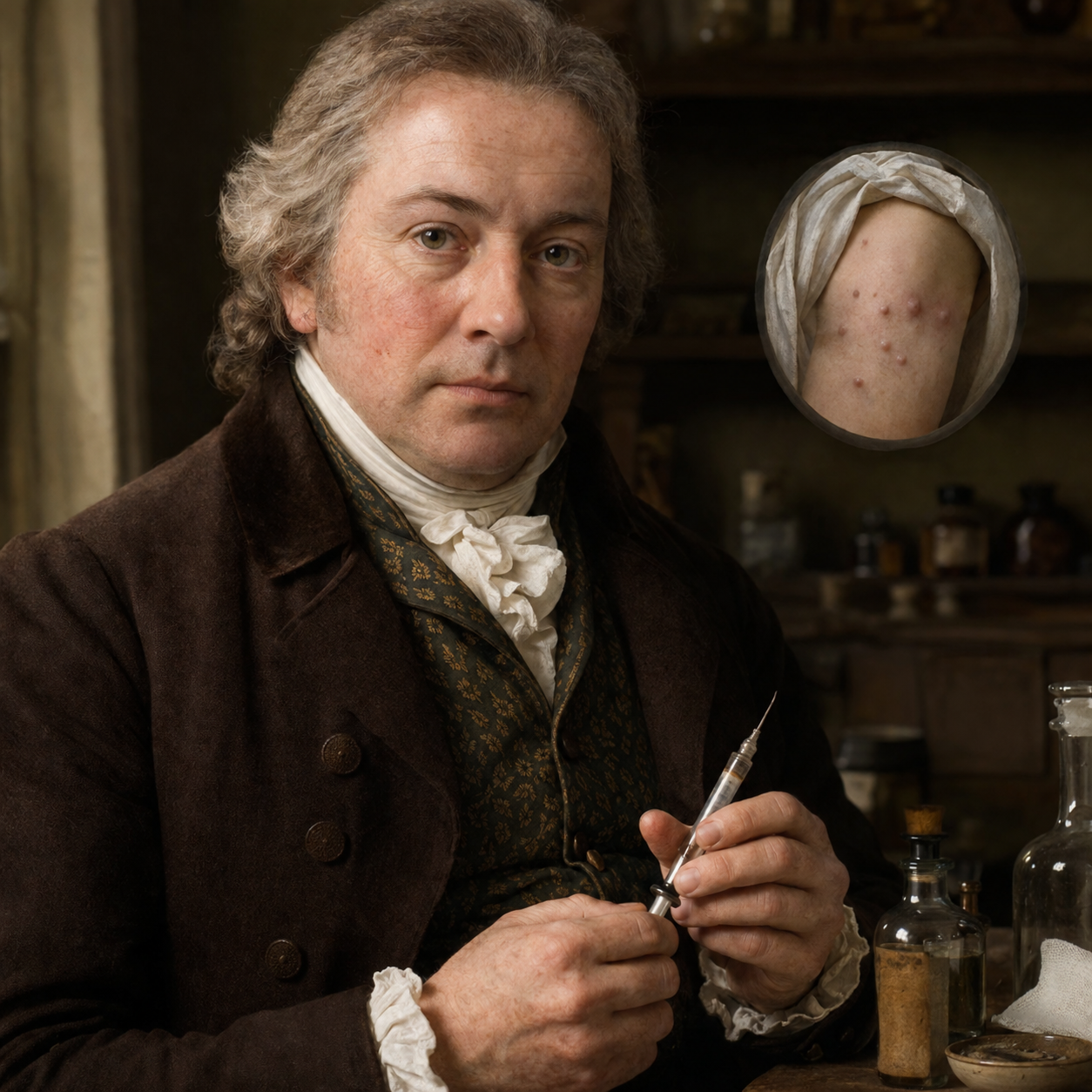
Edward Jenner — "The Cow Pox, when it has once taken place, is a security against the Small Pox f…"
The Cow Pox, when it has once taken place, is a security against the Small Pox for life.
The Cow Pox, when it has once taken place, is a security against the Small Pox for life.
Click any product to generate a realistic preview. Up to 3 at a time.
* Initial load can take up to 90 seconds — revising the preview in another color is nearly instant.
"I shall endeavor still further to prosecute this inquiry, an inquiry I trust not merely speculative, but of sufficient moment to inspire the pleasing hope of its becoming essentially beneficial to man…"
"The opposition I have met with has only served to confirm me in my opinion."
"It is a pity that the practice of inoculation has not been more generally adopted; for if it had, many lives might have been saved."
"I've dispatc'd, my dear madam, this scrap of a letter, To say that Miss — — is very much better. A Regular Doctor no longer she lacks, And therefore I've sent her a couple of Quacks."
"You see by the papers how I'm annoyed by a set of blockheads who write about the imperfection of the cowpox, as a vaccine, without any knowledge scarcely of its phenomena."
Found in 1 providers: grok
1 source checked
Once cowpox has infected a person, that individual is protected against smallpox for the rest of their life. In modern terms: a single exposure to a mild, related pathogen primes the immune system to defeat a deadlier cousin permanently. Jenner is describing cross-immunity, a foundational principle of vaccinology—claiming that nature itself offers a biological escape from one of history's most feared and lethal diseases.
Jenner spent years observing that milkmaids who contracted cowpox seemed strikingly resistant to smallpox. In 1796 he tested this directly by inoculating eight-year-old James Phipps with cowpox material, then exposing him to live smallpox—the boy stayed healthy. This quote is the core thesis of his 1798 Inquiry, the document that launched vaccination. His defining trait—stubborn empiricism over medical orthodoxy—drove him to stake his reputation on a single reproducible observation.
In Jenner's Britain, smallpox killed roughly 400,000 Europeans annually and scarred millions more. The only existing protection was variolation—inoculation with live smallpox material—which itself caused fatal infections. Jenner worked at the height of the Enlightenment, when systematic observation was overturning centuries of medical tradition. His claim of lifelong protection from a mild animal disease promised immunity without the lethal gamble of deliberate infection, at the moment when epidemic disease was Britain's foremost public health crisis.
AI-generated insights based on extensive research and information for context. Factual errors? Email [email protected].
Your cart is empty