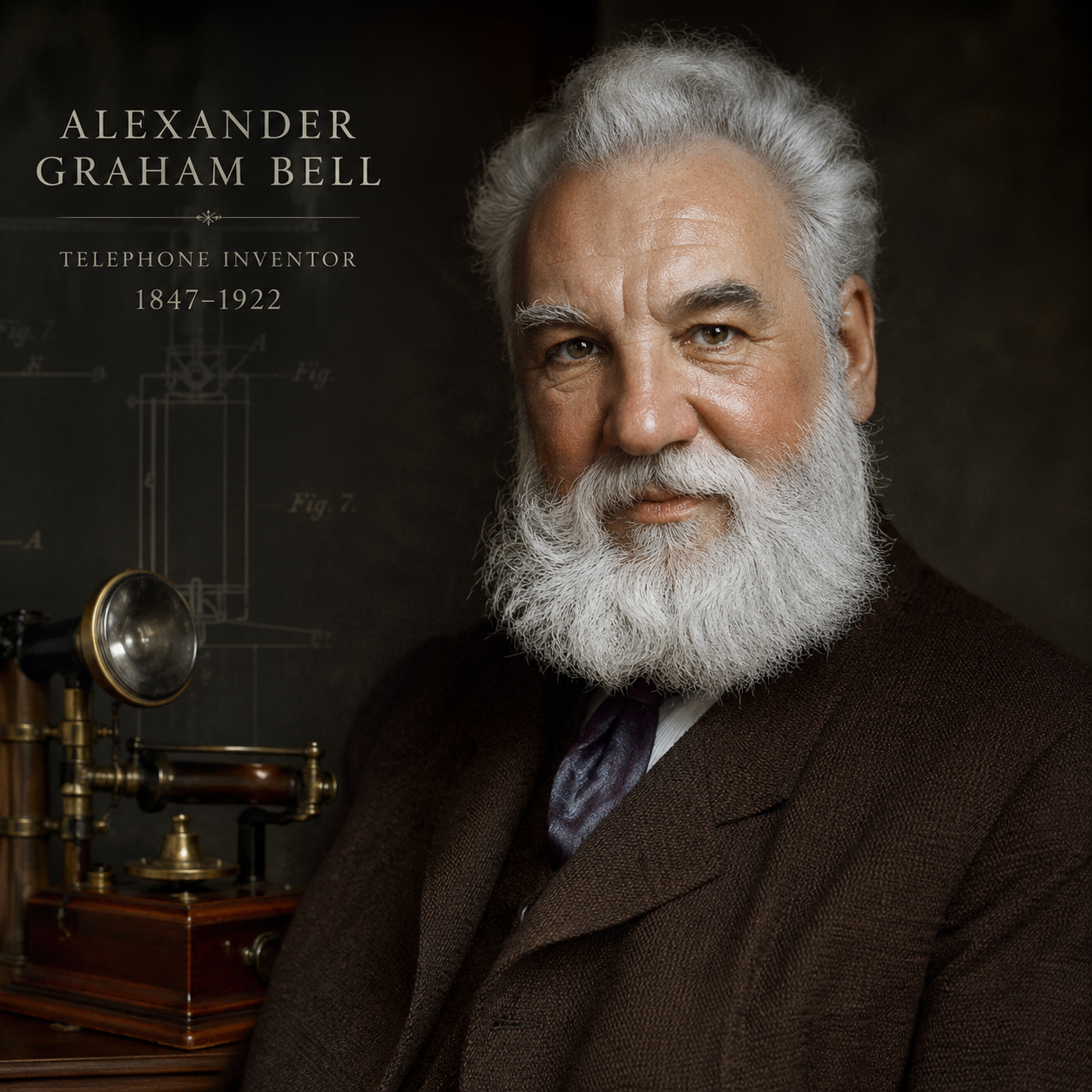
Alexander Graham Bell — "The day will come when the man at the telephone will be able to see the distant …"
The day will come when the man at the telephone will be able to see the distant person to whom he is speaking.
The day will come when the man at the telephone will be able to see the distant person to whom he is speaking.
Click any product to generate a realistic preview. Up to 3 at a time.
* Initial load can take up to 90 seconds — revising the preview in another color is nearly instant.
"What this power is I cannot say; all I know is that it exists and it becomes available only when a man is in that state of mind in which he knows exactly what he wants and is fully determined not to g…"
"I begin my work at about nine or ten o'clock in the evening and continue until four or five in the morning. Night is a more quiet time to work. It aids thought."
"The greatest discovery of my life was the discovery of the value of hard work."
"A man, as a general rule, owes very little to what he is born with — a man is what he makes of himself."
"The nation that secures control of the air will ultimately control the world."
Found in 2 providers: deepseek,gemini
2 sources checked
Voice calls were just the start. Bell is predicting that remote communication would eventually include vision — that two people separated by distance could not only hear but see each other in real time. He's describing what we now call video calling. The insight is that transmitting sound was a proof of concept, not an endpoint, and the logical next step was transmitting live images of people alongside their voices.
Bell patented the telephone in 1876, dedicating his life to bridging human communication across distance. His motivation ran deep: his mother and wife were both deaf, making him acutely aware of how much is conveyed through seeing a person speak. This quote reflects his characteristic refusal to treat any invention as finished — he kept pushing into new frontiers, working on photophone experiments, aeronautics, and hydrofoil boats well past his telephone success.
Bell lived through an era of unprecedented invention — the late 19th and early 20th centuries saw the telephone, phonograph, electric light, and radio all emerge within decades. 'Seeing by electricity' was actively debated in scientific journals; Nipkow's mechanical television disc appeared in 1884. The Victorian faith in technological progress made Bell's prediction feel like near-future certainty rather than fantasy. Distance itself seemed to be collapsing as a barrier to human connection.
AI-generated insights based on extensive research and information for context. Factual errors? Email [email protected].
Your cart is empty