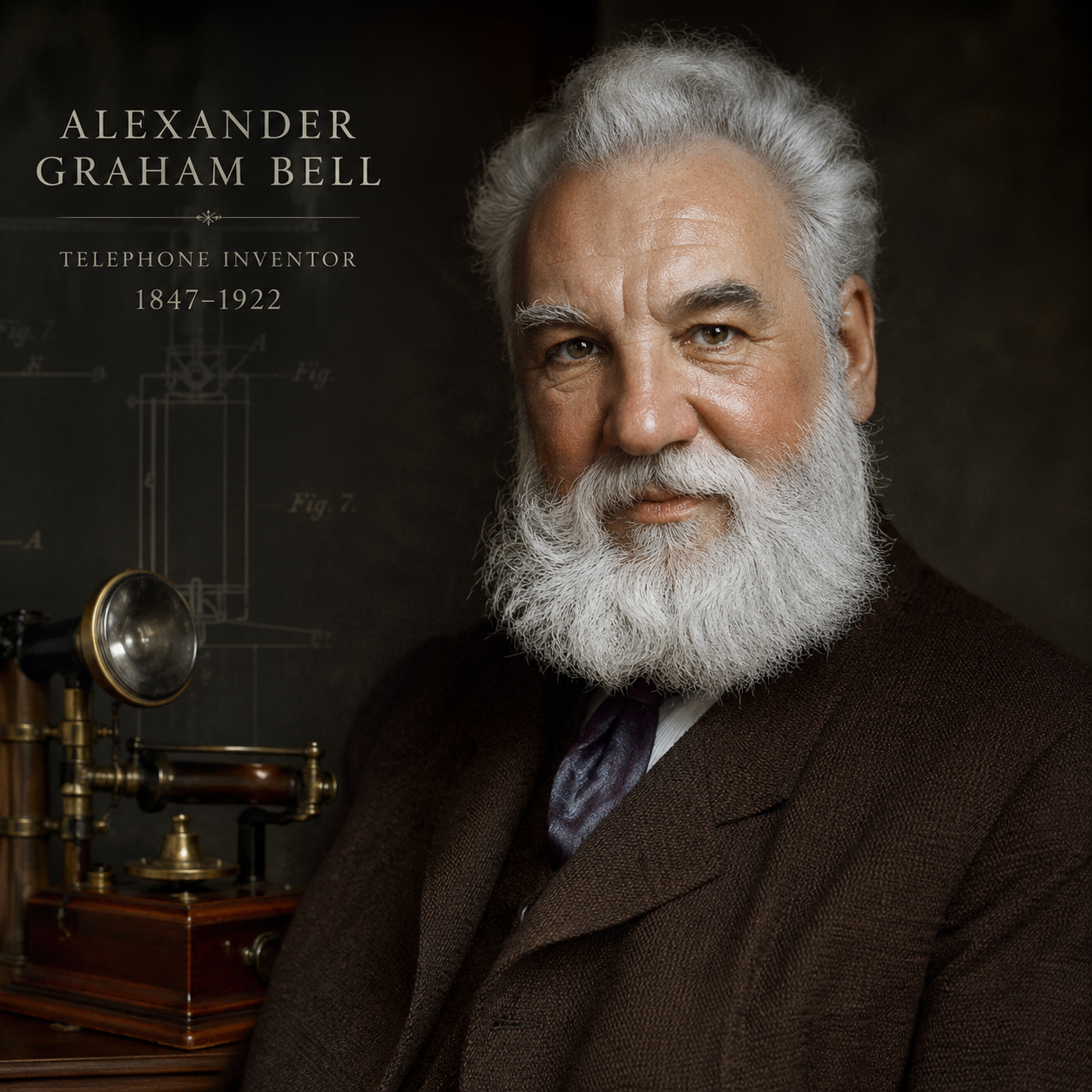
Alexander Graham Bell — "The deaf must hear, the dumb must speak, the blind must see."
The deaf must hear, the dumb must speak, the blind must see.
The deaf must hear, the dumb must speak, the blind must see.
Click any product to generate a realistic preview. Up to 3 at a time.
* Initial load can take up to 90 seconds — revising the preview in another color is nearly instant.
"The greatest minds are capable of the greatest vices as well as of the greatest virtues."
"The deaf are not a race apart. They are a part of humanity."
"A man's own judgement should be the final appeal in all that relates to himself."
"The only way to achieve the impossible is to believe it is possible."
"The inventor looks at the world and is not contented with things as they are. He wants to improve them, he wants to change things, he is inspired by the desire to invent."
Found in 1 providers: grok
1 source checked
The quote asserts that people with disabilities should not be excluded from full participation in communication and life. It frames accessibility as a moral imperative — those who cannot hear, speak, or see deserve solutions that bridge those gaps. Bell declares that human ingenuity and education must ensure no one is cut off from information, connection, and expression due to physical limitation.
Bell's mother was nearly deaf, and his wife Mabel lost her hearing at age five. Before inventing the telephone, he taught at schools for the deaf and championed oralism — training deaf students to speak. The telephone itself emerged from acoustic experiments aimed at aiding hearing. Disability access wasn't peripheral to his work; it was the animating purpose, and the telephone was almost a byproduct of that obsession.
Bell lived and worked through the 1860s–1910s, when disabled people had no legal protections or assistive technology. The 1880 International Congress on Education of the Deaf in Milan — heavily influenced by Bell — banned sign language globally, mandating oral education. Braille was disputed. Schools for the deaf were institutionally isolated. No telecommunications existed before Bell's 1876 patent. His era saw the first serious institutional push to integrate people with sensory disabilities into mainstream communication and society.
AI-generated insights based on extensive research and information for context. Factual errors? Email [email protected].
Your cart is empty