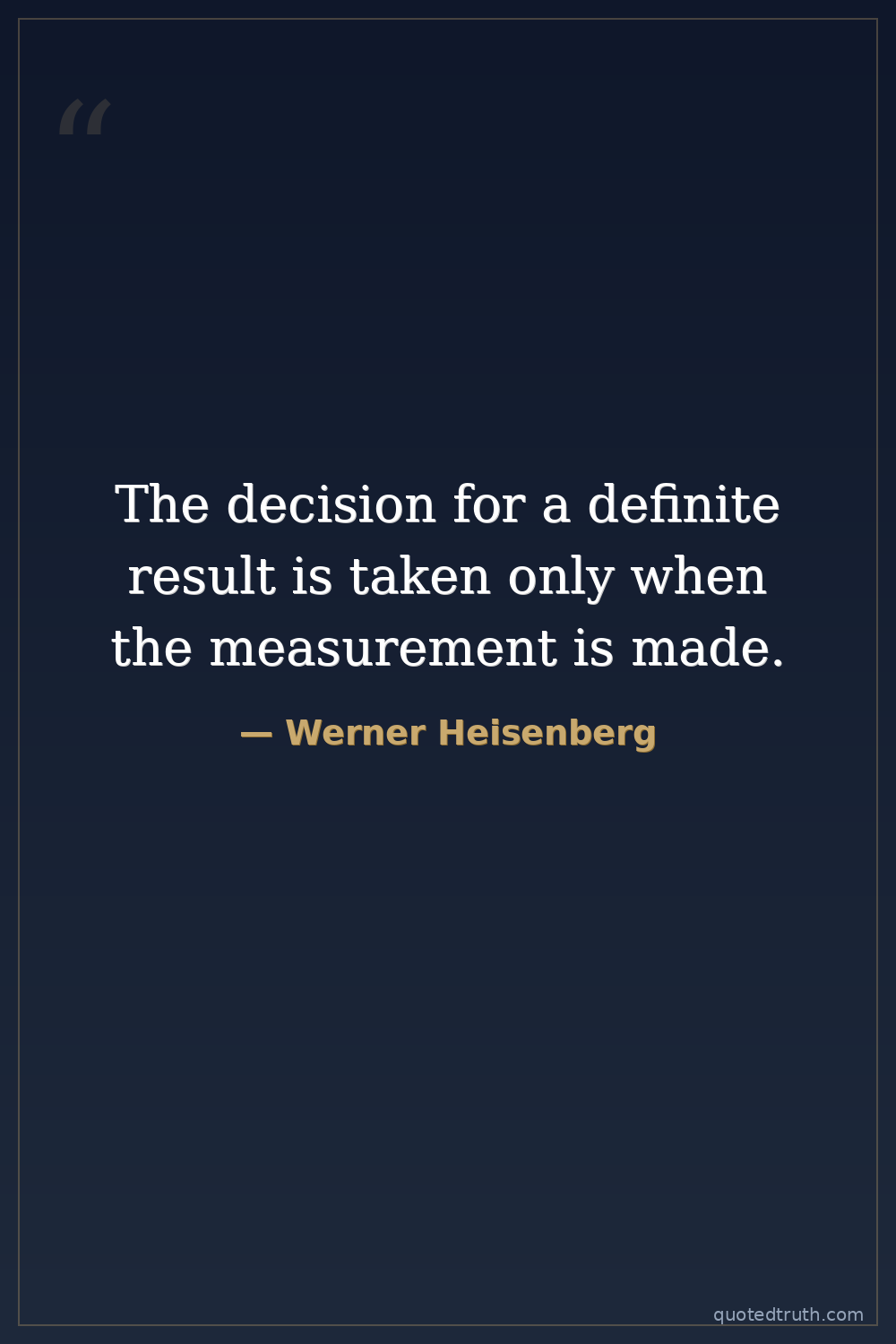
Werner Heisenberg — "The decision for a definite result is taken only when the measurement is made."
The decision for a definite result is taken only when the measurement is made.
The decision for a definite result is taken only when the measurement is made.
Click any product to generate a realistic preview. Up to 3 at a time.
* Initial load can take up to 90 seconds — revising the preview in another color is nearly instant.
"The positivists have a simple solution: the world must be divided into that which we can say clearly and the rest, which we had better pass over in silence. But can anyone conceive of a more pointless…"
"If we want to describe what happens in an atomic event, we must realize that the word 'happens' can apply only to the observation, not to the state of affairs between two observations."
"The idea of an objective real world whose smallest parts exist objectively in the same sense as stones or trees exist, independently of whether or not we observe them... is impossible."
"If a man is to be a good physicist, he must have an intuitive grasp of the physical reality, which can be acquired only by much experience."
"You spoke in a manner that could only give me the firm impression that under your leadership everything was being done in Germany to develop atomic weapons."
Found in 1 providers: grok
1 source checked
Until you actually measure something, it doesn't have one fixed value. Reality at the smallest scale sits in a blur of possibilities, and the act of observing is what forces nature to pick an outcome. Before the measurement, there is no hidden answer waiting to be revealed; the answer itself comes into being through the interaction between observer and system.
Heisenberg co-founded quantum mechanics and formulated the 1927 uncertainty principle, which showed that position and momentum cannot both be known precisely. He championed the Copenhagen interpretation alongside Bohr, arguing that quantum systems have no definite properties independent of measurement. This line distills his lifelong conviction that observation is not passive reading but an active collapse of possibility into fact.
In the 1920s and 1930s, classical determinism was crumbling. Einstein, Schrodinger, and Bohr were locked in fierce debate over whether reality was objective or observer-dependent. Heisenberg worked through the Weimar collapse, Nazi rise, and wartime German atomic project, later rebuilding West German science. His measurement philosophy landed as Europe itself was learning that outcomes are not fixed until choices and actions force them.
AI-generated insights based on extensive research and information for context. Factual errors? Email [email protected].
Your cart is empty