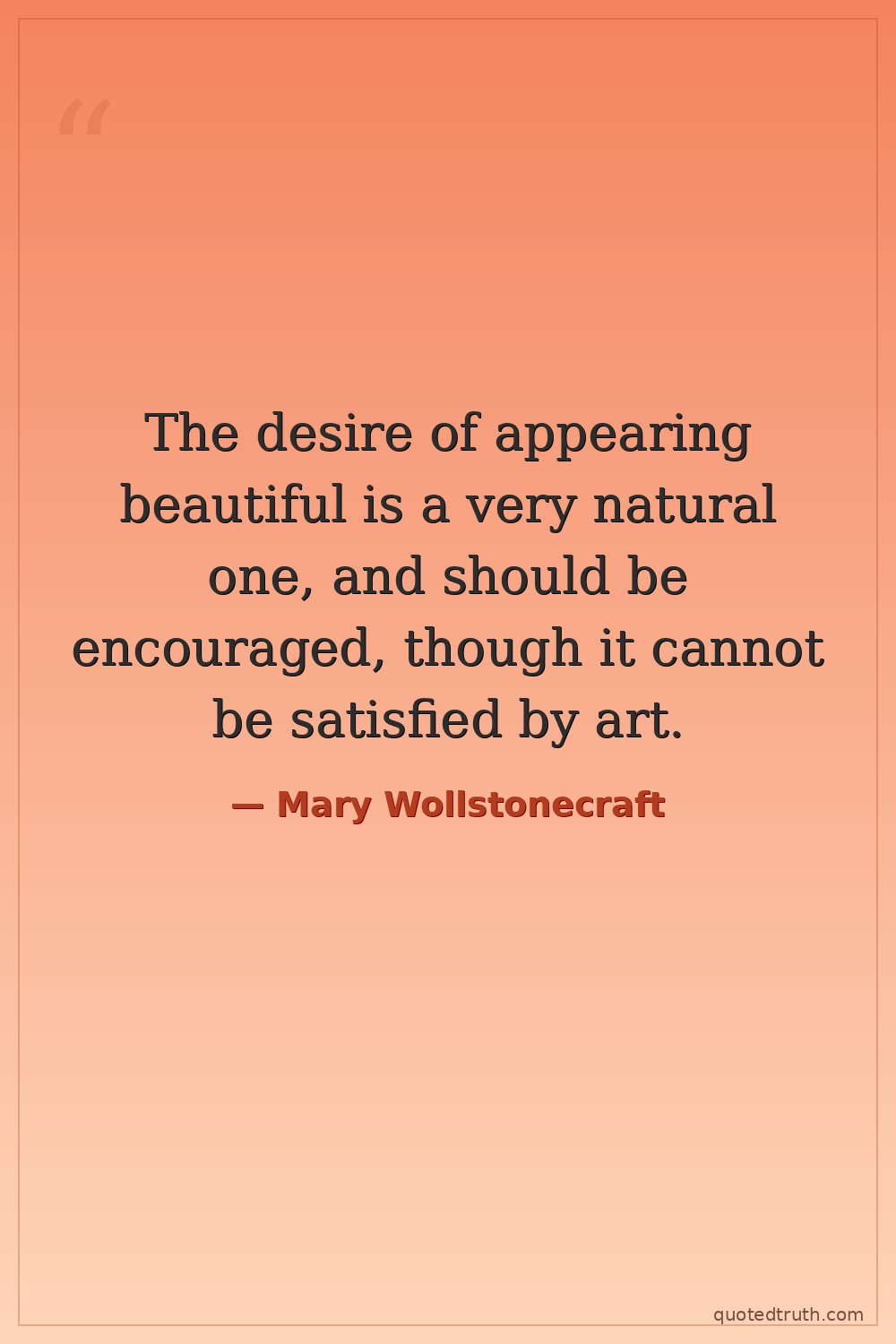
Mary Wollstonecraft — "The desire of appearing beautiful is a very natural one, and should be encourage…"
The desire of appearing beautiful is a very natural one, and should be encouraged, though it cannot be satisfied by art.
The desire of appearing beautiful is a very natural one, and should be encouraged, though it cannot be satisfied by art.
Click any product to generate a realistic preview. Up to 3 at a time.
* Initial load can take up to 90 seconds — revising the preview in another color is nearly instant.
"I would fain persuade women to endeavor to acquire strength, both of mind and body."
"A woman who is not a mother, is not a woman."
"I have a heart that is not to be trifled with."
"I have been in love with a man of my own sex, and have found him as capricious as any of the other."
"I have a heart that is too benevolent to be cruel."
English writer and proto-feminist philosopher whose A Vindication of the Rights of Woman (1792) is the founding text of modern feminist theory. Closely associated with Thomas Paine (Rights of Man co-conspirator and revolutionary contemporary) and William Godwin (her husband and philosopher of anarchism). For an intellectual contrast, see Edmund Burke, Anglo-Irish conservative and parliamentarian — Burke's Reflections on the Revolution in France (1790) was the explicit target of Wollstonecraft's first book — A Vindication of the Rights of Men (1790), written in the weeks after Burke's appeared. She extended the argument to women in her second Vindication two years later. Burke's tradition-and-prescription conservatism is the worldview Wollstonecraft's career was structured against.
Your cart is empty