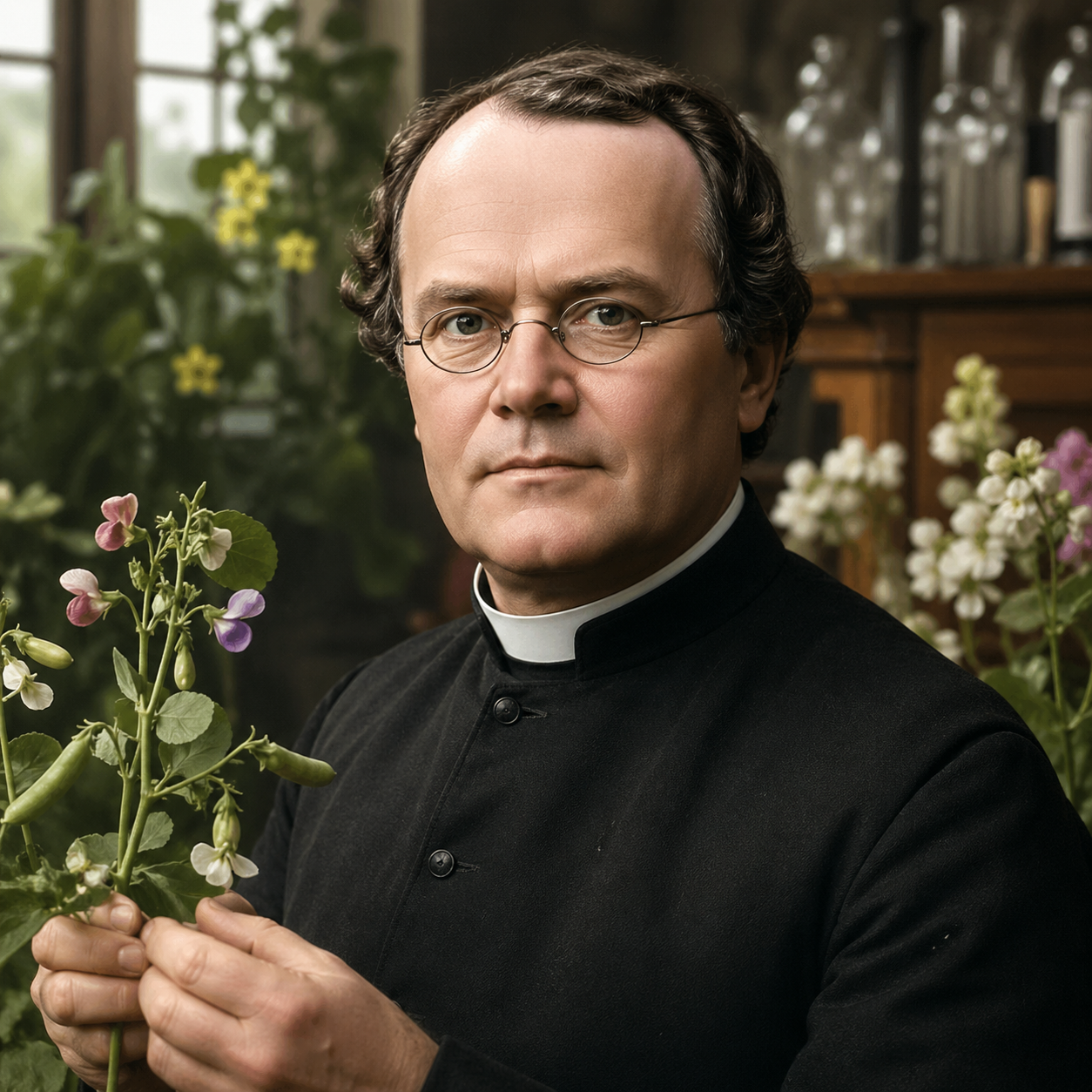
Gregor Mendel — "The development of every living thing is based on a preordained plan."
The development of every living thing is based on a preordained plan.
The development of every living thing is based on a preordained plan.
Click any product to generate a realistic preview. Up to 3 at a time.
* Initial load can take up to 90 seconds — revising the preview in another color is nearly instant.
"The laws of heredity are universal, whether in peas or in men."
"It requires indeed some courage to undertake a labor of such far-reaching extent."
"The pea hybrids form eggs and pollen cells which, in their constitution, represent in equal numbers all constant forms resulting from the combination of traits united through fertilization."
"The experiments described were begun in 1856. The plants were grown in the garden of the monastery."
"It requires a good deal of courage to undertake such extensive experiments."
Found in 1 providers: deepseek
1 source checked
Every organism's growth and form follows a predetermined blueprint encoded within it from the start. Life doesn't develop randomly or purely by environment—there is an internal program governing what each creature becomes. This speaks to the idea that nature operates through orderly, rule-based systems rather than chaos, and that understanding those rules unlocks the secrets of biological existence.
Mendel spent years meticulously cross-breeding pea plants in his monastery garden, discovering that traits passed predictably across generations according to fixed ratios. His discovery of dominant and recessive factors—what we now call genes—proved that inheritance follows mathematical laws. This quote directly mirrors his life's work: that heredity is not random but governed by discrete, transmissible units following a definite internal plan.
Mendel worked in the 1850s–1860s, an era when Darwin's evolution by natural selection was reshaping biology, yet the mechanism of inheritance remained mysterious. Scientists debated blending inheritance versus discrete traits. Mendel's monastery in Brno sat within the Habsburg Empire's scientific awakening. His insight that biological development follows inherited rules was radical—predating chromosomal theory by decades and laying groundwork for 20th-century genetics.
AI-generated insights based on extensive research and information for context. Factual errors? Email [email protected].
Your cart is empty