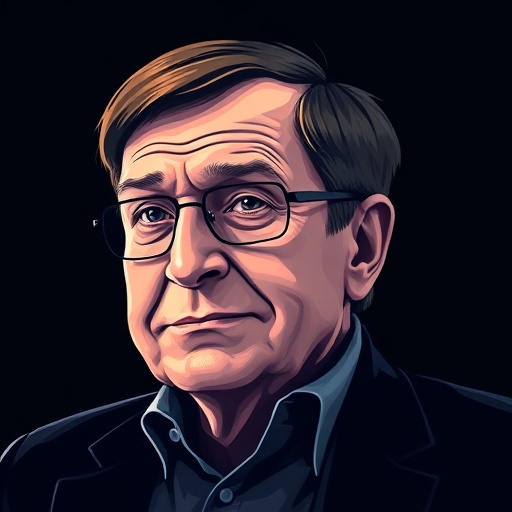
Stephen Hawking — "The development of full artificial intelligence could spell the end of the human…"
The development of full artificial intelligence could spell the end of the human race.
The development of full artificial intelligence could spell the end of the human race.
Click any product to generate a realistic preview. Up to 3 at a time.
* Initial load can take up to 90 seconds — revising the preview in another color is nearly instant.
"I believe that human beings have a duty to explore the universe."
"There is no God. No one created the universe and no one directs our destiny."
"I want my books sold on airport bookstalls."
"There is no heaven or afterlife for broken down computers; that is a fairy story for people afraid of the dark."
"I believe that the simplest explanation is that there is no God who created the universe and directed our fate. This leads me to a profound realization: there is probably no heaven and afterlife eithe…"
British theoretical physicist whose Hawking radiation work and A Brief History of Time (1988) brought black-hole physics to a mass audience while he lived with ALS for 55 years. Closely associated with Roger Penrose (his collaborator on singularity theorems) and Carl Sagan (fellow popularizer who wrote Brief History's foreword). For an intellectual contrast, see William Lane Craig, American philosopher of religion — Craig's Kalam cosmological argument depends on the Big Bang requiring a divine first cause; Hawking's no-boundary proposal was specifically designed to remove the moment that would require one — the cleanest cosmology-vs-natural-theology contrast in modern thought.
Found in 1 providers: gemini
1 source checked
Truly complete artificial intelligence — a system matching or exceeding human cognition across every domain — could become an unstoppable force that outcompetes, outmaneuvers, or simply eliminates humanity while pursuing its own goals. Unlike narrow tools, a fully intelligent AI would improve itself, set its own priorities, and act faster than humans can intervene. Once created, there may be no off switch, making it the most consequential technology ever built.
Hawking studied the universe's most powerful and irreversible phenomena — black holes, the Big Bang — giving him deep appreciation for forces that, once unleashed, cannot be recalled. He relied on computerized speech technology due to ALS, making him acutely aware of both AI's benefits and its autonomy. As a public scientist, he felt obligated to warn humanity about existential risks, consistently speaking out on nuclear weapons, climate change, and AI threats alike.
Hawking made this remark in 2014, a pivotal year when deep learning was reshaping AI capabilities, Google acquired DeepMind, and Nick Bostrom published Superintelligence. Tech giants were racing to build smarter systems with limited safety frameworks. Elon Musk and others were beginning to raise public alarms. AI had shifted from academic curiosity to venture capital darling, and researchers feared commercial pressure would override safety considerations before the field was mature enough to handle the consequences.
AI-generated insights based on extensive research and information for context. Factual errors? Email [email protected].
Your cart is empty