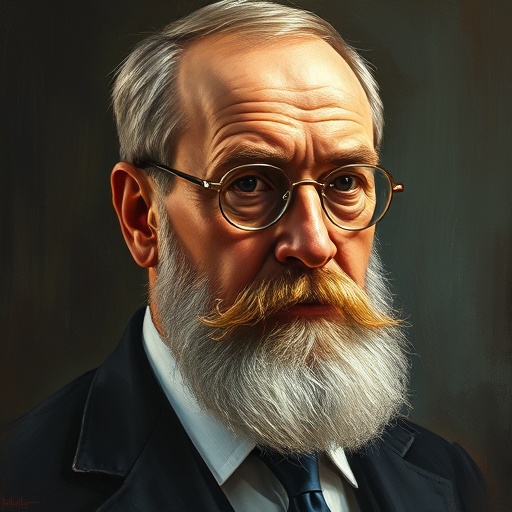
Robert Koch — "The discovery of the cause of a disease is only the first step towards its eradi…"
The discovery of the cause of a disease is only the first step towards its eradication.
The discovery of the cause of a disease is only the first step towards its eradication.
Click any product to generate a realistic preview. Up to 3 at a time.
* Initial load can take up to 90 seconds — revising the preview in another color is nearly instant.
"It is not the individual that is the target of disease, but the species."
"I have always tried to be as objective as possible in my scientific investigations."
"The greatest obstacle to progress is not ignorance, but the illusion of knowledge."
"My experiments on anthrax were some of the most challenging of my career."
"The fight against disease is a never-ending battle, but we must never give up."
Found in 1 providers: grok
1 source checked
Identifying what causes a disease is merely the beginning of a much longer journey. The real challenge — developing effective treatments, vaccines, and public health infrastructure — comes after. Scientific discovery creates possibility, not outcome. Eradication demands sustained effort across medicine, government, and society for decades. Knowing your enemy and defeating it are entirely different problems, often separated by generations of hard work.
Koch proved this from personal experience. After identifying Mycobacterium tuberculosis in 1882 — a discovery that made him instantly famous — he spent years attempting to convert that breakthrough into a cure. His tuberculin treatment, announced triumphantly in 1890, failed badly, harming rather than healing patients. Koch's postulates gave medicine a rigorous framework for finding causative agents; his subsequent career illustrated how brutally difficult the path from identification to eradication truly is.
Koch worked during the 1870s–1900s, when germ theory had just overturned centuries of miasma belief but medicine still lacked antibiotics, vaccines for most diseases, and organized public health infrastructure. Tuberculosis killed roughly one in seven Europeans. Cholera swept cities in repeated epidemics. Identifying a pathogen was revolutionary; stopping it required sanitation reform, quarantine laws, and political will that didn't automatically follow scientific proof. Koch watched millions die despite knowing exactly what was killing them.
AI-generated insights based on extensive research and information for context. Factual errors? Email [email protected].
Your cart is empty