Carl Linnaeus — "The Earth's Creation is the glory of God, as seen from the works of Nature by Ma…"
The Earth's Creation is the glory of God, as seen from the works of Nature by Man alone.
The Earth's Creation is the glory of God, as seen from the works of Nature by Man alone.
Click any product to generate a realistic preview. Up to 3 at a time.
* Initial load can take up to 90 seconds — revising the preview in another color is nearly instant.
"The stony rocks are not primeval, but daughters of Time."
"The highest good is to know God and His works."
"The greatest joy is to be useful to one's fellow men."
"The Asiatic is haughty, greedy, and governed by opinions."
"The species and the genus are always the work of nature [i.e. specially created]; the variety mostly that of circumstance; the class and the order are the work of nature and art."
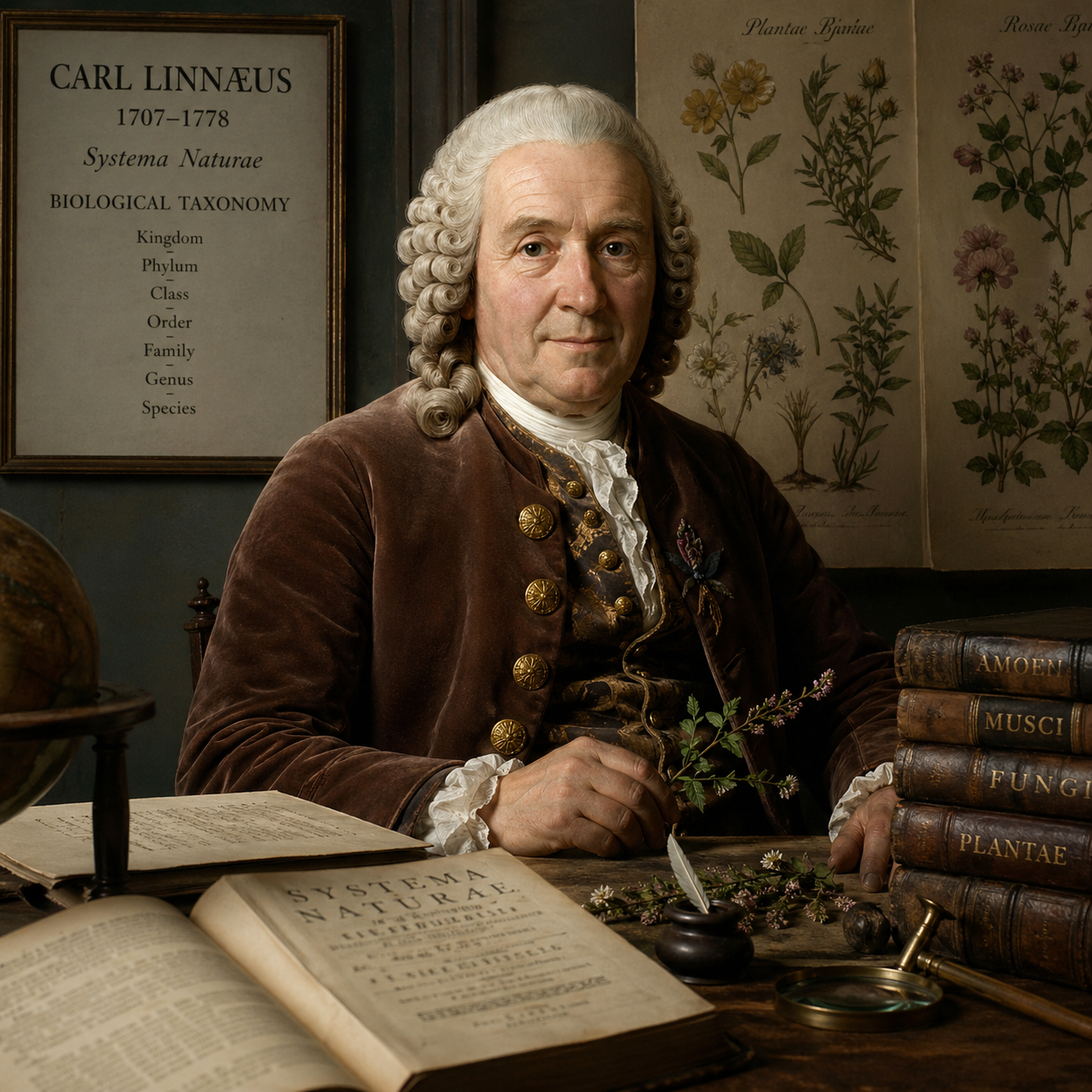
Swedish botanist and the father of modern taxonomy whose Systema Naturae (1735) introduced binomial nomenclature for naming all species. Closely associated with Joseph Banks (British naturalist who carried Linnaean classification on Cook's voyages). For an intellectual contrast, see Comte de Buffon, French naturalist and Histoire Naturelle author (1749-1788) — Buffon explicitly attacked Linnaean fixed-categories taxonomy as artificial and rejected the binomial system; his gradualist, environment-shaped natural history was the explicit alternative. Anticipates the fixed-species-vs-evolution debate Darwin would later resolve.
A statement linking natural history to theological understanding.
Date: 18th Century
PhilosophicalFound in 1 providers: gemini
1 source checked
God's greatness is not found in scripture alone but is visible in the physical world around us. Humans, uniquely capable of observation and reason, bear the responsibility to study nature as a form of divine witness. Creation itself is the proof of God's existence and grandeur, and to examine it carefully is to comprehend something sacred that no other creature can perceive.
Linnaeus was a devout Lutheran who framed his entire scientific career as an act of worship. His motto 'Deus creavit, Linnaeus disposuit' — God created, Linnaeus arranged — captures this belief precisely. He saw taxonomy not as dry cataloging but as revealing the rational order God had imposed on life. Classifying every species was, to him, a religious obligation: mapping the architecture of divine intelligence embedded in the natural world.
In the 18th-century early modern period, natural theology dominated educated thought — the doctrine that God's existence could be demonstrated through rational study of His creation. The Scientific Revolution had legitimized systematic observation, and thinkers like Ray, Derham, and Linnaeus fused piety with empiricism. Science and faith were not opponents but partners. Classifying plants and animals was considered reverent work, and the growing catalog of species was taken as evidence of God's inexhaustible creativity.
AI-generated insights based on extensive research and information for context. Factual errors? Email [email protected].
Your cart is empty