Gregor Mendel — "The experiments lead to the conclusion that the characters of the two parental f…"
The experiments lead to the conclusion that the characters of the two parental forms are transmitted to the hybrid unchanged.
The experiments lead to the conclusion that the characters of the two parental forms are transmitted to the hybrid unchanged.
Click any product to generate a realistic preview. Up to 3 at a time.
* Initial load can take up to 90 seconds — revising the preview in another color is nearly instant.
"The inheritance of traits is not a matter of chance but of law."
"The traits of living things are governed by unseen laws."
"I measure, I count, I compare—this is the way of science."
"My experiments with single traits all lead to the same result: that from the seeds of hybrids, plants are obtained half of which in turn carry the hybrid trait (Aa), the other half, however, receive t…"
"I have been patient, and patience is the key to discovery."
Found in 1 providers: grok
1 source checked
When two parent organisms reproduce, their distinct traits pass to offspring intact — not blended or diluted, but preserved as discrete units. The hybrid carries both parents' characteristics in their original form. This was a radical departure from the prevailing belief that traits merged like mixed paints. It established that heredity operates through separable, stable factors passed from one generation to the next.
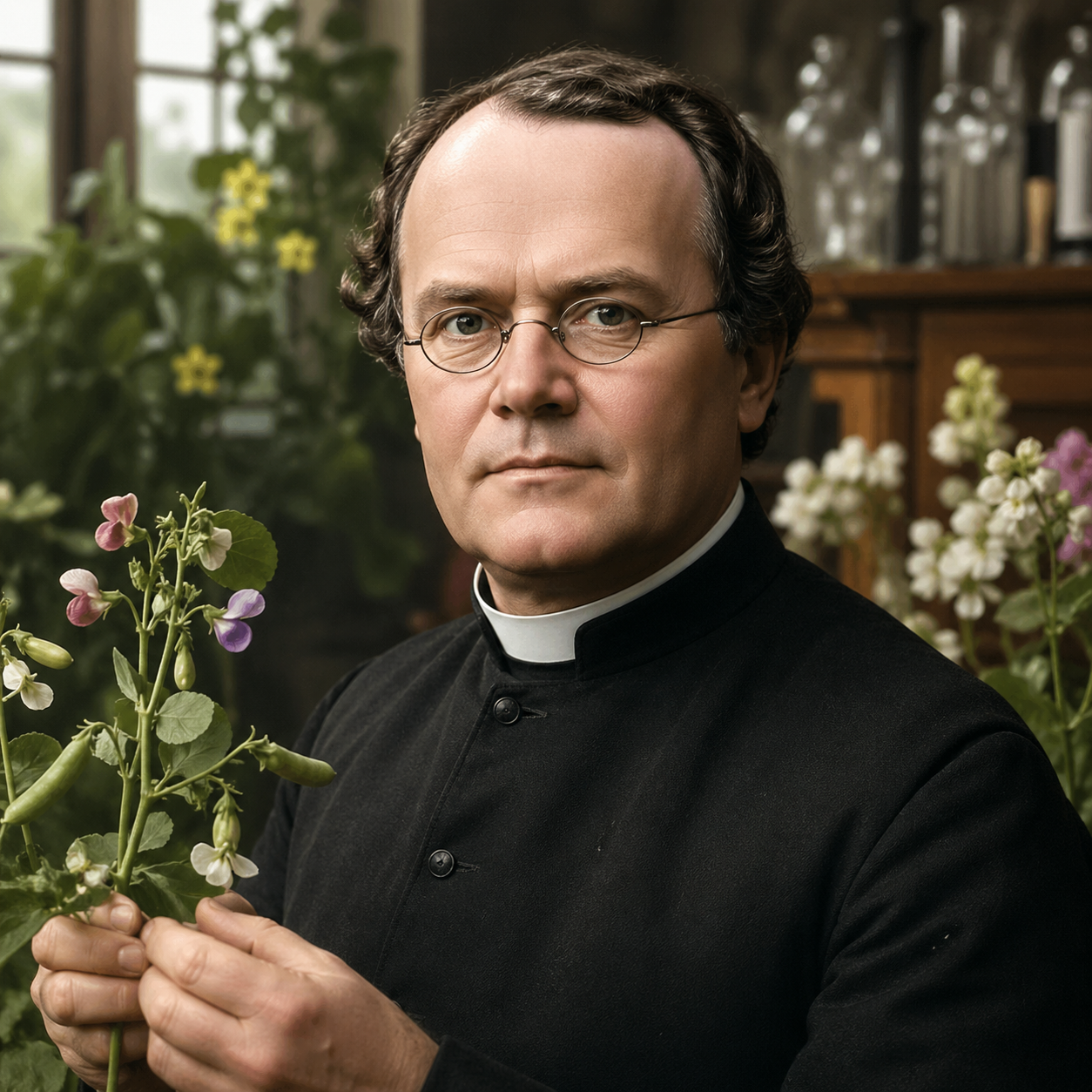
Mendel spent years in his Augustinian monastery garden in Brünn meticulously cross-breeding thousands of pea plants and recording results with mathematical precision. His training in physics and statistics drove him to count and ratio rather than simply observe. This quote is the core conclusion of that labor — the discovery that hereditary factors remain discrete, directly reflecting his disciplined, quantitative, and patient scientific character.
Mendel published in 1866, seven years after Darwin's *On the Origin of Species* shook biology but left a critical gap: how exactly are traits inherited and preserved across generations? Blending inheritance — the dominant assumption — actually undermined Darwin's theory by eroding variation. Mendel's monastery experiments provided the missing mechanism, though the scientific community largely ignored his work until three researchers independently rediscovered it in 1900.
AI-generated insights based on extensive research and information for context. Factual errors? Email [email protected].
Your cart is empty