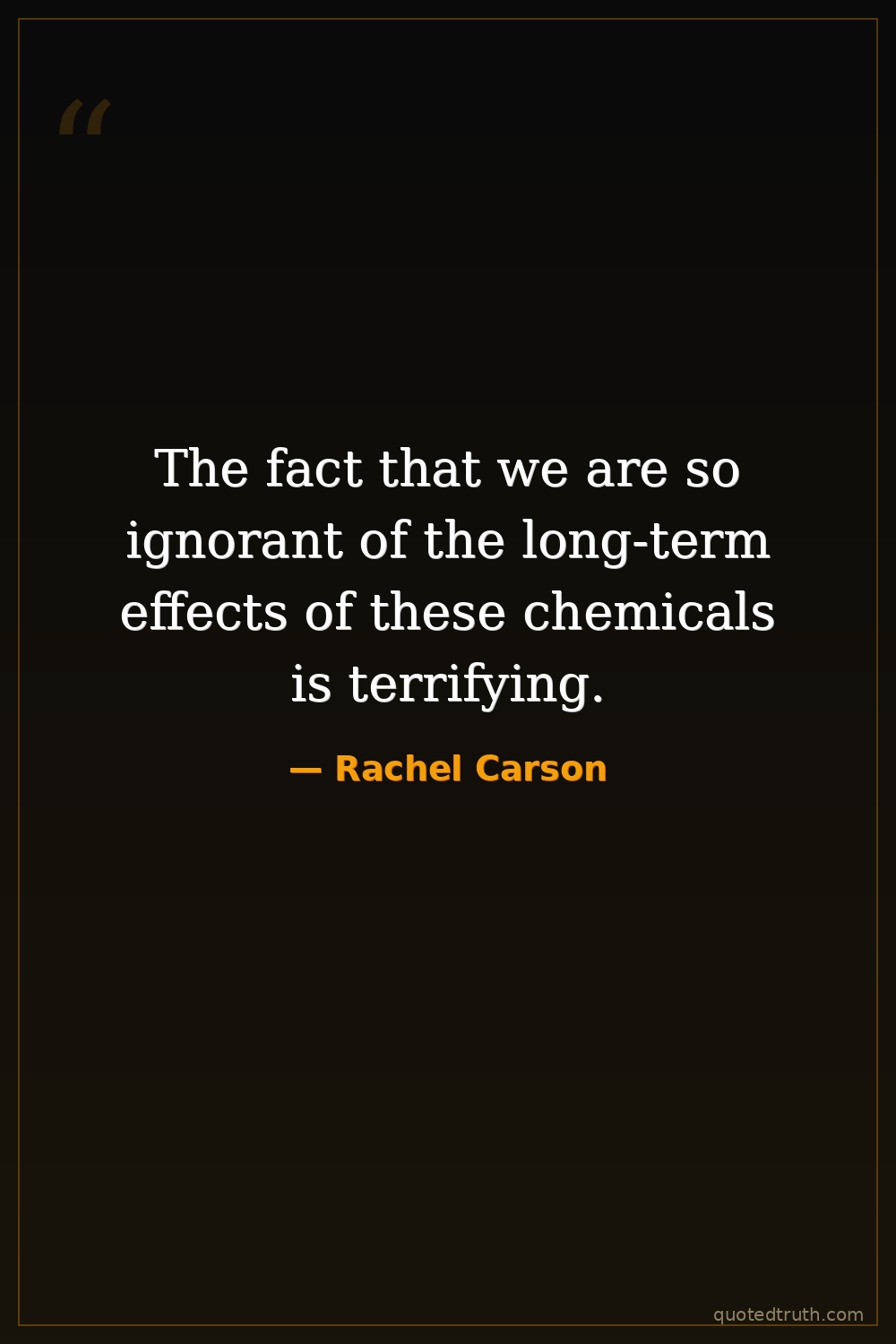
Rachel Carson — "The fact that we are so ignorant of the long-term effects of these chemicals is …"
The fact that we are so ignorant of the long-term effects of these chemicals is terrifying.
The fact that we are so ignorant of the long-term effects of these chemicals is terrifying.
Click any product to generate a realistic preview. Up to 3 at a time.
* Initial load can take up to 90 seconds — revising the preview in another color is nearly instant.
"I am not afraid of controversy; I am afraid of silence in the face of such a grave threat."
"The chemical war is not a war against insects alone, it is a war against the earth and all its inhabitants."
"For the first time in the history of the world, every human being is now subjected to contact with dangerous chemicals, from the moment of conception until death."
"Our heedless and destructive uses of the earth's resources are a form of self-destruction."
"The time has come for us to make peace with the earth."
Found in 1 providers: grok
1 source checked
We treat unknown risks as if they were no risks at all. Carson warns that deploying powerful chemicals into nature without understanding their long-term effects on health, wildlife, and ecosystems is dangerous precisely because of that ignorance. Not knowing what harm we cause doesn't mean no harm is being done. The absence of knowledge, she argues, should terrify us — we cannot defend against consequences we cannot even identify.
Carson spent years as a U.S. Fish and Wildlife Service marine biologist before writing Silent Spring in 1962, meticulously tracing how DDT and other pesticides bioaccumulated through food chains. Federal agencies were approving chemicals with virtually no longitudinal studies. She was secretly battling cancer she suspected was pesticide-linked while finishing the book. Her career was a sustained fight against industry-funded dismissals — this quote captures her deepest frustration: regulatory policy was racing ahead of evidence.
Silent Spring arrived in 1962 when post-WWII America treated synthetic chemistry as unambiguous progress. DDT had been celebrated for defeating malaria; pesticide companies held massive government contracts. The EPA did not yet exist. The thalidomide crisis of 1961 had just exposed how chemicals deemed safe could devastate human health across generations. Carson's warning represented the first major public reckoning with the idea that chemical innovation was outpacing toxicological science by decades.
AI-generated insights based on extensive research and information for context. Factual errors? Email [email protected].
Your cart is empty