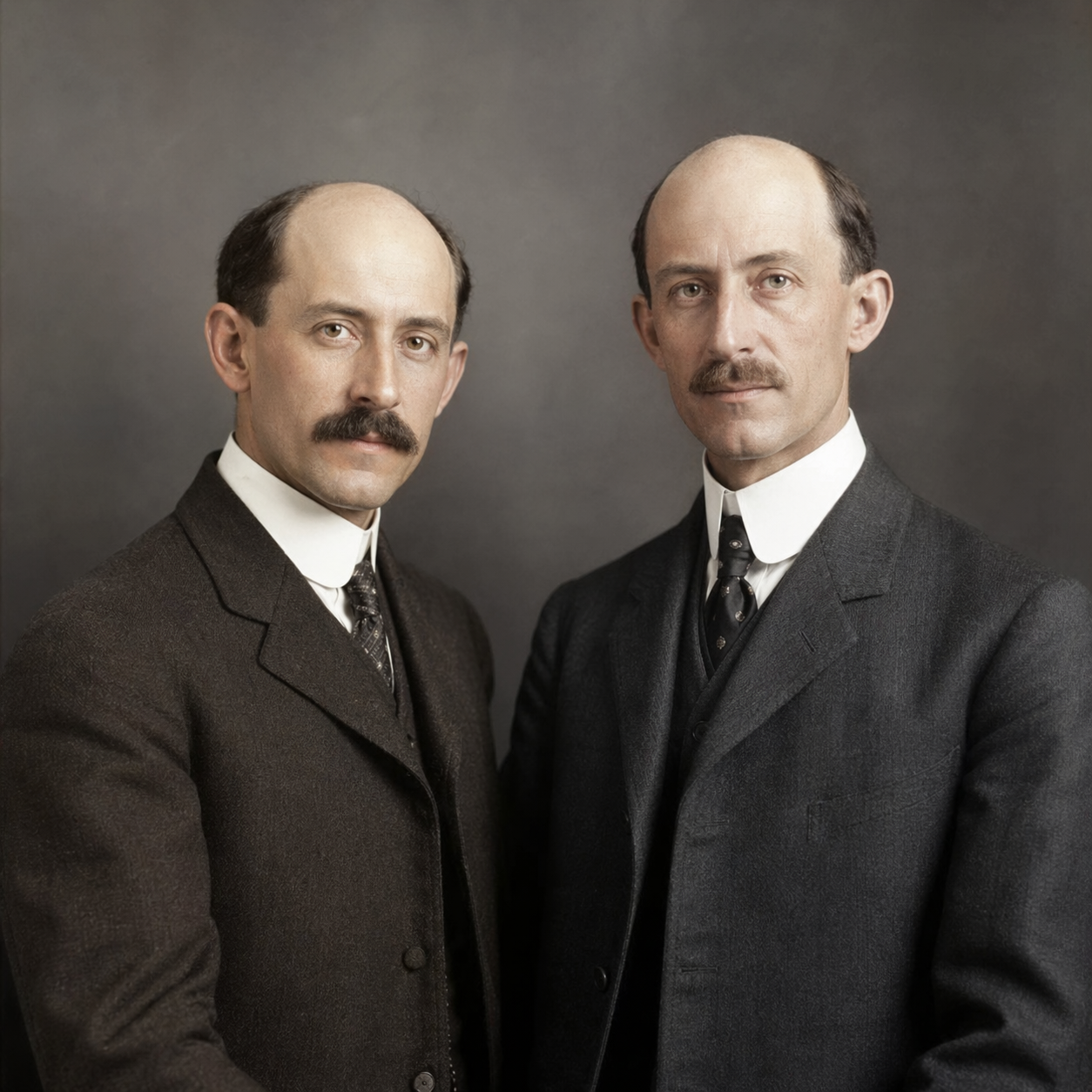
Wright Brothers (Orville & Wilbur) — "The first great principle of success in flying is to learn to soar without power…"
The first great principle of success in flying is to learn to soar without power.
The first great principle of success in flying is to learn to soar without power.
Click any product to generate a realistic preview. Up to 3 at a time.
* Initial load can take up to 90 seconds — revising the preview in another color is nearly instant.
"The time will come when man will fly."
"The aeroplane will be a great factor in bringing together the different nations of the earth."
"It was a beautiful machine and it worked."
"We are not content to walk upon the ground."
"The machine is a success and we are well pleased with it."
American aviation pioneers who achieved the first sustained powered controlled airplane flight at Kitty Hawk, NC, on December 17, 1903. Closely associated with Octave Chanute (their gliding mentor and aeronautical correspondent). For an intellectual contrast, see Samuel Pierpont Langley, Smithsonian Institution Secretary and government-funded aviation researcher — Langley's Aerodrome crashed twice into the Potomac in October-December 1903 with $50,000 of War Department funding; the Wright Brothers' bicycle-shop empiricism beat Langley's institutional Big Science by 9 days. The most-cited example in engineering history of empirical-tinkerer beating institution-funded credentialism.
Found in 1 providers: grok
1 source checked
Real mastery of flight begins by understanding how to glide on air currents alone, before adding an engine. The rider must first learn balance, lift, and control by working with the wind. Only once that foundation is solid does added thrust become useful rather than dangerous. Applied broadly, it says skill and understanding of the underlying system must come before you pile on power or shortcuts.
The Wright brothers spent years flying unpowered gliders at Kitty Hawk before bolting on an engine in 1903. They studied Lilienthal, built wind tunnels, and logged hundreds of glides to solve three-axis control and wing warping. Rivals like Langley chased horsepower and crashed; the Wrights mastered balance first. This quote distills their method: bicycle-shop tinkerers who treated flight as a control problem, not a power problem, and won the race because of it.
In the late 1890s and early 1900s, inventors worldwide were racing to achieve powered flight, often by strapping bigger engines onto unstable frames. Samuel Langley's federally funded Aerodrome famously plunged into the Potomac weeks before Kitty Hawk. The era worshipped steam, combustion, and raw mechanical might amid the Second Industrial Revolution. The Wrights' glider-first discipline cut against that prevailing brute-force mindset and helped birth modern aeronautical engineering grounded in aerodynamics.
AI-generated insights based on extensive research and information for context. Factual errors? Email [email protected].
Your cart is empty