Isaac Newton — "The frame of nature, and the system of the world, we are to observe by the pheno…"
The frame of nature, and the system of the world, we are to observe by the phenomena, and not to frame by imagination.
The frame of nature, and the system of the world, we are to observe by the phenomena, and not to frame by imagination.
Click any product to generate a realistic preview. Up to 3 at a time.
* Initial load can take up to 90 seconds — revising the preview in another color is nearly instant.
"God is the same God, always and everywhere. He is omnipresent not virtually only, but also substantially; for virtue cannot subsist without substance."
"I have studied these things – you have not."
"The way to chastity is not to struggle directly with incontinent thoughts but to avert the thoughts by some employment, or by reading, or by meditating on other things."
"We are to admit no more causes of natural things than such as are both true and sufficient to explain their appearances."
"I was like a boy playing on the seashore."
Found in 1 providers: grok
1 source checked
Understanding nature and the cosmos demands direct observation of what actually happens—phenomena—not imagined explanations invented to seem logical. Science must start with evidence, not clever theories built from assumptions. We observe the world as it is, gather data, and let reality tell us its rules. Any system we build to describe nature must answer to what we actually see, not to what we find intellectually satisfying or intuitively pleasing.
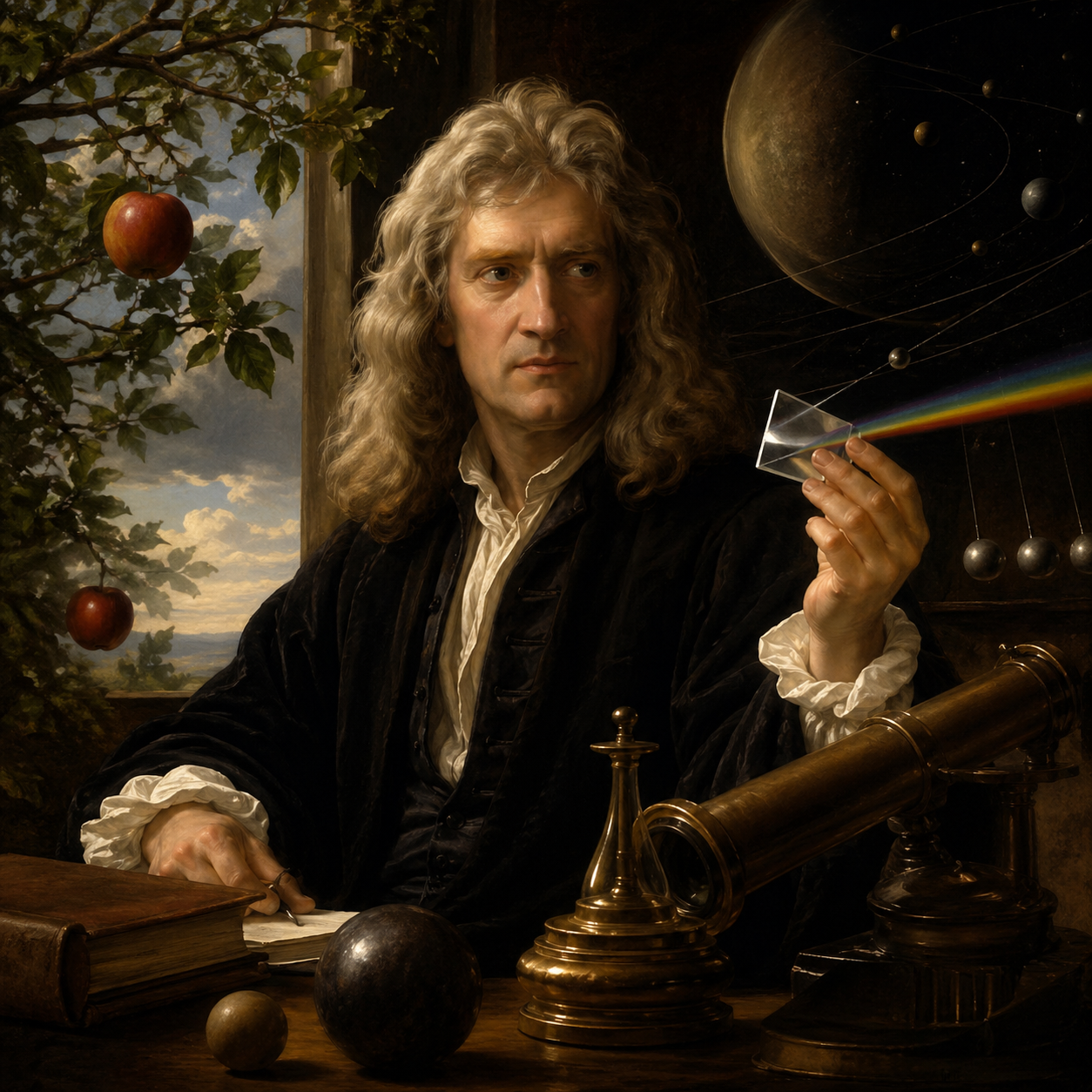
Newton's entire career embodied this principle. His Principia Mathematica drew on observed planetary data from Kepler and Galileo, not philosophical assertions. He famously declared 'hypotheses non fingo'—I frame no hypotheses—refusing to speculate on gravity's cause beyond describing its mathematics. His optics work relied on prisms and real light. He rejected Descartes' vortex theory of planetary motion precisely because it was imagination dressed as explanation, unsupported by observation.
In Newton's 17th-century Europe, natural philosophy was split between Aristotelian scholasticism taught in universities and Cartesian rationalism, which built elaborate mechanical systems through pure reasoning. Descartes explained planetary orbits using imaginary vortices of invisible matter—no experiment required. The Royal Society, founded 1660, championed 'nullius in verba'—take nobody's word for it. Newton's empirical insistence was a decisive break from century-old habits of reasoning from first principles rather than from observed data.
AI-generated insights based on extensive research and information for context. Factual errors? Email [email protected].
Your cart is empty