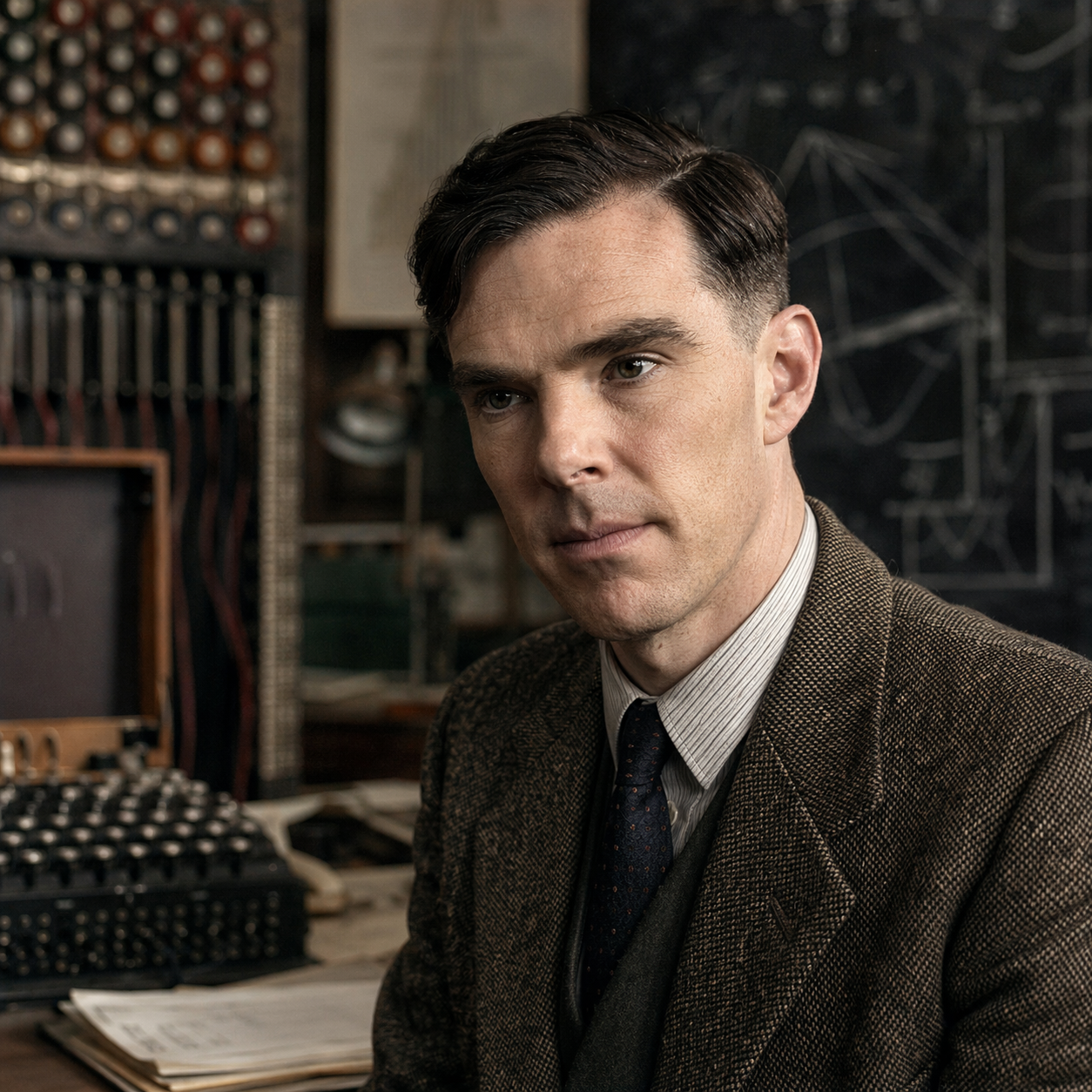
Alan Turing — "The future of computing lies in the development of intelligent machines."
The future of computing lies in the development of intelligent machines.
The future of computing lies in the development of intelligent machines.
Click any product to generate a realistic preview. Up to 3 at a time.
* Initial load can take up to 90 seconds — revising the preview in another color is nearly instant.
"A smallish proportion are supercritical. An idea presented to such a mind may give rise to a whole 'theory' consisting of secondary, tertiary and more remote ideas. Animals' minds seem to be very defi…"
"In the time of Galileo it was argued that the texts, 'And the sun stood still ... and hasted not to go down about a whole day' (Joshua x. 13) and 'He laid the foundations of the earth, that it should …"
"The story of how it all came to be found out is a long and fascinating one, which I shall have to make into a short story one day, but haven't the time to tell you now."
"No, I am not interested in developing a powerful brain. All I am interested in is a rather crude imitation of a child's brain."
"I'm afraid that the following syllogism may be used by some in the future. Turing believes machines think. Turing lies with men. Therefore machines do not think. Yours in distress, Alan."
Found in 1 providers: grok
1 source checked
Progress in computing isn't just about faster calculations — it's about machines that can reason, adapt, and solve problems the way minds do. The real leap forward happens when machines stop being passive tools executing fixed instructions and start exhibiting intelligence: learning from data, recognizing patterns, making decisions. Raw processing power matters less than building systems capable of thought-like behavior that can tackle problems humans struggle to define precisely.
Turing's 1950 paper 'Computing Machinery and Intelligence' proposed the Turing Test — a benchmark for machine intelligence still debated today. His 1936 Universal Turing Machine proved any computable problem could be solved algorithmically, laying computing's theoretical foundation. At Bletchley Park he built Bombe machines that mimicked logical reasoning to crack Enigma. He genuinely believed machines could think, spending his final years researching machine learning and morphogenesis before his death in 1954.
In the late 1940s and early 1950s, computers were enormous, room-filling machines used for military calculations and census tabulation — no one imagined them as thinking tools. The Cold War accelerated government investment in computing while scientists debated whether machines could exhibit real intelligence. The field of AI didn't formally exist until the 1956 Dartmouth Conference — two years after Turing's death — making his early articulation of this vision remarkably prescient.
AI-generated insights based on extensive research and information for context. Factual errors? Email [email protected].
Your cart is empty