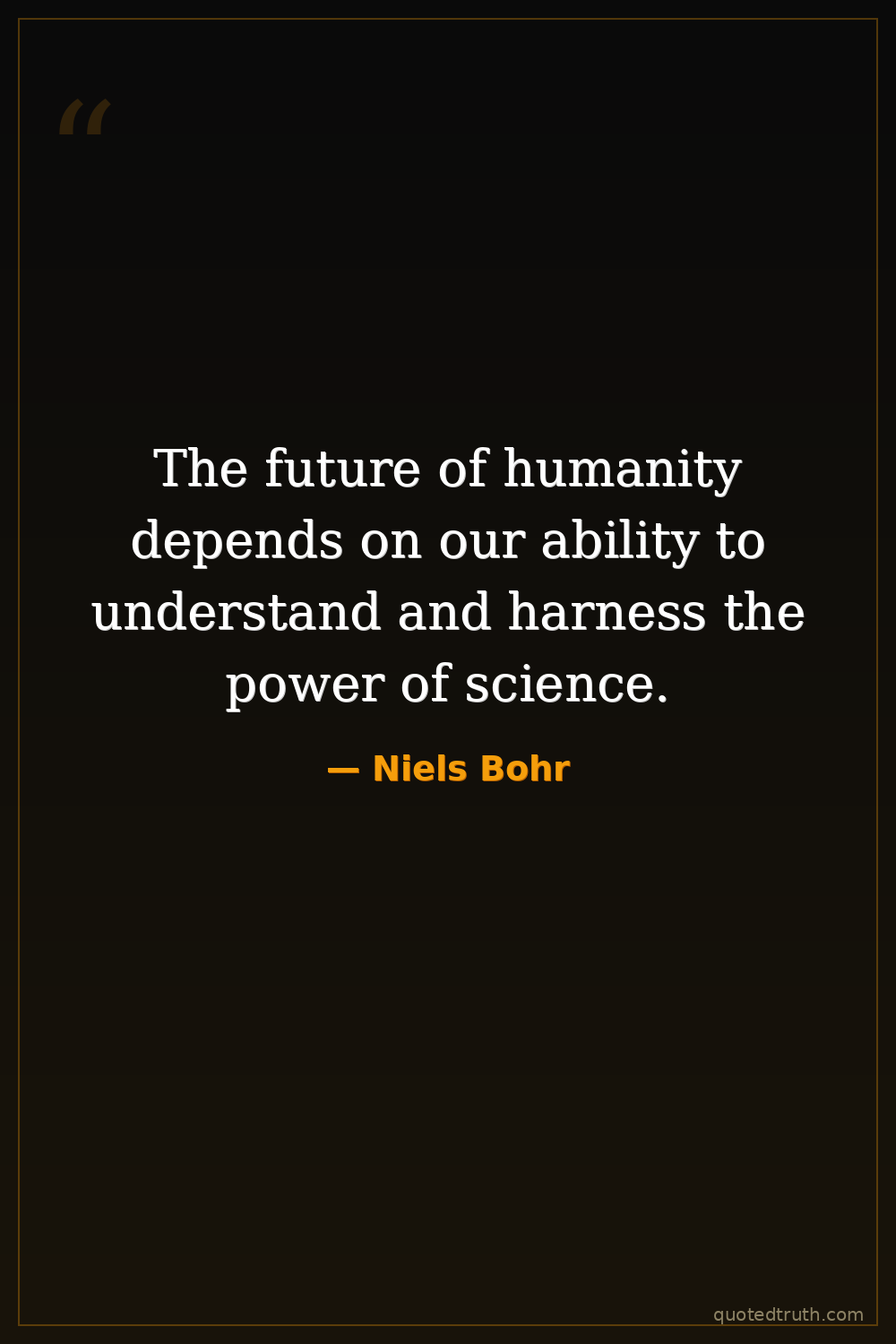
Niels Bohr — "The future of humanity depends on our ability to understand and harness the powe…"
The future of humanity depends on our ability to understand and harness the power of science.
The future of humanity depends on our ability to understand and harness the power of science.
Click any product to generate a realistic preview. Up to 3 at a time.
* Initial load can take up to 90 seconds — revising the preview in another color is nearly instant.
"The meaning of life is that it stops."
"When it comes to atoms, language can be used only as in poetry. The poet, too, is not nearly so concerned with describing facts as with creating images and establishing mental connections."
"The goal of science is to understand the world, and the goal of life is to live it."
"The electron is not a 'thing' in the ordinary sense, but a 'tendency to exist'."
"We are suspended in language. Our task is to communicate experience and ideas to others. We constantly have to be aware of the fact that we are suspended in language."
Found in 1 providers: grok
1 source checked
Human civilization's survival and progress rests on whether people can genuinely comprehend scientific principles and direct technological power responsibly. Understanding science isn't optional or academic—it determines whether humanity flourishes or destroys itself. The emphasis is on both comprehension and control: knowing what science reveals and making wise choices about how its capabilities are applied to real-world problems affecting everyone.
Bohr witnessed science transform from theoretical curiosity to civilization-altering force. His 1913 atomic model unlocked quantum mechanics, and he worked on the Manhattan Project before becoming a passionate advocate for peaceful nuclear use. He founded Copenhagen's Institute for Theoretical Physics and lobbied world leaders for open atomic cooperation, believing scientists bore direct moral responsibility for how their discoveries shaped humanity's trajectory.
Bohr lived through two world wars, the atomic bomb's creation, and the Cold War's onset—a period when science visibly determined national survival. The splitting of the atom demonstrated that theoretical physics could reshape geopolitics overnight. Post-1945, humanity faced unprecedented existential risks from nuclear arsenals, making scientific literacy and governance not philosophical ideals but urgent necessities for preventing civilizational collapse.
AI-generated insights based on extensive research and information for context. Factual errors? Email [email protected].
Your cart is empty