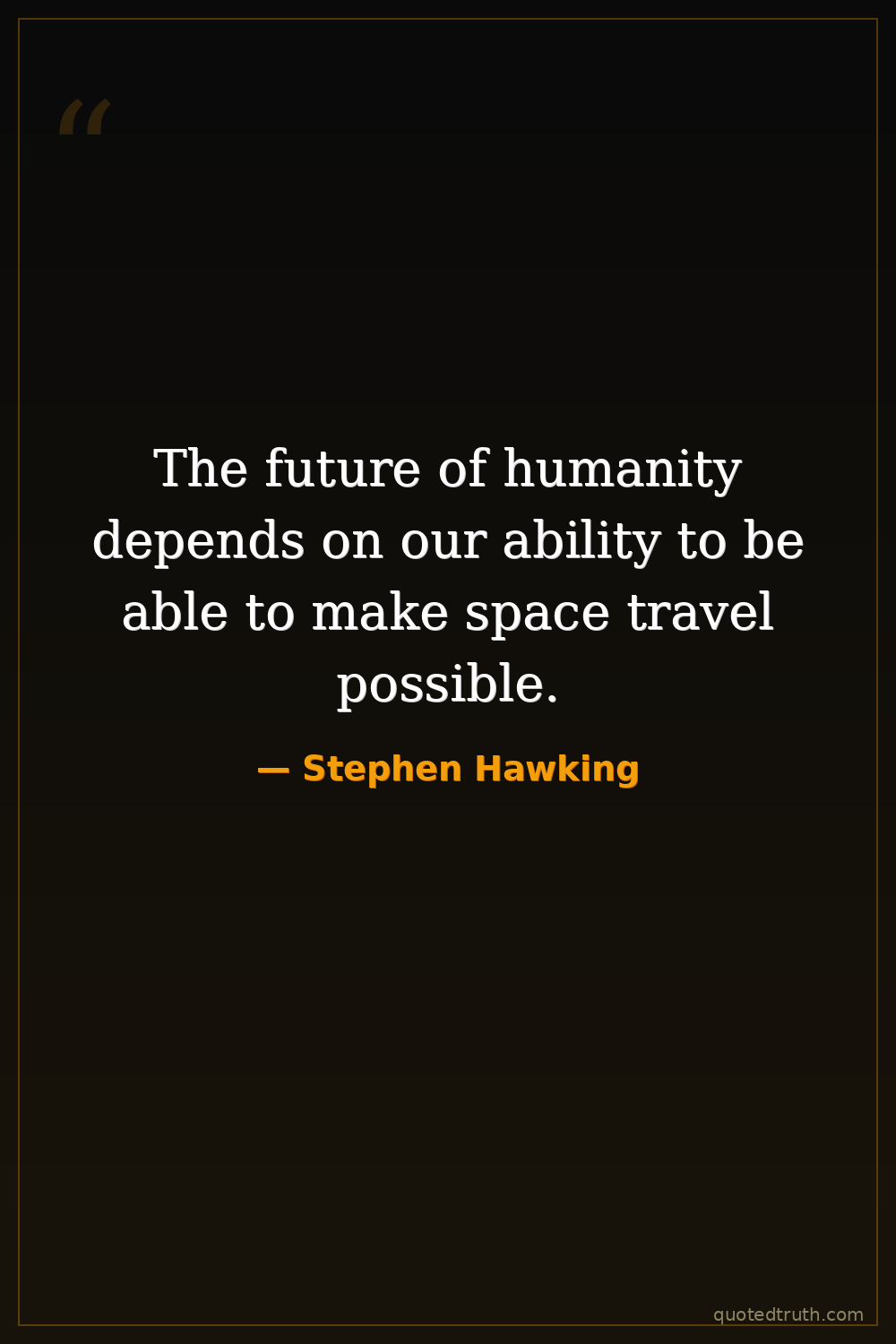
Stephen Hawking — "The future of humanity depends on our ability to be able to make space travel po…"
The future of humanity depends on our ability to be able to make space travel possible.
The future of humanity depends on our ability to be able to make space travel possible.
Click any product to generate a realistic preview. Up to 3 at a time.
* Initial load can take up to 90 seconds — revising the preview in another color is nearly instant.
"The universe is not only stranger than we imagine, it is stranger than we can imagine."
"I think that the human race has a destiny to explore the universe."
"The universe is full of wonders, and we are lucky to be a part of it."
"The universe is a constant source of wonder and inspiration."
"The universe is not expanding into anything."
British theoretical physicist whose Hawking radiation work and A Brief History of Time (1988) brought black-hole physics to a mass audience while he lived with ALS for 55 years. Closely associated with Roger Penrose (his collaborator on singularity theorems) and Carl Sagan (fellow popularizer who wrote Brief History's foreword). For an intellectual contrast, see William Lane Craig, American philosopher of religion — Craig's Kalam cosmological argument depends on the Big Bang requiring a divine first cause; Hawking's no-boundary proposal was specifically designed to remove the moment that would require one — the cleanest cosmology-vs-natural-theology contrast in modern thought.
Found in 1 providers: grok
1 source checked
Humanity's long-term survival hinges on becoming a multi-planetary species. Confined to Earth, we remain vulnerable to a single catastrophic event — asteroid impact, runaway climate change, nuclear war — that could end us permanently. Space travel is existential insurance: spreading humans across multiple worlds ensures no single disaster wipes us out. Our continuation isn't guaranteed on one fragile planet; it requires making the rest of the universe accessible and inhabitable.
Hawking spent his career decoding the cosmos — black holes, the Big Bang, the nature of time — while physically imprisoned by ALS from age 21. That contrast gave his space advocacy unusual weight: his mind ranged freely where his body could not. He repeatedly warned humanity might have only centuries left on Earth and actively backed Breakthrough Starshot, treating interstellar travel not as science fiction but as urgent necessity.
Hawking's most active public years spanned the post-Apollo retreat from space, the Shuttle program's tragic failures (Challenger 1986, Columbia 2003), and NASA budget cuts. Meanwhile, climate change, nuclear proliferation, and emerging AI risks recast extinction as a credible near-term threat. By the 2010s, SpaceX was only beginning to prove private spaceflight viable. Hawking's urgency was deliberate: humanity was stepping back from space precisely as new existential dangers accumulated.
AI-generated insights based on extensive research and information for context. Factual errors? Email [email protected].
Your cart is empty