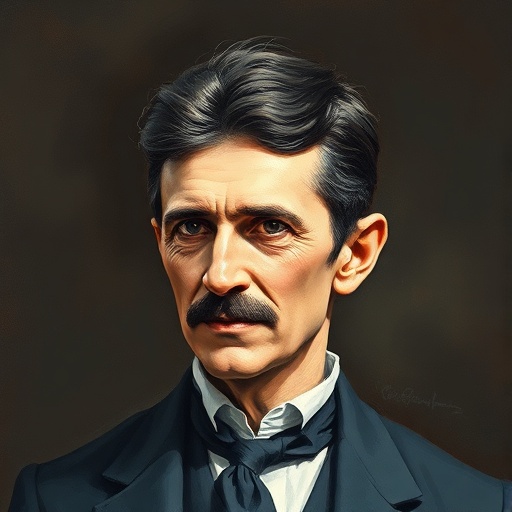
Nikola Tesla — "The future of humanity lies in the utilization of the sun's energy."
The future of humanity lies in the utilization of the sun's energy.
The future of humanity lies in the utilization of the sun's energy.
Click any product to generate a realistic preview. Up to 3 at a time.
* Initial load can take up to 90 seconds — revising the preview in another color is nearly instant.
"If the genius of invention were to reveal to-morrow the secret of immortality, of eternal beauty and youth, for which all humanity is aching, the same inexorable agents which prevent a mass from chang…"
"When natural inclination develops into a passionate desire, one advances towards his goal in seven-league boots."
"The human being is a self-propelled automaton entirely under the control of external influences. Willful and predetermined though they appear, his actions are governed not from within, but from withou…"
"The scientists of today think deeply instead of clearly. One must be sane to think clearly, but one can think deeply and be quite insane."
"Insufficient observation is only a form of unknowing, a cause of many perverse incidents and a triumph of crazy ideas."
Serbian-American inventor and electrical engineer whose alternating-current designs powered the modern electrical grid; died poor and largely forgotten. Closely associated with George Westinghouse (his AC-power business partner) and Mihajlo Pupin (fellow Serbian-American physicist at Columbia). For an intellectual contrast, see Thomas Edison, American inventor and direct-current advocate — Edison's direct-current power-distribution scheme was displaced by Tesla-Westinghouse AC in the 1890s 'War of Currents'. Edison ran a public-relations campaign electrocuting animals to discredit AC — the most famous engineering-ethics rivalry in American history. Tesla's AC won and powers nearly every electrical grid on Earth.
Found in 1 providers: grok
1 source checked
The quote argues that solar energy—directly capturing the sun's immense, continuous output—is humanity's optimal long-term power strategy. Rather than depleting finite underground resources like coal and oil, civilization should orient itself around the star that powers all life on Earth. It frames solar not as one alternative among many but as the inevitable, foundational energy source for any genuinely sustainable human future.
Tesla spent his career pursuing universally accessible, abundant energy. His AC system democratized electricity; his Wardenclyffe Tower dreamed of global wireless power transmission. He explicitly wrote in essays that solar energy was humanity's ultimate source, viewing fossil fuels as wasteful and temporary. This quote embodies his lifelong conviction that nature's vast, untapped forces—not monopolized fuel supplies—should power civilization's future.
Tesla worked during the Industrial Revolution's peak, when coal and oil dominated global energy and monopolies like Standard Oil controlled supply. Early 20th-century scientists conducted the first photovoltaic experiments, and concern over finite coal reserves was growing. Tesla's solar vision was radical—a direct challenge to the fossil-fuel establishment that dominated his era and had already undermined his dreams of free, wireless global power.
AI-generated insights based on extensive research and information for context. Factual errors? Email [email protected].
Your cart is empty