Francis Crick — "The genetic material must be able to replicate itself."
The genetic material must be able to replicate itself.
The genetic material must be able to replicate itself.
Click any product to generate a realistic preview. Up to 3 at a time.
* Initial load can take up to 90 seconds — revising the preview in another color is nearly instant.
"The idea that man was created in God's image is a myth."
"An honest man, armed with all the knowledge available to us now, could only state that in some sense, the origin of life appears at the moment to be almost a miracle, so many are the conditions which …"
"If you want to understand function, study structure."
"If you are honest, you will find that you are often wrong. But if you are not honest, you will never find out."
"If you want to understand life, you have to understand DNA."
Found in 1 providers: grok
1 source checked
Life requires a molecule that can copy itself with precision across generations. Whatever carries an organism's instructions must be able to duplicate those instructions exactly so offspring inherit them intact. This isn't just about storing information — the mechanism must actively reproduce it. Without self-replication, heredity collapses and evolution has nothing to work with. It is a logical prerequisite, not an observation: any candidate for genetic material that cannot replicate itself is disqualified by definition.
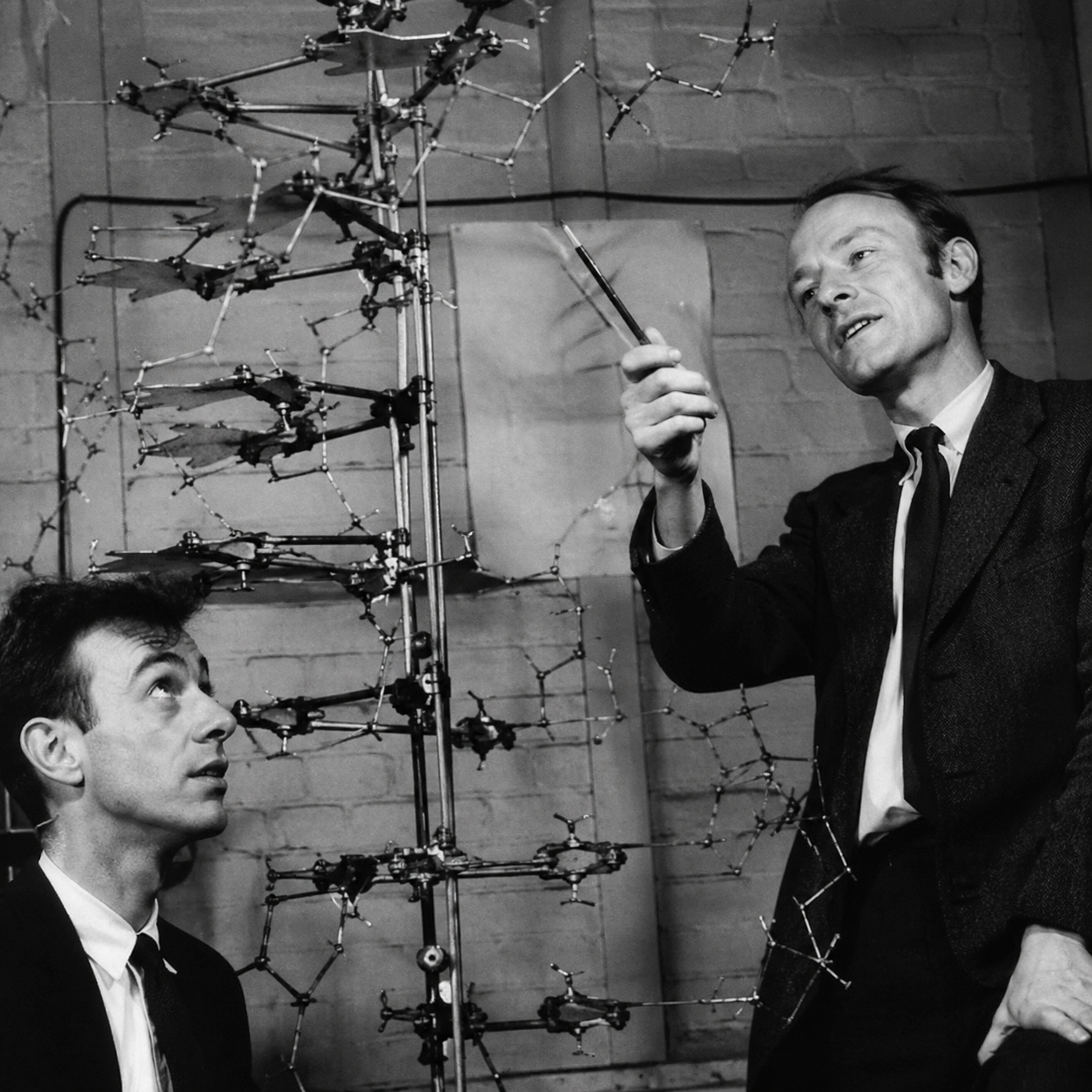
Crick spent years before 1953 reasoning from first principles about what life's molecules must do, not just what they are. When he and Watson deduced the double helix, the antiparallel complementary strands instantly answered his own demand: each strand templates a new copy. His subsequent work on the central dogma and the genetic code extended this logic — information flows one way, from replicating DNA outward to proteins, never back. Replication was his north star throughout his career.
In the early 1950s, biologists still debated whether proteins or nucleic acids carried heredity — the question was genuinely open. The Watson-Crick structure arrived in 1953 amid a postwar explosion of physics-trained scientists entering biology with mechanistic ambitions. The decade that followed cracked the genetic code and established molecular biology as a rigorous discipline. This principle of obligatory self-replication became the conceptual foundation for everything from genetic engineering to our modern understanding of cancer and viral disease.
AI-generated insights based on extensive research and information for context. Factual errors? Email [email protected].
Your cart is empty