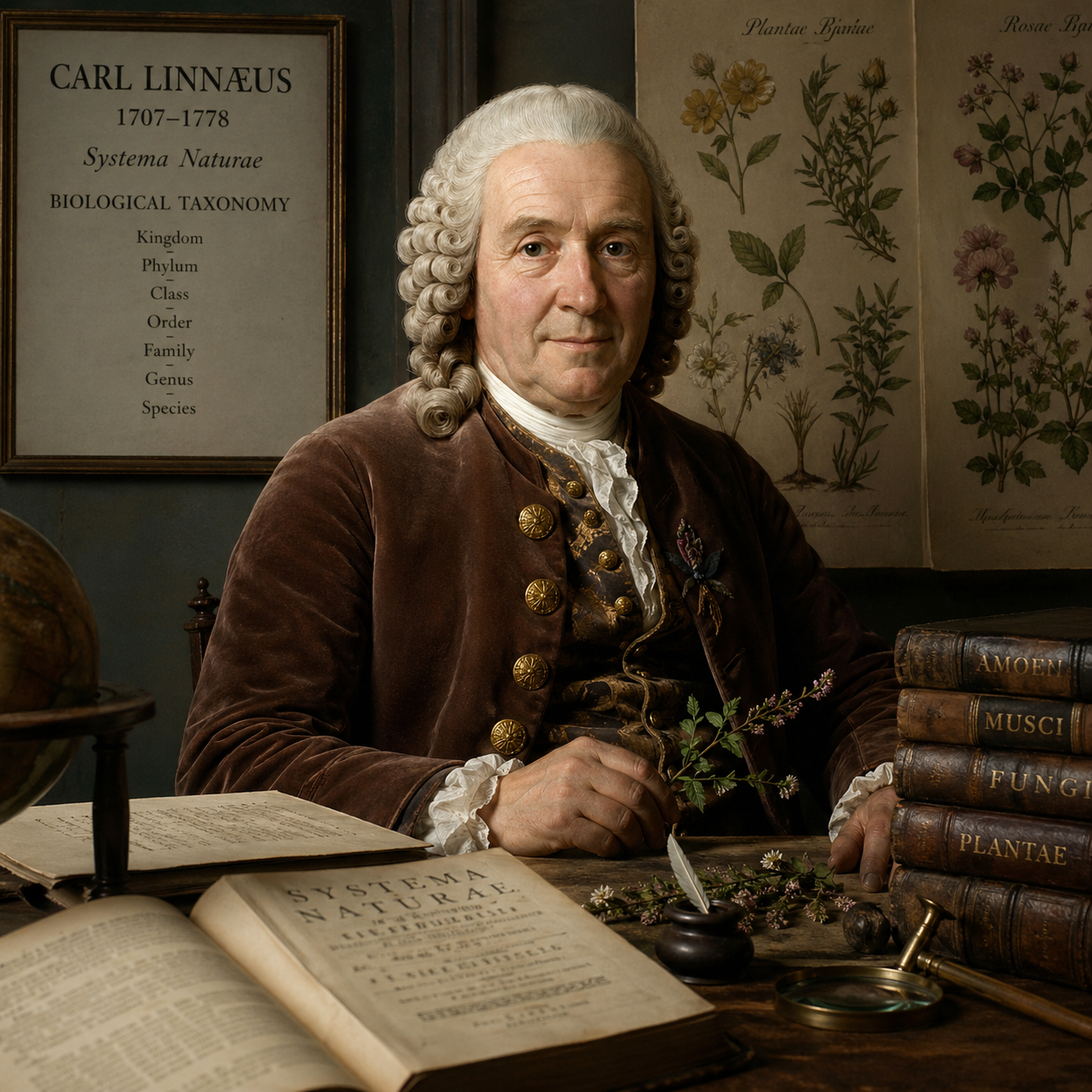
Carl Linnaeus — "The greatest delight is to behold the earth, and to know what it is."
The greatest delight is to behold the earth, and to know what it is.
The greatest delight is to behold the earth, and to know what it is.
Click any product to generate a realistic preview. Up to 3 at a time.
* Initial load can take up to 90 seconds — revising the preview in another color is nearly instant.
"The more I study nature, the more I am amazed at the Creator."
"I have been as happy as a king, and happier."
"The natural system is the highest goal of botany."
"Nature does not make any leaps. (Natura non facit saltus)"
"The most beautiful thing in the world is a flower, but it is not so beautiful as a woman."
Swedish botanist and the father of modern taxonomy whose Systema Naturae (1735) introduced binomial nomenclature for naming all species. Closely associated with Joseph Banks (British naturalist who carried Linnaean classification on Cook's voyages). For an intellectual contrast, see Comte de Buffon, French naturalist and Histoire Naturelle author (1749-1788) — Buffon explicitly attacked Linnaean fixed-categories taxonomy as artificial and rejected the binomial system; his gradualist, environment-shaped natural history was the explicit alternative. Anticipates the fixed-species-vs-evolution debate Darwin would later resolve.
Reflecting his passion for natural history and discovery.
Date: Uncertain (attributed)
Nature & WorldFound in 1 providers: gemini
1 source checked
The deepest joy comes not just from observing the natural world but from truly understanding it — combining sensory experience with intellectual comprehension. Real satisfaction requires both seeing and knowing. It champions curiosity and scientific inquiry as sources of profound happiness, arguing that wonder and knowledge are inseparable, and that understanding nature's complexity fundamentally elevates and deepens the experience of simply witnessing it.
Linnaeus devoted his life to cataloguing thousands of plant and animal species, creating the binomial nomenclature system still used in biology today. This quote reflects his core conviction that naming and classifying nature — truly knowing it — was an act of reverence and joy, not mere academic exercise. His field expeditions across Scandinavia and vast correspondence with naturalists worldwide showed a man equally driven by sensory wonder and the intellectual need to make sense of biological diversity.
Linnaeus lived during the 18th-century Enlightenment, when European thinkers were systematically cataloguing the natural world. Expeditions to the Americas, Asia, and Africa returned with thousands of unknown species. Natural history was a celebrated pursuit, and understanding creation through taxonomy was seen as both scientific and spiritual work. Scholars believed knowledge of nature revealed divine order — for Linnaeus's era, knowing the earth was a philosophical and even religious imperative, not merely academic curiosity.
AI-generated insights based on extensive research and information for context. Factual errors? Email [email protected].
Your cart is empty