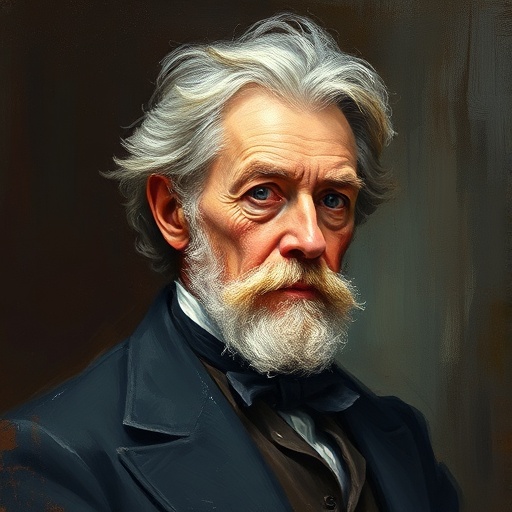
Michael Faraday — "The greatest enemy of knowledge is not ignorance, it is the illusion of knowledg…"
The greatest enemy of knowledge is not ignorance, it is the illusion of knowledge.
The greatest enemy of knowledge is not ignorance, it is the illusion of knowledge.
Click any product to generate a realistic preview. Up to 3 at a time.
* Initial load can take up to 90 seconds — revising the preview in another color is nearly instant.
"The lecturer should give the audience full reason to believe that all his powers have been exerted for their pleasure and instruction."
"I am no poet, but if you think for a moment of the energy that is in a single drop of water, you will see a poetry in it."
"There's nothing quite as frightening as someone who knows they are right."
"The more we know of the laws of nature, the more we are led to believe in the wisdom, intelligence, and design of God."
"The lecturer should endeavor to rouse the minds of his auditors, and to fix their attention."
Often attributed to Stephen Hawking or Daniel Boorstin, likely misattributed to Faraday.
Date: Mid 19th Century (approx.)
EducationalFound in 1 providers: grok
1 source checked
Thinking you already understand something is more dangerous than knowing nothing at all. A person aware of their ignorance stays curious and open to learning, while someone convinced they have the answers stops questioning, stops investigating, and stops growing. False certainty closes the door on discovery. Real progress in understanding requires humility about the limits of what you actually know versus what you merely assume.
Faraday was a self-taught bookbinder's apprentice who rose to transform physics through relentless experimentation rather than theoretical assumption. He distrusted received wisdom, testing ideas directly in the lab, which led him to discover electromagnetic induction in 1831. His humility about formal mathematics pushed him to visualize fields physically, a leap others missed because they assumed existing frameworks were complete. Curiosity over certainty defined his method.
Faraday worked in early-to-mid 1800s Britain, when the Industrial Revolution was reshaping society and science was professionalizing. Established authorities dominated the Royal Society, and many assumed Newtonian mechanics had largely completed physics. Faraday's era rewarded those willing to challenge settled consensus: electricity, magnetism, and chemistry were wide open frontiers where dogmatic confidence in existing theory blinded researchers to phenomena hiding in plain sight, waiting for experimental humility.
AI-generated insights based on extensive research and information for context. Factual errors? Email [email protected].
Your cart is empty