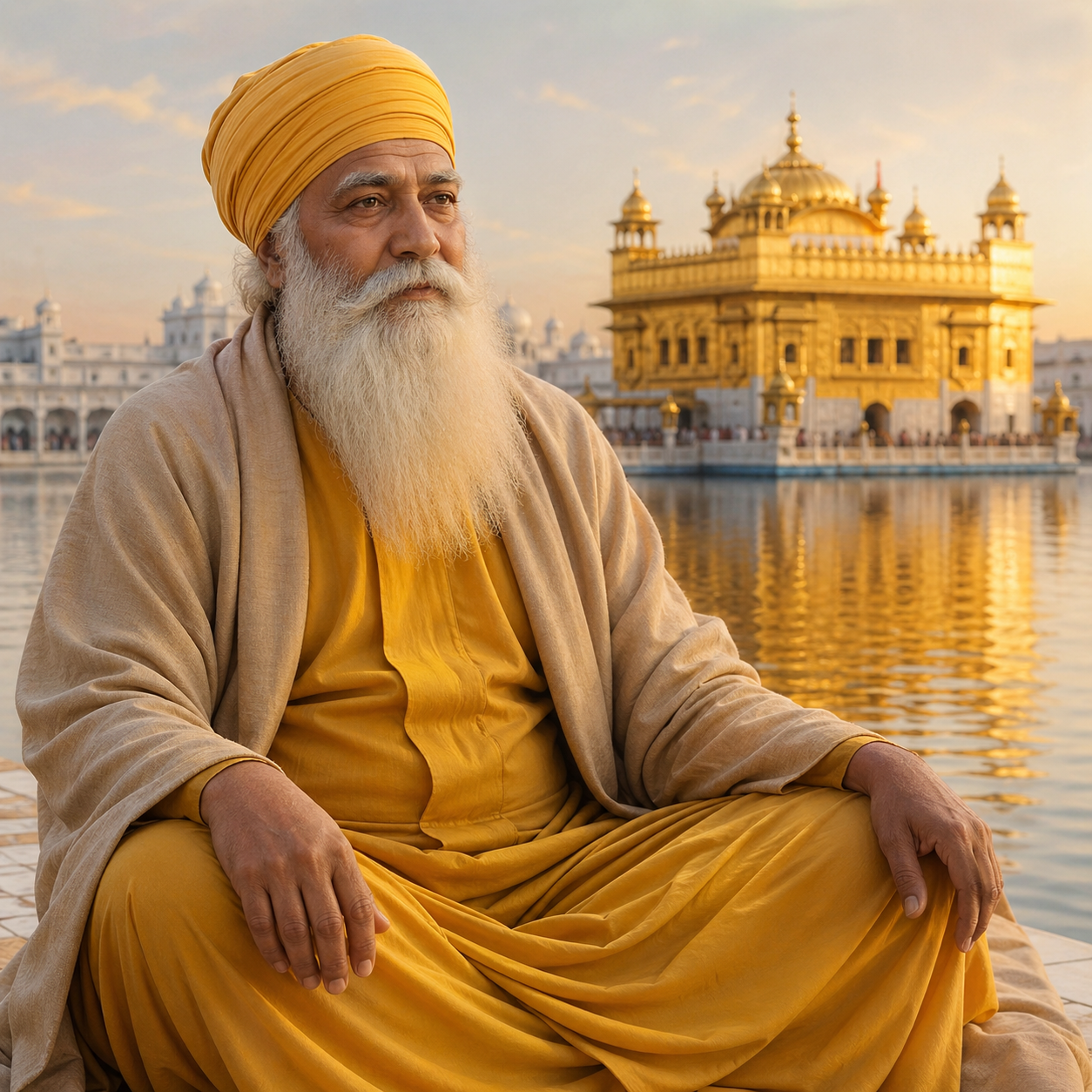
Guru Nanak — "The greatest gift is to share. Especially if it's your last piece of samosa."
The greatest gift is to share. Especially if it's your last piece of samosa.
The greatest gift is to share. Especially if it's your last piece of samosa.
Click any product to generate a realistic preview. Up to 3 at a time.
* Initial load can take up to 90 seconds — revising the preview in another color is nearly instant.
"I bow at His feet constantly and pray to Him. The Guru, the True Guru, has shown me the Way."
"There is no Hindu, there is no Muslim. There's just people trying to figure out what's for dinner."
"Keep your mind pure, like the lotus in the water, untouched by its impurities."
"The ignorant person is blind, even though he has eyes."
"A true yogi does not wander around, but fixes his mind on God within."
Founder of Sikhism and the first of the Ten Sikh Gurus, whose teachings of one universal God and rejection of caste shaped Punjab. Closely associated with Kabir (mystical poet whose verses appear in the Sikh Guru Granth Sahib). For an intellectual contrast, see Brahmanical orthodoxy, the Hindu caste-and-ritual establishment of his era — Sikhism was founded as a deliberate alternative to both Hindu ritual hierarchy and Islamic exclusivism — Nanak's universalism was a structural rejection of caste and priestly mediation.
Found in 1 providers: grok
1 source checked
True generosity means sharing even when resources are nearly gone. Giving from abundance requires little courage; giving your last portion demands real sacrifice. The humor of a beloved food grounds an ancient spiritual principle in daily life: a gift's value lies not in its size but in what it costs the giver. Genuine sharing transforms both parties and reflects a commitment to others over self-interest.
Guru Nanak (1469–1539) built Sikhism around seva (selfless service) and langar, the free community kitchen feeding everyone regardless of caste or wealth. For Nanak, sharing food was not charity but recognition of the divine in all people. He gave away his father's trading money to feed the hungry instead, calling it the truest bargain. His entire life demonstrated that giving, especially sacrificial giving, was the highest act of worship.
In 15th–16th century Punjab, food sharing across caste lines was socially forbidden under Brahminical hierarchy. The Mughal Empire reinforced rigid social stratification. Famine and poverty were widespread realities, making the act of sharing one's last meal genuinely costly. Guru Nanak's langar was a radical political and spiritual statement: all humans equal at the table. Sharing food defied both religious orthodoxy and imperial social order simultaneously.
AI-generated insights based on extensive research and information for context. Factual errors? Email [email protected].
Your cart is empty