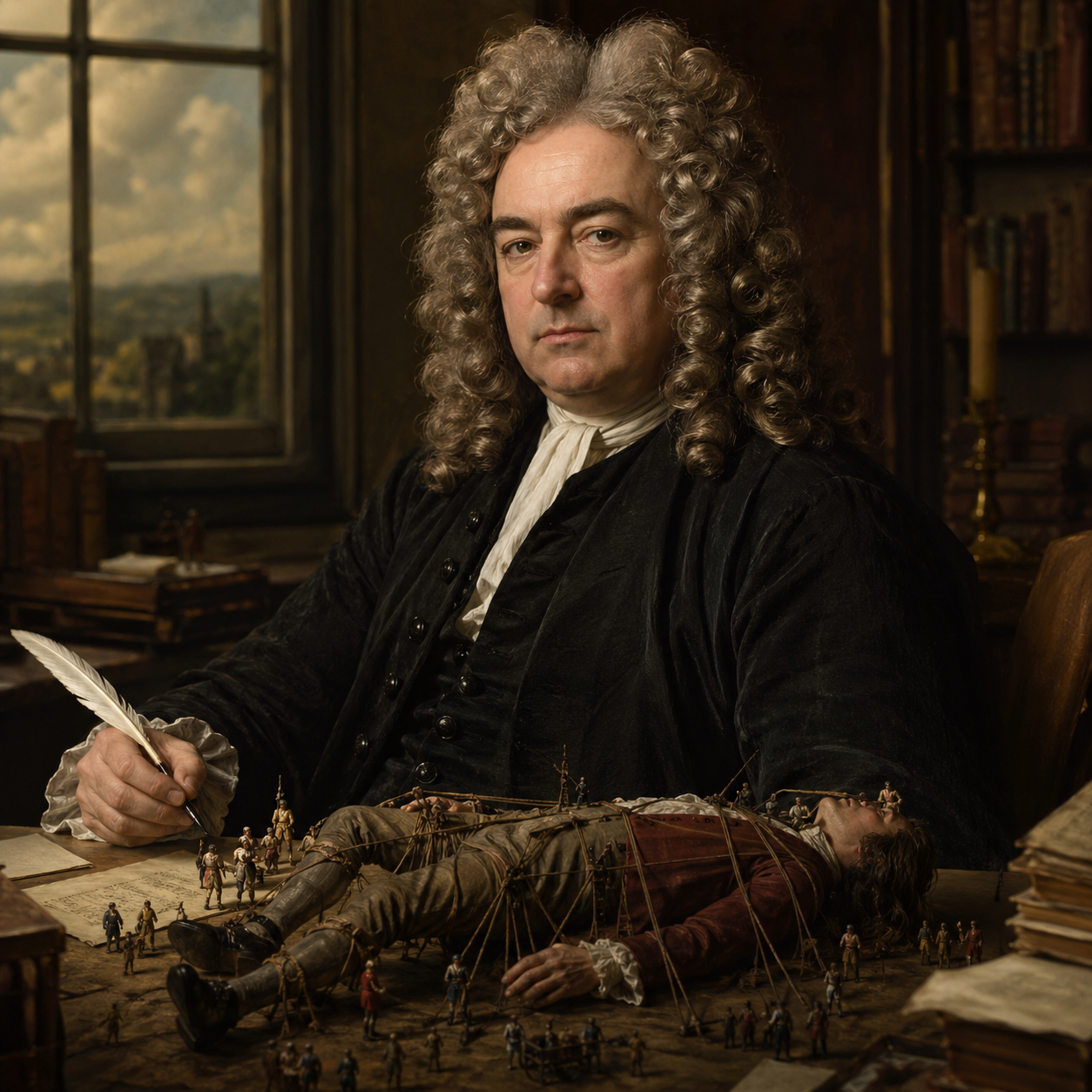
Jonathan Swift — "The greatest inventions were at first but the rudiments of experiments."
The greatest inventions were at first but the rudiments of experiments.
The greatest inventions were at first but the rudiments of experiments.
Click any product to generate a realistic preview. Up to 3 at a time.
* Initial load can take up to 90 seconds — revising the preview in another color is nearly instant.
"It is a miserable thing to be a dependent, and to have no other resource but the favor of great men."
"Instead of dirt and poison we have rather chosen to fill our hives with honey and wax; thus furnishing mankind with the two noblest of things, which are sweetness and light."
"As for yourself, whom I have the honour to know, you are a person of distinction, and would have been an ornament to any court in Europe."
"May you live all the days of your life."
"But as to myself, having been wearied out for many years with offering vain, idle, visionary thoughts, and at length despairing of success, I fortunately fell upon this proposal, which, as it is wholl…"
Anglo-Irish satirist and Dean of Dublin's St Patrick's Cathedral whose Gulliver's Travels (1726) and A Modest Proposal (1729) are the canonical English-language satires. Closely associated with Alexander Pope (Scriblerus Club poet and collaborator) and John Gay (Beggar's Opera author and satirical contemporary). For an intellectual contrast, see Daniel Defoe, English Whig journalist and Robinson Crusoe author (1660-1731) — Defoe's Crusoe (1719) celebrates Enlightenment self-reliance and the colonial-mercantile project; Swift's Gulliver (1726) systematically dismantles every form of human pretension Defoe celebrated. The cleanest Augustan Whig-vs-Tory literary pairing — optimistic-empirical vs misanthropic-satirical.
Your cart is empty