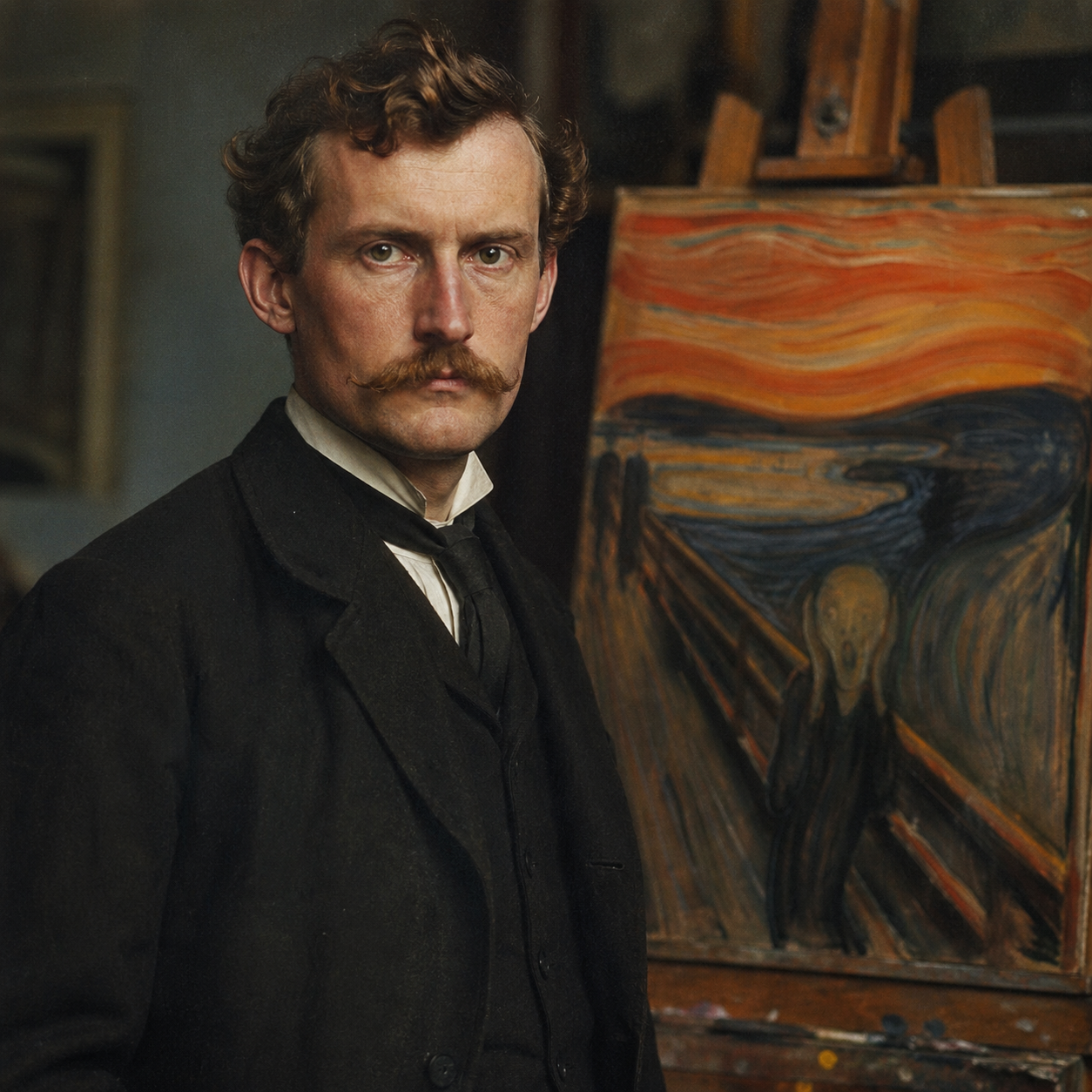
Edvard Munch — "The greatest pleasure in life is to create."
The greatest pleasure in life is to create.
The greatest pleasure in life is to create.
Click any product to generate a realistic preview. Up to 3 at a time.
* Initial load can take up to 90 seconds — revising the preview in another color is nearly instant.
"Death is pitch-dark, but colors are light. To be a painter, one must work with rays of light."
"My art is a prayer."
"Had I been in possession of the as yet undiscovered little remote telephone which one carries around in one's pocket, you would have long ago received communications from me."
"It is so strange to be entirely gone that it must that the hour must come when you can say to yourself now you have 10 now 5 minutes left and then it will happen and you shall feel how little by littl…"
"I am not interested in painting pretty pictures."
Norwegian Expressionist painter whose The Scream (1893) became the iconic image of modern existential dread. Closely associated with James Ensor (Belgian Expressionist peer) and Egon Schiele (younger Expressionist heir). For an intellectual contrast, see Pierre-Auguste Renoir, French Impressionist (1841-1919) — Munch and Renoir were exact contemporaries painting the same Belle Époque from opposite emotional poles — Renoir's dappled-light bourgeois pleasure and Munch's anxiety-soaked bourgeois terror are the late-19th-century painting's two halves. The same world; the cleanest emotional inversion.
Your cart is empty